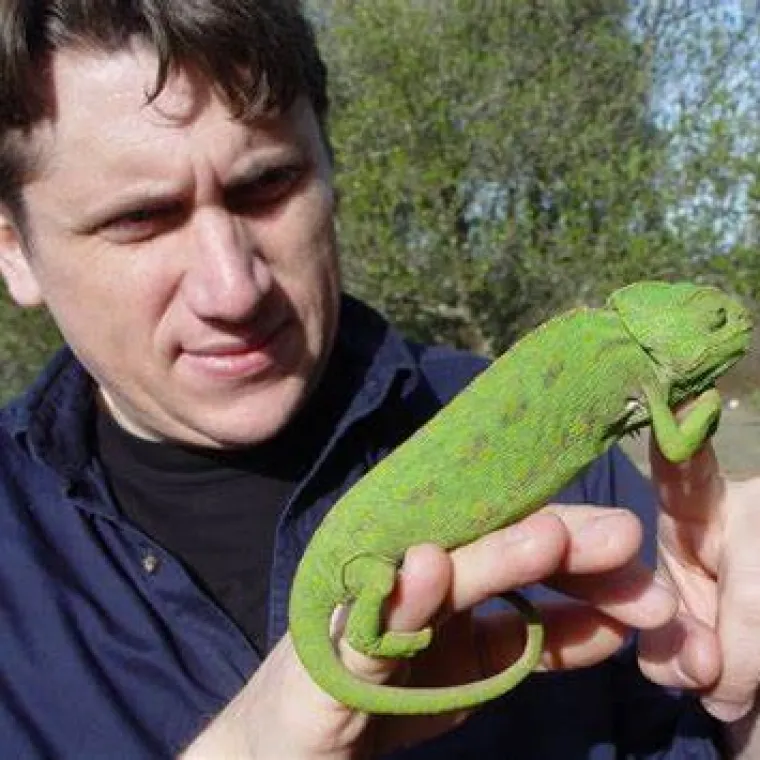
John Wiens
· ProfessorUniversity of Arizona · Ecology and Evolutionary Biology
Active 1979–2024
About
John Wiens is a Professor of Ecology and Evolutionary Biology at the University of Arizona, a position he has held since 2013. His research focuses on using an integrative phylogenetic approach to address broad conceptual questions in evolutionary biology and ecology, with particular emphasis on the phylogeny, evolution, and ecology of reptiles and amphibians. His work encompasses a variety of specific topics including species richness patterns, speciation, niche evolution and conservatism, life-history evolution, adaptive radiation, ecological diversification, rates and patterns of morphological change, phylogenomics, and species responses to climate change. Wiens combines collection and analysis of genetic, morphological, ecological, and physiological data through both laboratory and fieldwork, integrating bioinformatic, computational, and theoretical approaches to advance understanding in these areas.
Research topics
- Biology
- Ecology
- Paleontology
- Evolutionary biology
- Environmental science
- Geography
Selected publications
The origins of acoustic communication in vertebrates
Nature Communications · 2020 · 162 citations
Senior authorCorresponding- Evolutionary biology
- Biology
- Ecology
Acoustic communication is crucial to humans and many other tetrapods, including birds, frogs, crocodilians, and mammals. However, large-scale patterns in its evolution are largely unstudied. Here, we address several fundamental questions about the origins of acoustic communication in terrestrial vertebrates (tetrapods), using phylogenetic methods. We show that origins of acoustic communication are significantly associated with nocturnal activity. We find that acoustic communication does not increase diversification rates, a surprising result given the many speciation-focused studies of frog calls and bird songs. We also demonstrate that the presence of acoustic communication is strongly conserved over time. Finally, we find that acoustic communication evolved independently in most major tetrapod groups, often with remarkably ancient origins (~100-200 million years ago). Overall, we show that the role of ecology in shaping signal evolution applies to surprisingly deep timescales, whereas the role of signal evolution in diversification may not.
Niche Breadth: Causes and Consequences for Ecology, Evolution, and Conservation
The Quarterly Review of Biology · 2020 · 324 citations
Senior authorCorresponding- Ecology
- Biology
Niche breadth is a unifying concept spanning diverse aspects of ecology, evolution, and conservation biology. Niche breadth usually refers to the diversity of resources used or environments tolerated by an individual, population, species, or clade. Here we review key research in ecology, evolution, and conservation biology in light of niche breadth. Namely, we explore the role of niche breadth in shaping geographic distributions and species richness from local to landscape scales, how niche breadth evolves and influences lineage diversification, and its use for understanding species invasions, responses to climate change, vulnerability to extinction, and ecosystem functioning. This diverse literature informs a research agenda that identifies focused needs for further progress: testing the hierarchical nature of niche breadth (e.g., of individuals, populations, and species); quantifying correlations in niche breadth among different niche axes and the role of environmental drivers and organismal constraints in generating these correlations; and evaluating the factors that decouple fundamental and realized niches. We describe how this research agenda could help unify disparate subdisciplines and shed light on key questions in ecology, evolution, and conservation.
Recent responses to climate change reveal the drivers of species extinction and survival
Proceedings of the National Academy of Sciences · 2020 · 712 citations
Senior authorCorresponding- Environmental science
- Geography
- Ecology
Climate change may be a major threat to biodiversity in the next 100 years. Although there has been important work on mechanisms of decline in some species, it generally remains unclear which changes in climate actually cause extinctions, and how many species will likely be lost. Here, we identify the specific changes in climate that are associated with the widespread local extinctions that have already occurred. We then use this information to predict the extent of future biodiversity loss and to identify which processes may forestall extinction. We used data from surveys of 538 plant and animal species over time, 44% of which have already had local extinctions at one or more sites. We found that locations with local extinctions had larger and faster changes in hottest yearly temperatures than those without. Surprisingly, sites with local extinctions had significantly smaller changes in mean annual temperatures, despite the widespread use of mean annual temperatures as proxies for overall climate change. Based on their past rates of dispersal, we estimate that 57-70% of these 538 species will not disperse quickly enough to avoid extinction. However, we show that niche shifts appear to be far more important for avoiding extinction than dispersal, although most studies focus only on dispersal. Specifically, considering both dispersal and niche shifts, we project that only 16-30% of these 538 species may go extinct by 2070. Overall, our results help identify the specific climatic changes that cause extinction and the processes that may help species to survive.
Recent grants
Frequent coauthors
- 28 shared
Tod W. Reeder
San Diego State University
- 27 shared
Jeffrey W. Streicher
Natural History Museum
- 20 shared
Daniel S. Moen
Oklahoma State University
- 19 shared
Kenneth H. Kozak
University of Minnesota System
- 17 shared
Yan‐Fu Qu
Nanjing Normal University
- 14 shared
Patrick R. Stephens
University of Georgia
- 14 shared
Paul T. Chippindale
The University of Texas at Arlington
- 13 shared
Elizabeth Christina Miller
Awards & honors
- ISI Highly Cited Researcher, 2014
- President’s Award, American Society of Naturalists, 2011
- BIOS Distinguished Lecturer, Univ. Nevada-Las Vegas, 2009
- Kirschner Lecture, Department of Zoology, Washington State U…
- National Science Foundation Graduate Research Fellowship 199…
Similar researchers at University of Arizona
- Resume-aware match score
- Save to shortlist
- AI-drafted outreach
See your match with John Wiens
PhdFit ranks faculty by your research interests, methods, and publications — grounded in their actual work, not templates.
- Free to start
- No credit card
- 30-second signup