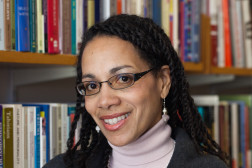
Erica Caple James
· Affiliate Faculty Professor of Medical Anthropology and Urban StudiesMassachusetts Institute of Technology · Sociology
Active 1842–2024
About
Erica Caple James is a Professor of Medical Anthropology and Urban Studies at MIT. Her work focuses on violence and trauma, philanthropy, humanitarianism, and charity, as well as human rights, democratization, and postconflict transitions. She also explores issues related to race, gender, culture, religion and healing, and climate change and food security, particularly in the context of Haiti's cocoa farmers. Her award-winning first book, Democratic Insecurities: Violence, Trauma, and Intervention in Haiti, documents the psychosocial experiences of Haitian torture survivors during the 1991-94 coup period and analyzes the politics of humanitarian assistance in post-conflict nations transitioning to democracy. Her ethnographic research emphasizes the importance of integrating justice-oriented psychosocial interventions in postconflict political development efforts. Her second ethnographic book, Life at the Center: Haitians and Corporate Catholicism in Boston, examines the biopolitics of charity within a faith-based organization serving Haitian immigrants and refugees, supported by the NIH. She is also the editor of Governing Gifts: Faith, Charity, and the Security State, which investigates the impact of U.S. anti-terrorism laws on NGOs. Currently, she has two manuscripts in progress: one on environmental justice and race in Charlottesville, Virginia, and another on Haiti's cocoa industry, analyzing the role of international aid and climate challenges faced by smallholder farmers. Her research broadly addresses violence, trauma, philanthropy, human rights, democratization, race, gender, religion, and environmental issues, with a particular focus on Haiti and the United States.
Research topics
- Political Science
- Computer Science
- Law
Selected publications
3 Life in Purgatorial Spaces: Haitian Migrants between Church, State, and Law
2024-05-24
book-chapterOpen access1st authorCorrespondingHaitian Migrants between Church, State, and LawFrom birth to mourning after death, law "takes hold of " bodies in order to make them its text.Through all sorts of initiations (in rituals, at schools, etc.) it transforms them into tables of the law, into living tableaus of rules and customs, into actors in the drama organized by a social order.-Michel de Certeau It's not a whole lot of difference between the Catholic structure and the penal structure.
Building the Brand: Migrants and Roman Catholic Charity
2024-05-28
book-chapterOpen access1st authorCorresponding9 Bureaucratic Disenchantments and Wounds of Charity
University of California Press eBooks · 2024
1st authorCorresponding- Political Science
- Political Science
- Law
2010).Perhaps all these dynamics were present.In the attempt to characterize how the cumulative discord disconnected the institution's long-standing partisans from the goal of establishing an independent institution "by Haitians, for Haitians, " I am reminded that charity can move from compassion to repression, as Didier Fassin (2005) has described the shift from aiding to incarcerating and expelling undocumented migrants in France in the early 2000s.Similarly, Catherine Besteman (2019), drawing on Jacques Derrida (2000), shows how charity can encompass both hospitality and hostility, producing "hostipitality." Her ethnographic work in the United States is a particular touchstone as she documents the agonistic charitable relationships between Catholic Charities, native Maine residents, and Somali Bantu refugees in Lewiston, Maine.In Besteman's example, race and racism, ideals of citizenship and belonging, and disputes about whether refugees were unentitled recipients of charity or deserving beneficiaries of welfare-a distinction based on legal status and rights to receive public assistance-negatively charged civic debates about African newcomers to a predominantly white town.These ethnographic examples portray similar paradoxical tensions of care, control, inclusion, and abandonment seeming to underlie some of these events at the Haitian Multi-Service Center.In contrast to ethnographic works describing the institutional extension of charity to, or the withholding of it from, refugees and migrant clients, the uncharitable practices I now present were directed toward the human service providers and charitable volunteers who advocated for their (compatriot) refugee and migrant clients.The shift from a hospitable homeplace to a bureaucratically routine but hostile workspace had predictable effects-such as the production of activities fulfilling projected programmatic outcomes but largely perceived to have failed in terms of stakeholder participation.I interpret four specific episodes: a September 2006 general staff meeting, the hiring of a new health program manager, the 2007 health fair, and finally, the Center's thirtieth anniversary fundraising celebration (held belatedly in 2009)-a celebration that lost more funding than it earned.Interwoven among these episodes were confrontations among the Center management and stakeholders regarding ethical gift giving.These interludes showed the Charity did not, and perhaps could not, always monitor how program sites implemented human services.The intra-organizational contests over care, charity, and advocacy were enmeshed with issues of race, class, gender, and even ethnonationalism.These protracted dynamics eroded a sense that the Church, Charity, Center, and even the City could be aligned to aid Haitians.SET TING THE SCENE By late summer 2006, I was still having difficulty communicating with several of the twenty-five plus full-and part-time staff members beyond engaging in simple pleasantries.Requesting formal interviews proved especially challenging, as the staff members were busy with program labor both on-and off-site.I would later learn all was not well under the surface of everyday routines.For
University of California Press eBooks · 2024
1st authorCorresponding- Computer Science
- Computer Science
Corporate Schisms: Life and Death between Church, State, and Law
2024-05-28
book-chapterOpen access1st authorCorrespondingLuminos is University of California Press’ Open Access publishing program for monographs. With the same high standards for selection, peer review, production and marketing as our traditional program, Luminos is a transformative model, built as a partnership where costs and benefits are shared.
Life in Purgatorial Spaces: Haitian Migrants between Church, State, and Law
2024-05-28
book-chapterOpen access1st authorCorrespondingLuminos is University of California Press’ Open Access publishing program for monographs. With the same high standards for selection, peer review, production and marketing as our traditional program, Luminos is a transformative model, built as a partnership where costs and benefits are shared.
Bureaucratic Disenchantments and Wounds of Charity
2024-05-28
book-chapterOpen access1st authorCorresponding6 Corporate Schisms: Life and Death between Church, State, and Law
2024-05-24
book-chapterOpen access1st authorCorrespondingCorporate SchismsLife and Death between Church, State, and Law We started as a grassroots organization [and] now we've become a churchbased organization. . . .Now we have a church making decisions for the community.-Dr.Rnald Raphal
There Is No More Haiti: Between Life and Death in Port-au-Prince by Greg Beckett
Anthropological Quarterly · 2020-01-01
article1st authorCorrespondingReviewed by: There Is No More Haiti: Between Life and Death in Port-au-Prince by Greg Beckett Erica Caple James Greg Beckett. There Is No More Haiti: Between Life and Death in Port-au-Prince. Berkeley: University of California Press, 2019. 312 pp. Greg Beckett. There Is No More Haiti: Between Life and Death in Port-au-Prince. Berkeley: University of California Press, 2019. 312 pp. In this ethnography, researched during intermittent periods of fieldwork in Haiti from 2002 until after the 2010 earthquake, Greg Beckett shows how phenomena I characterized as ensekirite ("insecurity" in Haitian Creole)—the unpredictability, violence, and resulting embodied vulnerability of Haitians (and to lesser degree, others residing in the nation)—have become routine rather than exceptional. Beckett uses a similar concept of dezòd (disorder) to characterize the unpredictability of social, political, environmental, and economic ruptures across chapters anchored by the experiences of intrepid individuals. The work is sprawling, both temporally and geographically, but centers primarily in Port-au-Prince, the nation's capital. Beckett launches his study of the lived experience of vulnerability from Martissant, a community in which I also conducted ethnographic work (from 1996–2000). The neighborhood, residing along both sides of a national route to southern Haiti, is a highly densely populated coastal area that ranges from seaside shanties to older established middle-class homes, as well as squatter settlements in the ravines and higher elevations of the mountain range that parallels the sea. The continuities in the phenomena Beckett describes (and even the theoretical frameworks employed to contextualize them) provide uncanny and heartbreaking confirmation of my own witnessing and analysis of "routines of rupture," and the "ontological insecurity" that enduring social precarity produces, in the lived experience of many Haitians (James 2008, 2010). It is challenging to offer reflections on a work whose themes, events, theoretical orientation, [End Page 811] and locales overlap deeply with my own. What follows is a reflection not only on the book, but also on the ethics and practice of ethnography. With its provocative (and dispiriting) title, There Is No More Haiti: Between Life and Death in Port-au-Prince, Beckett aims to describe how environmental and urban crises are intertwined with the ongoing crisis of the state. The author takes great pains to articulate his struggles to tell a story of "crisis" rooted in the experiences of people who lived in, advocated for, and attempted to control a forest in Martissant. In early chapters, the lens through which the reader comes to understand these dynamics is Beckett's narration of the lives of a range of intimate associates—predominantly younger and middle-aged men—who attempt to survive and seek life (chache lavi) amidst the unpredictable ebbs and flows of ensekirite. He also portrays the views of some Haitian and expatriate elites whose political and economic interests are vested in controlling the political economy of crisis. The methodological choice of focusing on stories recounted and remembered give the ethnography more of a novelistic style in which the context and deep historical roots that frame the situations narrated are enfolded within the story. Beckett's theoretical analyses are largely contained in the endnotes. For readers who are new to Haiti's history and the unfolding of various contemporary crises, this mode of writing creates an accessible text that is engaging to read, but may also leave some of the empirical and theoretical nuance in the background and to be sought in referenced texts. Beckett's voice (and role) is at times that of the omniscient narrator, and at others one of a concerned friend who is willing to risk personal safety to seek the story, to witness, and to support others in need materially and emotionally. But a shift occurs between the initial and later chapters that may reflect the author's dilemma of how to capture an encompassing, rather than "ethnographically intimate" (10) and more localized story. The book culminates in detailed descriptions of a succession of "unnatural" disasters that strike the nation over a decade and continues a narrative of unending crisis that can be experienced as debilitating to his resilient colleagues. But in detailing these stories, Beckett may also be perpetuating...
Introduction: Democracy, Insecurity, and the Commodification of Suffering
2019-12-31
book-chapter1st authorCorresponding
Frequent coauthors
- 1 shared
David R. Antonenko
University of North Dakota
- 1 shared
Yvonne Gómez
Hospital Clínic de Barcelona
- 1 shared
Amanda M. Cooley
Nicholls State University
- 1 shared
Malick W. Ghachem
- 1 shared
Wendell M. Swenson
- 1 shared
Jiri Lenz
- 1 shared
De Kay
Education
- 2004
Ph.D., Medical Anthropology
University of California, Berkeley
- 1999
M.A., Anthropology
University of California, Berkeley
- 1995
B.A., Anthropology
University of California, Los Angeles
Awards & honors
- Social Science Research Council-MacArthur Foundation Fellows…
- NIH Health Disparities Research Program
- Resume-aware match score
- Save to shortlist
- AI-drafted outreach
See your match with Erica Caple James
PhdFit ranks faculty by your research interests, methods, and publications — grounded in their actual work, not templates.
- Free to start
- No credit card
- 30-second signup