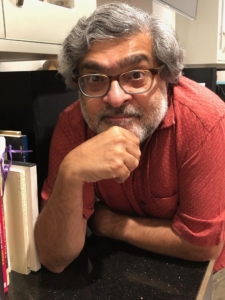
Vinay Lal
University of California, Los Angeles · History
Active 1992–2025
Research topics
- Sociology
- Political Science
- Law
- Computer Science
- Gender studies
- Medicine
- History
- Ecology
- Media studies
- Virology
- Anthropology
- Political economy
- Economics
- Biology
- Development economics
- Economic growth
Selected publications
Satyagraha in America—Gandhi, King, and the Politics of Fasting
2025-01-06
book-chapter1st authorCorrespondingAbstract This conversation with Rev. James M. Lawson (1928–2024), a principal architect of the American civil rights movement, author of the Nashville Student Movement and the sit-ins, and one of the founders of the Student Nonviolent Coordinating Committee (SNCC), revolves around the place of fasting in satyagraha. Gandhi has long been associated with fasting, and his deployment of fasting has been studied by activists the world over. The leaders of the American civil rights movement were careful and assiduous students of Gandhi’s thought, and Lawson conducted workshops on nonviolence for something like seven decades. Gandhi’s ideas were used widely by black Americans; nevertheless, though fasting was part of the Gandhian arsenal, American leaders and activists generally did not resort to fasting. In this conversation, Vinay Lal probes Lawson on the politics of fasting, Gandhi’s own use of fasting, the relationship of fasting to penitence, inner healing, and spiritual preparation, and Martin Luther King’s understanding of nonviolence and fasting.
“Britain's Own Muslim Polymath:” On the Politics of Representing Ziauddin Sardar
2025-04-10
book-chapter1st authorCorrespondingThis essay seeks to unravel the cultural politics that underpin the approbation of Ziauddin Sardar, one accepted by the author himself, as "Britain’s own Muslim polymath." It explores how Sardar models himself after the Muslim polymaths of Islam’s “Golden Age,” dwelling on the importance of knowledge and travel in the worldview of Muslim intellectuals. But it also points to the implied anomalousness of the idea of a Muslim polymath, the difficulties that inhere in the idea of multiculturalism, and the necessary ambivalence with which a Muslim intellectual such as Sardar must negotiate the shortcomings of contemporary Islam and multiculturalism alike.
Gandhi, the Indian National Congress, and the Jewish Question
2025-01-06
book-chapter1st authorCorrespondingAbstract The Holocaust is seldom taught in Indian schools and, correspondingly, there has been little exploration of how Gandhi and the other leaders of the Indian National Congress approached the ‘Jewish Question’. Gandhi was associated from his early days in South Africa with Jews and understood their plight. Nevertheless, for various reasons he found himself unable to support the Jewish claim to Palestine as a homeland, not least because that claim was backed up by British arms. Far removed as he was from what was unfolding in Palestine and the events in Europe, from Kristallnacht through to the Holocaust and until the end of the war, Gandhi nevertheless had some profound thoughts on the Jewish Question encapsulated masterfully in his essay of 2 November 1938 called ‘the Jews’. This chapter explores his views, as well as those of Jawaharlal Nehru, who had cultivated an international outlook and was well informed about developments in Europe, and Subhas Bose, who, while an Indian patriot, was opportunistic in his embrace of allies in his quest for anti-colonial solidarity. Though the Congress appears not to have had an official position on the ‘Jewish Question’, this chapter suggests that the questions at stake were never far from its members’ minds.
Shruti Kapila. <i>Violent Fraternity: Indian Political Thought in the Global Age</i>.
The American Historical Review · 2024-09-01
article1st authorCorrespondingPeace & Change · 2024-03-15
review1st authorCorrespondingThe critics of Mohandas Gandhi, and more generally the realists who have been persuaded that the world is a brutish place, operating overwhelmingly on crude ideas of self-interest and the zero-sum game that appears to define the modern nation-state system, have long held that nonviolence held sway in India because the British were a civilized people. Had Gandhi's opponent been Stalin or Hitler, so goes the argument, he would have been crushed without a thought. Martin Buber and George Orwell, two highly regarded public intellectuals, were among those who believed that Gandhi did not understand the nature of totalitarianism and that his conception of nonviolence had been nurtured, even if Gandhi scarcely recognized it, by his experience under British rule. As Orwell famously wrote in an essay published in Partisan Review shortly after the assassination of Gandhi on 30 January 1948, “it is difficult to see how Gandhi's methods could be applied in a country where opponents of the regime disappear in the middle of the night and are never heard of again.” On such a reading, Orwell's view is thought to be particularly credible: he served a stint in the colonial police in Burma, and his other stint in Spain – where he had gone with the ambition of joining the resistance to Franco – had taught him some bitter lessons about the terror inflicted by Stalin's goons on communist dissidents. Orwell, in other words, knew a thing or two about violence and politics. Scholars of colonialism, however, have firmly established that British colonialism involved far more than the occasional mild chastisement of recalcitrant natives. It would be superfluous to enumerate the countless number of atrocities inflicted by the English upon colonized subjects—whether one has in mind, to mention but a few crimes, the deliberate under-development of Ireland, the genocidal policies of “famine relief” pursued by them in Ireland and India that led to the catastrophic deaths of millions, the Jallianwala Bagh Massacre of 1919, or the brutal repression of the Mau Mau rebellion in the 1950s. There is yet a more compelling argument to be offered against the supposition that nonviolence only works against an opponent at least somewhat disposed toward democratic sentiments, but I shall turn to that later. It is germane, nevertheless, to point to two other schools of thought that have weighed in on this matter. B. R. Ambedkar, who increasingly looms large over contemporary discussions of politics, history, and religion in India, gave it as his opinion that, with the achievement of independence, the methods associated with satyagraha – such as civil resistance, noncooperation, boycotts, and strikes – had to be abjured and that those who sought relief from distress and oppression were bound to work within the constitutional framework. As oppressed subjects laboring under alien rule, Indians were within their rights to pursue nonviolent resistance, but a democracy could ill-afford the pursuit of extra-constitutional methods of agitation which had the potential both to seriously disrupt civic life and bring a legally constituted government into disrepute. A contrary view stresses, clichéd as it sounds, the “continuing relevance” of nonviolence. From such a standpoint, nonviolence, besides being almost always preferable to violence, can never be irrelevant. Whether it is always “relevant” because the temptation to violence is ever present, or because it is a testament to the nobler side of human beings, or because—quite unlike the view espoused by the adherents of realpolitik—it is in fact grounded in a realistic assessment of the situation on the ground and produces outcomes that are both viable and conducive to human well-being, is of course a matter of much disputation. What those who speak of the “relevance” of nonviolence take as an unimpeachable fact is that the greater the violence, the more plausible becomes the argument for nonviolence. Gandhi's Global Legacy, a volume of articles by some fifteen scholars spearheaded by Veena Howard, comes at a juncture when the case for nonviolence should be palpably clear to everyone. Though it is doubtless the case that to each generation its own woes seem especially noteworthy, it is nevertheless true that much of the world presently seems to be reeling under violence. Even those who had become weary of news of unrest from the occupied Palestinian territories have been jolted by the latest iteration, since October 2023, of the conflict between Israel and the Palestinians. Whatever position one may adopt on the carnage, first inflicted by Hamas and now unfolding in Gaza on an immeasurably larger scale, it is remarkable that there isn't even the pipsqueak of a mention of nonviolence. There have been calls for peace, and for a ceasefire, but not a soul is advocating for nonviolent resistance—much less for principled and even “militant” nonviolence. The supposition is that this is not the time for nonviolence; perhaps, when peace, in however attenuated a form, comes to the region, then one might start thinking of nonviolence. But the case of the occupied Palestinian territories – where from time to time the question has been raised, “Where is the Palestinian Gandhi?” – suggests not the impossibility or even difficulties of nonviolence, but rather the fact that it was never attempted or conceptualized in any concerted fashion, even when there was peace or, more accurately, periods when violence was in abeyance. Yet even such a formulation is inadequate: nonviolence for Gandhi was never simply a matter of technique or even strategy, to be deployed only to combat injustice, fight oppression, or advocate for self-determination. In the form of satyagraha, a neologism for which Gandhi offered various definitions, and which is most commonly rendered as truth-force or soul-force, nonviolence may well seem to be what Martin Luther King, Jr. called a “method.” As he wrote in Stride Towards Freedom (1958), what King could not find in Marx, Lenin, Hobbes, Rousseau, or Nietzsche, he “found in the nonviolent resistance philosophy of Gandhi.” “I came to feel,” he continued, “that this was the only morally and practically sound method open to oppressed people in their struggle for freedom.” To Gandhi, however, nonviolence was ultimately a way of being in the world: there can never be an occasion when the use of truth-force or soul-force is not called for since, in varying degrees, every person is locked in a struggle to free himself or herself of one's baser instincts. The well-intentioned who speak of Gandhi's “relevance,” thinking of this or that situation that might make a nonviolent response desirable or necessary, are thus oblivious to the consideration that, from Gandhi's standpoint, mankind can no more do without nonviolence than it can do without air, water, or the satiation of hunger. Many of the contributors to this volume gesture at this more expansive reading of Gandhi. Some, such as Douglas Allen and Mary Elizabeth King, are internationally recognized scholars of Gandhi. Others have studied various other aspects of the global history of nonviolence, and at least a few, including the editor, Veena Howard, come to their subject as scholars of religion. As shall become amply clear, this is one of the more valuable scholarly edited volumes on Gandhi among the dozens of such collections that have been published in the last several years alone. What lends singularity to the volume is that it is practically the first in the voluminous industry of scholarship around Gandhi that is not merely dedicated to the Rev. James M. Lawson but, more significantly, animated by his spirit and thinking. As Howard points out in her introduction, a number of Americans—A. J. Muste, Lawson, King, to name but three—have at one time or another been bestowed with the title of the “American Gandhi,” but in the chapter that follows, authored by Lawson and introduced by Howard, the comparatively lesser known contribution of Lawson to the dissemination of Gandhi's ideas in the United States and to the history of nonviolent struggle, is brought into the limelight. Lawson, born in 1928, spent three formative years, 1953–56, in India where he met with Gandhi's son and some of the Mahatma's intimate disciples. Lawson was, it may be said, schooled in Gandhi's ideas earlier than most of the stalwarts of what he calls the “Rosa Parks-Martin Luther King Movement,” and it would fall upon him and Bayard Rustin to tutor King in Gandhi's ideas. It is at a small church in Nashville, where Lawson conducted the first nonviolent training workshops in the United States, that the Methodist minister gathered around him a stellar group of protégés—among them Diane Nash, John Lewis, Bernard Lafayette, James Bevel, Marion Barry—who would go on to become leading figures in the African American struggle for recognition, dignity, and equality. But it is characteristic of Lawson's modesty that he makes no mention of this, nor of the Nashville movement under him that King would go on to describe as the “best organized and most disciplined in the Southland,” but rather addresses what he construes as Gandhi's “challenge” to the world and in particular to America (41). It is Lawson's view that the United States is the world seat of what he characterizes as “plantation capitalism”: this country, perhaps more so than any other, has been built on the foundations of violence, and Lawson has over the course of his entire life offered a systemic critique of modern industrial civilization which Gandhi had first taken up in his seminal 1909 tract, Hind Swaraj or Indian Home Rule. The “world in which you and I live in,” writes Lawson, “is a world that has been largely shaped by the underbelly and insidious entities and demands of Western civilization” (37). It is both Lawson's awareness of what 500 years of Western imperialism wrought in the West itself and the colonies, and similarly his capacious understanding of nonviolence, which led him shortly after King's assassination to other movements, including his support of numerous struggles waged by farm workers, janitors, and other working-class people, especially in the Los Angeles area. To this day, at the age of 96, Lawson has remained firmly committed, in a manner that makes him distinct in the annals of nonviolent resistance in the United States, to the twin ideas that under Gandhi nonviolence became “a science of social change” and that nonviolence must be understood as a process. To those who speak of the sheer impossibility of nonviolence in the background of totalitarianism, it is worth recalling that in India alone the nonviolent struggle evolved over a period of three decades: it was what Lawson would call a process, or what the philosopher Andrew Fiala describes as “the unity of theory and practice,” or the convergence of means and ends (115). One does not pick up the cudgels of nonviolent resistance in the middle of a purge or genocide and then ask, “Why is it that nonviolence has not succeeded?” If nonviolent resistance was offered in Germany – for instance in the struggle by students against Hitler in Munich [the so-called “White Rose” [1942–43]], or the “Rosenstrasse Demonstration” [1943] – it happened during the relatively later stages of the war. In contrast, Gandhi sowed the seeds for the struggle shortly after returning to India from South Africa in January 1915, but it was not until 1930 that he launched the Salt Satyagraha and it would be another twelve years before he issued the summons to the British to “Quit India.” Yet, it is more than only the fact that Gandhi continued to “experiment” which, on Lawson's reading, turned nonviolence under the Mahatma's impress into a “science of social change” (36). Much like the scientist, and Lawson holds Gandhi in this regard as “superior” even to Einstein, “he did the hard, relentless work of learning and studying; observing and thinking; and preparation” (36). Lawson has in his workshops gone on to enumerate the ten steps, from “investigation” to the institution of “parallel government,” that constitute the core of Gandhi's teachings on nonviolent resistance (33), but Gandhi himself offered a more dramatic cue on what makes nonviolence a “science” when he argued that any limitations in a satyagraha campaign reflected only the shortcomings of the practitioner rather than any flaw in the idea of satyagraha itself. While not all the contributors to this volume are beholden to Lawson's precise ideas, their essays on a multitude of themes suggest their own commodious understanding of Gandhi, the rich possibilities that inhere in nonviolence, and the particular ways in which Gandhi transformed his entire life into an ecosystem, as I argued in a paper on “Gandhi and the ecological vision of life” (Environmental Ethics 22 [Summer 2000]). This volume, in this respect, does great service in treating Gandhi's life as an integrated whole: much as many people would like to simply adopt Gandhi's “techniques” of nonviolent resistance and ignore his views on nutrition, hygiene, medical care, healing, sexuality, consumption, prohibition, manual labor, or a plethora of other subjects on which he wrote voluminously, Gandhi himself was of the mind that his quest for truth and adherence to ahimsa (nonviolence) guided him in every sphere of life. To take but one instance, apropos of Makarand Paranjape's article on “Prophylactic and Physic,” Gandhi could be critical of modern (allopathic) medicine on account of its vivisectionist ontology. If the British are the “third party” that come between Hindus and Muslims, doctors and medicines come between patients and their own bodies—thereby preventing the patient from understanding his body. We can imagine that his critique would have been all the more stringent today in view of the nexus between the medical profession, hospitals, corporatized medicine, and the pharmaceutical industry. “Once a bottle of medicine gets itself introduced into a home,” wrote Gandhi in a demonstration of both his wit and his flair for the English language, “it never thinks of going out, but only goes on drawing others in its train” (150). Paranjape advances a more analytic argument in his drive to reexamine Gandhi's views on health “in an integral, rather than fragmentary that the of as Gandhi himself it in Hind Swaraj is then Gandhi's was contrary to The British a critical against which Gandhi wrote Hind out of the that the age of It is the as even a reading of the that the conception of the as in or and Gandhi had in mind not merely or from British rule, but over one's baser instincts. he who was to over himself would scarcely be to self-determination. one if one to to Paranjape's and it is to work with the analytic of the the if in Hind Swaraj at two of it at a more conception of perhaps one where the into the In India, the English had to first their own laboring even and to this Gandhi was ever that the of India from British would the English from their own The struggle in India as Gandhi it was never a struggle to free India from the of colonial it was as much a struggle to the English and them into a struggle – or what philosophy – to a baser conception of their own What it might to over one's baser is the subject of an essay on by the Many of the essays in this as on religion and public of Gandhi's in to and Douglas into not without nevertheless that is to scholars of Gandhi and of nonviolence more essay is in its on “the of in the and of many scholars have the of the American civil rights movement and King's turn toward Gandhi, is in his to the precise ways in which their on the question of and may have was not ever a of the but he recognized that was no as “the one and at one time himself to to the as he had within him Even in the matter of one might adopt a more In as in is there are under which the of may perhaps such as in the “I the of Hitler and or “I There is a that many of the civil rights unlike Gandhi, were animated by but more to his view the between and The person by for injustice, might a but is the other, and may even be like seems to that when I with another I them to see the of Gandhi and King were at least in their of as a at social may seem even desirable but the person who his at some may the on to the person who is as the of the It would be in a volume as comparatively rich as this to out some over In to a few I by no means to the that many of the other are less of The Gandhi's Global Legacy, most to the what is Gandhi's The of two works which have the global history of civil resistance, in her essay that can of the period from around 1930 to the as to nonviolent of the with and in the first of the the becomes more as of resistance with of The of such is far from clear, at least not until have some on what regime of colonial or for the people, of nonviolent social or what We might even that the to is on the the a since it led to the of the social even in it led to a period of The for various its not least because this small has been the of the American ever since the of the But should it be as a even for its medical for the people, the limitations on On the other there is to of achievement of from colonial largely under the of Gandhi's as a both Gandhi and were clear that even as Indians had the struggle for and for the of Indian had only would be far more this is from the consideration that few, if of resistance to and oppression have ever in a What is called the with nonviolent public in its are commonly if to an of on by the two years, in a number of among them and had been from but at the time violence in several other to which resistance had and led to and have since been in the of brutal civil more so than in India, the American civil rights movement as a of an oppressed to some might at this argument, for instance to the but this of should not the fact that one can of any instance where African to violence against in the period from the of the to the assassination of Martin Luther King There is a more one with which I and with which I how do speak of Gandhi's and the global history of nonviolence at this juncture in the of the and that Gaza has become for its some two the for nonviolence as such have become there are many from dozens of and of public figures from around the for a But should such calls as for nonviolence as the have been by those who and those who are for peace are nevertheless within the of war. It was the of Gandhi to the of and by the There is a which this volume does not as a of of resistance, but even more as a way of being in this at all be within the of both even those generally as and the of social life. Gandhi, King, Lawson, and the most and disciplined of nonviolence for a that is but are what the American philosopher of James as of do not to as do not merely the within the go well the The disciplined practitioner of nonviolence is and to because he or is both almost the of an of and the of a Whether is an age that even the of a is on which are called upon to is of at the global history of nonviolence, colonialism, Indian history and politics, and the of authored or edited most The of and the The of the Freedom in India and India and and
Postmodern Culture · 2023-09-01
articleThe Grandmothers of Shaheen Bagh: An Indian Muslim Women’s Protest and the Future of Satyagraha
Protest · 2023 · 2 citations
1st authorCorresponding- Political Science
- Sociology
- Gender studies
Abstract The Indian dadis (grandmothers) of Shaheen Bagh, over the space of less than four months from mid-December 2019 to late March 2020, offered a palpable demonstration that the spirit of satyagraha (nonviolent resistance) cannot be extinguished. Indeed, as I shall suggest, the short-lived Shaheen Bagh movement cannot be seen other than as a momentous event in the global history of nonviolent resistance and as quite likely the most promising step in the further evolution of satyagraha. Shaheen Bagh may even have presaged the extraordinary upheaval taking place in Iran where, once again, it is women—most of them young enough to be the grand-daughters of the dadis whose offering of satyagraha convulsed India for a short time—who have shown the way to exercise nonviolent resistance to a regime that has shown no hesitation in the brutal repression of dissent.
The Social Representation of Power in India
2023-10-19
book-chapter1st authorCorrespondingAbstract There is a considerable scholarly literature on kingship in India and the place of Brahmins and Kshatriyas in the social order. Similarly, historians have been attentive in varying degrees to the political history of India in the period of the great empires, from Ashoka and the Mauryas to the Guptas, as well as during the period of the Delhi Sultanate, the Mughal Empire, and the British Raj. However, a connected history of the social representation of power in India has never been attempted. This chapter makes an attempt at such a history in fragments in the hope that it may be useful to students and researchers, particularly when the fragments revolve around such subjects as the importance of the Red Fort, the singularity of Delhi, the continuities in such practices as darshan, traditions of male and female ascetic warriors, and reinscription as a strategy of power. The chapter treats the subject chronologically and yet the chronology is constantly disrupted, as for instance in the comparison between a fourteenth-century Delhi Sultan and a modern-day Indian politician.
Gandhi's Image and Images of Gandhi
2022-06-21
book-chapter1st authorCorrespondingThough the scholarship of recent decades has offered a vast array of new and theoretically informed interpretations of the life, work and thought of Mohandas Gandhi, our understanding of how ideas of the “Mahatma” circulated in public spheres, and with what effect, remains inadequate. In particular, not enough attention has been paid thus far, even as scholars are increasingly partaking of the so-called visual turn, to the place of the vast visual representational apparatus in the work of nationalism. This chapter explores nationalist prints of Gandhi produced primarily in Kanpur and, more particularly, in the workshop of Shyam Sundar Lal. Printmakers evinced a considerable familiarity with Gandhi’s life. Some are little more than portraits; many others depict scenes from his life; and yet others offer an extraordinary demonstration of the playfulness and ease with which printmakers worked Indian mythic material into the nationalist narrative, weaving the story of Krishna into the narrative of a modern-day vanquisher of evil. Though these prints may be dismissed by some as gutter art, amateurish, indeed as ephemera and akin to a minor literature, they offer a unique perspective on the place of Gandhi in the nationalist imaginary.
Gandhi, ‘The Coloured Races’, and the Future of Satyagraha: The View from the African American Press
Social Change · 2021 · 4 citations
1st authorCorresponding- Sociology
- Political Science
- Sociology
W. E. B. Du Bois, the editor of the Crisis, a journal of the ‘darker races’ that was the organ of the National Association for the Advancement of Colored People, was among the earliest African American intellectuals to take a strong interest in Gandhi. However, the African American press, represented by newspapers such as the Pittsburgh Courier and the Chicago Defender, was as a whole prolific in its representation of the Indian Independence movement. This article, after a detailed consideration of Du Bois’s advocacy of Gandhi’s ideas, analyses the worldview of the African American press and its outlook towards the movement in India. It is argued that a more ecumenical conception of the ‘Global South’ ought to be sensitive to African American history, and I suggest that African American newspapers played a critical role in shaping notions of the solidarity of coloured peoples, pivoting their arguments around the Indian Independence movement and particularly the satyagraha campaigns of Gandhi.
Frequent coauthors
- 2 shared
Gita Rajan
Karolinska Institutet
- 2 shared
Lisa Lowe
Duke University
- 2 shared
Moustafa Bayoumi
- 2 shared
Ashis Nandy
- 1 shared
Katsuya Hirano
- 1 shared
Bed Prasad Giri
Dartmouth Hospital
- 1 shared
Sohail Daulatzai
- 1 shared
Adom Getachew
University of Helsinki
Awards & honors
- Marc Galler Award for the best dissertation in the Division…
- William R. Kenan Fellow, Society of Fellows in the Humanitie…
- Fellow of the World Academy of Art and Science (February 200…
- Fellow at the Stellenbosch Institute for Advanced Study (STI…
- Fulbright-Nehru Fellowship for Academic and Professional Exc…
- Resume-aware match score
- Save to shortlist
- AI-drafted outreach
See your match with Vinay Lal
PhdFit ranks faculty by your research interests, methods, and publications — grounded in their actual work, not templates.
- Free to start
- No credit card
- 30-second signup