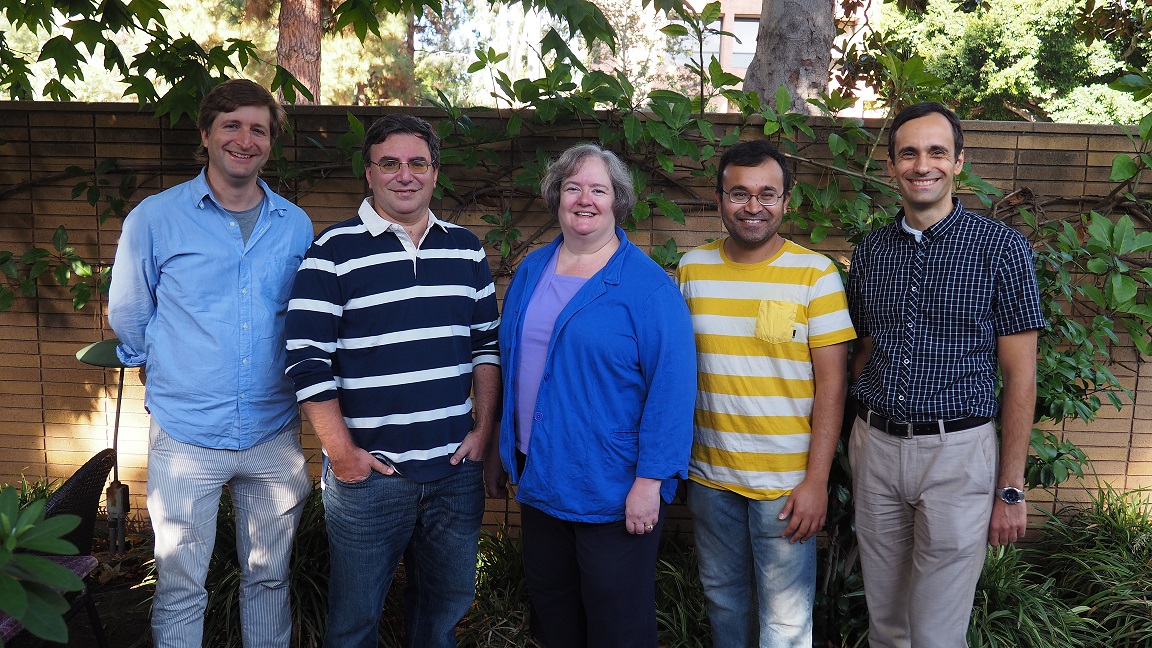
A. Bertozzi
· Member of the American Academy of Arts and Sciences, Member of US National Academy of SciencesVerifiedUniversity of California, Los Angeles · Mathematics
Active 1981–2026
Research signals
Five dimensions sourced from public faculty / publication signals. Sign in to compare against your own profile and see your match score.
Research topics
- Computer Science
- Medicine
- Political Science
- Artificial Intelligence
- Chemistry
- Nanotechnology
- Cardiology
- Polymer chemistry
- Biochemistry
- Immunology
- Genetics
- Molecular biology
- Computational biology
- Psychology
- Law
- Biology
- Social psychology
- Cell biology
- Criminology
- Computer vision
- Materials science
- Chemical engineering
- Internal medicine
Selected publications
Deep learning-assisted modeling for χ(2) nonlinear optics
Advanced Photonics · 2026-05-06
articleOpen accessArXiv.org · 2026-03-30
articleOpen accessSenior authorThe 2023 Lahaina wildfire killed 102 people on a peninsula served by a single two-lane highway, making exit lane capacity the binding constraint on evacuation time. We model the evacuation as a system of hyperbolic scalar conservation laws on a directed graph with game-theoretic junction conditions that maximize total network flux, an evacuation-calibrated piecewise linear-quadratic flux function, and a loss-driven optimization framework that tunes traffic distribution toward priority corridors. Analytical results on a toy network and numerical simulations of the Lahaina road network reveal a phase transition in exit lane capacity. Additional lanes improve throughput linearly until a computable critical threshold, beyond which no route optimization yields further benefit. For Lahaina, reversing one southbound lane captures nearly all achievable improvement, and a fourth lane can be reserved for emergency vehicles with negligible impact on civilian clearance time. These results provide a rigorous mathematical basis for contraflow recommendations in wildland-urban interface evacuations.
Numerical analysis of a floating Airborne Wind Energy farm with shared-mooring
SSRN Electronic Journal · 2026-01-01
preprintOpen access1st authorCorrespondingarXiv (Cornell University) · 2026-03-30
preprintOpen accessSenior authorThe 2023 Lahaina wildfire killed 102 people on a peninsula served by a single two-lane highway, making exit lane capacity the binding constraint on evacuation time. We model the evacuation as a system of hyperbolic scalar conservation laws on a directed graph with game-theoretic junction conditions that maximize total network flux, an evacuation-calibrated piecewise linear-quadratic flux function, and a loss-driven optimization framework that tunes traffic distribution toward priority corridors. Analytical results on a toy network and numerical simulations of the Lahaina road network reveal a phase transition in exit lane capacity. Additional lanes improve throughput linearly until a computable critical threshold, beyond which no route optimization yields further benefit. For Lahaina, reversing one southbound lane captures nearly all achievable improvement, and a fourth lane can be reserved for emergency vehicles with negligible impact on civilian clearance time. These results provide a rigorous mathematical basis for contraflow recommendations in wildland-urban interface evacuations.
ArXiv.org · 2025-12-04 · 2 citations
preprintOpen accessThis review charts the emerging paradigm of intelligent structured light for high-field laser-matter interactions, where the precise spatiotemporal and vectorial control of light is a critical degree of freedom. We outline a transformative framework built upon three synergistic pillars. First, we survey the advanced electromagnetic toolkit, moving beyond conventional spatial light modulators to include robust static optics and the promising frontier of plasma light modulators. Second, we detail the optimization engine for this high-dimensional design space, focusing on physics-informed digital twins and AI-driven inverse design to automate the discovery of optimal light structures. Finally, we explore the groundbreaking applications enabled by this integrated approach, including programmable electron beams, orbital-angular-momentum-carrying γ-rays, compact THz accelerators, and robust communications. The path forward necessitates overcoming grand challenges in material science, real-time adaptive control at MHz rates, and the extension of these principles to the quantum realm. This review serves as a call to action for a coordinated, interdisciplinary effort to command, rather than merely observe, light-matter interactions at the extreme.
Video: Transient Segregation Dynamics of Bidisperse Particle-Laden Flow on an Incline
2025-11-23
articleOpen accessSenior authorMobile Sensor Placement for the 3-Coverage Problem in Confined Geometries
2025-11-12
articleWe consider the 3-coverage problem in confined geometries using mobile sensors. Many sensor problems require the use of multiple cooperative sensors for geolocation of events (e.g. using sound for triangulation). Optimal placement of sensors can be challenging, especially when confined to unusual geometries. We propose a novel swarming algorithm involving pairwise interaction potentials. Such models have low-energy cooperative states in which the agents form local Voronoi-style hexagonal patterns. We focus on the Morse potential and show that under certain choices of parameters, particles reach a desirable uniform distribution of 3-coverage. Such properties include (a) maintaining optimal distance as sensors are added or removed, (b) ability to navigate with limited communication between sensors, such as near-neighbor interactions for the graph topology of the sensor network, and (c) ability to target specific areas within a confined geometry especially with limited sensor resources.
Plug-and-Play Image Restoration with Flow Matching: A Continuous Viewpoint
ArXiv.org · 2025-12-03
preprintOpen accessFlow matching-based generative models have been integrated into the plug-and-play image restoration framework, and the resulting plug-and-play flow matching (PnP-Flow) model has achieved some remarkable empirical success for image restoration. However, the theoretical understanding of PnP-Flow lags its empirical success. In this paper, we derive a continuous limit for PnP-Flow, resulting in a stochastic differential equation (SDE) surrogate model of PnP-Flow. The SDE model provides two particular insights to improve PnP-Flow for image restoration: (1) It enables us to quantify the error for image restoration, informing us to improve step scheduling and regularize the Lipschitz constant of the neural network-parameterized vector field for error reduction. (2) It informs us to accelerate off-the-shelf PnP-Flow models via extrapolation, resulting in a rescaled version of the proposed SDE model. We validate the efficacy of the SDE-informed improved PnP-Flow using several benchmark tasks, including image denoising, deblurring, super-resolution, and inpainting. Numerical results show that our method significantly outperforms the baseline PnP-Flow and other state-of-the-art approaches, achieving superior performance across evaluation metrics.
Machine learning techniques for frequency comb optimization
2025-03-19
articleSenior authorWe use supervised and unsupervised machine learning techniques to investigate how optical frequency combs may be used to identify gas molecules in the atmosphere. Dual comb heterodyne detection with GHz and THz repetition rates are often used as spectroscopic methods for probing ro-vibrational IR spectra of small molecules, proving to be promising in dispersive atmospheric sensing regimes. We simulate and recover an intensity spectrum from the molecule-specific IR absorption in the region spanned by the comb bandwidth. In practice, conventional frequency combs contain a narrow range of frequencies that may not span the spectral range associated with typical atmospheric target signals, prohibiting convenient molecule identification. We present several inexpensive, efficient machine learning methods to analyze optimal comb frequencies to maximize the ability to determine the molecular composition of a sample, based only on the interactions at those frequencies with respect to various channels of noise. Using a synthetic dataset, these methods are able to accurately identify molecules using simulated frequency combs, comparable to the ones used in practice. Furthermore, these methods withstand added noise (based on the imperfections of the experimental equipment) beyond what is expected in real applications. We also investigate the optimal comb generation parameters that provide the most informational value, and provide an analysis of the change in accuracy based on the number and size of allocated combs. The robustness of these methods suggests the techniques presented in this paper may be integrated into a laboratory setup and even in on-chip comb systems deployed in an atmospheric setting. This approach may be used as a detection framework for future quantum-enhanced systems via squeezed bi-photon comb inputs.
Mathematical Biosciences · 2025-06-27 · 2 citations
articleOpen accessSenior authorCorresponding
Recent grants
Extreme-scale algorithms for geometric graphical data models in imaging, social and network science
NSF · $300k · 2014–2018
BECS: Collaborative Research: Characterization and Control of Emergent Behavior in Complex Systems
NSF · $86k · 2010–2013
FRG: Collaborative Research: Robust, Efficient, and Private Deep Learning Algorithms
NSF · $435k · 2020–2024
ATD: Sparsity Models for Forecasting Spatio-Temporal Human Dynamics
NSF · $604k · 2017–2021
RAPID: Analysis of Multiscale Network Models for the Spread of COVID-19
NSF · $200k · 2020–2022
Frequent coauthors
- 41 shared
Stanley Osher
- 40 shared
P. Jeffrey Brantingham
University of California, Los Angeles
- 39 shared
Jocelyn Chanussot
Laboratoire Jean Kuntzmann
- 32 shared
Dino Di Carlo
- 26 shared
Hangjie Ji
- 22 shared
Martin B. Short
- 18 shared
Xiyang Luo
Google (United States)
- 18 shared
Bohan Chen
Education
- 1993
Ph.D., Mathematics
University of California, Berkeley
- 1988
B.S., Mathematics
Massachusetts Institute of Technology
- Resume-aware match score
- Save to shortlist
- AI-drafted outreach
See your match with A. Bertozzi
PhdFit ranks faculty by your research interests, methods, and publications — grounded in their actual work, not templates.
- Free to start
- No credit card
- 30-second signup