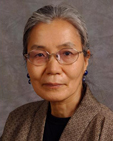
Sachiko Murata
· ProfessorStony Brook University · Asian and Asian American Studies
Active 1992–2024
About
Sachiko Murata is a professor in the Department of Asian & Asian American Studies at Stony Brook University. Her research investigates the interrelationships between Islamic and Far Eastern thought, with a particular focus on the writings of the Huiru, known as the Muslim Confucianists, who authored numerous tracts in Chinese from the seventeenth through the nineteenth centuries. Murata completed her undergraduate studies in family law at Chiba University in Japan, worked for a year in a law firm in Tokyo, and then pursued advanced studies in Iran, where she studied Islamic law. She earned her PhD in Persian literature from Tehran University in 1971 and was the first woman and the first non-Muslim enrolled in the faculty of theology there. She also completed an MA in Islamic jurisprudence in 1975. Her academic journey included work as a research associate at the Imperial Iranian Academy of Philosophy, and she has been teaching religious studies at Stony Brook University since 1983. Murata has published numerous scholarly articles and books, including translations and sourcebooks on Islamic jurisprudence, gender relationships in Islamic thought, and the intersection of Islamic and Confucian ideas. She has served as the director of Japanese Studies since its founding in 1990 and teaches courses on Japanese Studies, Buddhism, Feminine Spirituality in World Religions, and Islam and Confucianism.
Research topics
- Epistemology
- Literature
- Philosophy
- Theology
- Art
- Religious studies
Selected publications
Üsküdar Üniversitesi Tasavvuf Araştırmaları Enstitüsü Dergisi · 2024
1st authorCorresponding- Philosophy
- Theology
- Literature
There are only four Islamic texts on theology and philosophy which are known to have been translated into Chinese before the twentieth century. One of them, Ashiʿʿat al-lamaʿāt, Jāmī’s commentary on Fakhr al-Dīn ʿIrāqī’s Lamaʿāt, was translated by She Yunshan. He was one of the earliest members of the school of thought known as “the Muslim Confucianists.” In this article, I will present a few examples from Yunshan’s translation, who is also known by the penname Ponachi, in order to illustrate the elegance of his understanding of the universal dimensions of Sufism.
Harvard University Asia Center eBooks · 2017-09-07
book-chapter1st authorCorrespondingNihon Nyugan Kenshin Gakkaishi (Journal of Japan Association of Breast Cancer Screening) · 2013-01-01
articleOpen access当院は産婦人科の単科病院であり,年間分娩数は約2,000件を数える。平成16年度に乳がん検診にマンモグラフィを導入し,また同時期より超音波検査も積極的に施行してきた。超音波検査のエビデンスは現在J-START(乳がん検診における超音波検査の有用性を検証するための比較試験)の結果が待たれるところである。エビデンスがなくとも日常的に超音波検査は有用であると考えられている。平成22年7月に自動超音波装置を乳がん検診に導入し,スクリーニング用として活用している。自動超音波装置は過不足ない自動走査による動画保存で,これまでの超音波検査の欠点であった再現性の獲得と読影作業の独立が可能となった。当院の所属している対策型乳がん検診には超音波検査がないため任意希望で検査を実施している。検査の重要性の説明は一対一の患者対応によるところが大きい。産婦人科である当院の検診希望者は30歳代・40歳代が多く,さらに科の特性から若年者も多い。平成22年7月から平成24年3月までの自動超音波装置による総検査数は2,144件であった。受診年齢は20歳代から80歳代まで幅広かった。また産婦人科が日常診療する授乳期やホルモン剤投与中の検診に乳癌が発見された。自動超音波装置による乳がん検診結果は要精査率3%,乳癌発見率は0.9%であった(乳癌症例20例:非浸潤性乳管癌5例,浸潤性乳管癌15例)。この結果は超音波検診が目指す数字に十分満足できるものであると考えられた。
The Implicit Dialogue of Confucian Muslims
2013-04-02
otherSenior authorMuslims have lived in China for well over a thousand years, tracing their lineage back to an emissary sent by Muhammad to the emperor. Historians have found no concrete evidence of dialogue between Muslims and Confucians before the seventeenth century, when Muslims began writing about their religion in Chinese. Having understood that Muslims were becoming ever more ignorant of their own religion, Hu Dengzhou saw no other way for the ulama to transmit Islamic learning to monolingual Chinese. Chinese Muslim scholarly identity, while dialogically constructed, was one by which these scholars understood themselves as simultaneously Chinese and Muslim.
Muslim Approaches to Religious Diversity in China
Palgrave Macmillan eBooks · 2013-10-04 · 2 citations
book-chapter1st authorCorrespondingMuslim Approaches to Religious Diversity in China
Palgrave Macmillan US eBooks · 2013-01-01 · 1 citations
book-chapter1st authorCorrespondingMuslims entered China in the seventh century and established communities within a century or two, but it took almost 1,000 years for them to begin writing about Islam in the Chinese language. In 1642, Wang Daiyu 王岱輿 (ca. 1592-ca. 1658) published the first known Chinese book on Islamic teachings, and many others joined him over the next two centuries. These scholars have often been called the Huiru 回儒, the Muslim Confucians, and their writings the Han Kitab, a Chinese-Arabic hybrid word meaning "the Chinese Books." Many of them engaged in a profound dialogue with Confucian thought, and their approach may be able to suggest fruitful approaches to the contemporary dialogue of civilizations.
The Muslim Appropriate of Confucian Thought in Eighteenth-Century China
Comparative Islamic Studies · 2012-02-11
article1st authorCorrespondingThis article analyzes the concept of Huiru, “Islamic Confucianism.” From the seventeenth through the nineteenth century, a school of thought known as Huiru flourished in the Chinese language and produced many books on Islamic teachings taking full advantage of the rich vocabulary of the Neo-Confucian philosophical tradition. Probably the most influential of these books was Tianfang xingli, “Nature and Principle in Islam,” published by Liu Zhi in 1704. In contrast to the vast majority of modern-day books about Islam, which focus on legal, social, and political teachings, Liu Zhi addresses the underlying principles of the Islamic worldview—specifically unity, prophecy, and the return to God. The result is a surprisingly harmonious synthesis of Islamic and Confucian thought that can provide inspiration to those of us today who would like to carry out a meaningful “dialogue among civilizations.”
The Muslim Appropriate of Confucian Thought in Eighteenth-Century China
Comparative Islamic Studies · 2012-09-20
article1st authorCorrespondingThis article analyzes the concept of Huiru, “Islamic Confucianism.” From the seventeenth through the nineteenth century, a school of thought known as Huiru flourished in the Chinese language and produced many books on Islamic teachings taking full advantage of the rich vocabulary of the Neo-Confucian philosophical tradition. Probably the most influential of these books was Tianfang xingli, “Nature and Principle in Islam,” published by Liu Zhi in 1704. In contrast to the vast majority of modern-day books about Islam, which focus on legal, social, and political teachings, Liu Zhi addresses the underlying principles of the Islamic worldview—specifically unity, prophecy, and the return to God. The result is a surprisingly harmonious synthesis of Islamic and Confucian thought that can provide inspiration to those of us today who would like to carry out a meaningful “dialogue among civilizations.”
The Muslim Appropriate of Confucian Thought in Eighteenth-Century China
Comparative Islamic Studies · 2012-09-20
article1st authorCorrespondingThis article analyzes the concept of Huiru, “Islamic Confucianism.” From the seventeenth through the nineteenth century, a school of thought known as Huiru flourished in the Chinese language and produced many books on Islamic teachings taking full advantage of the rich vocabulary of the Neo-Confucian philosophical tradition. Probably the most influential of these books was Tianfang xingli, “Nature and Principle in Islam,” published by Liu Zhi in 1704. In contrast to the vast majority of modern-day books about Islam, which focus on legal, social, and political teachings, Liu Zhi addresses the underlying principles of the Islamic worldview—specifically unity, prophecy, and the return to God. The result is a surprisingly harmonious synthesis of Islamic and Confucian thought that can provide inspiration to those of us today who would like to carry out a meaningful “dialogue among civilizations.”
Harvard University Asia Center eBooks · 2009-12-08
book-chapter1st authorCorresponding
Frequent coauthors
- 27 shared
William C. Chittick
- 22 shared
Tu Weiming
Peking University
- 4 shared
Mutsumi Kitahashi
Women's Hospital
- 4 shared
Takako Mori
Tokyo Women's Medical University Adachi Medical Center
- 2 shared
Miho Kurisu
Women's Hospital
- 1 shared
Pierre Lory
- 1 shared
Li Guo
- 1 shared
Jāmī
- Resume-aware match score
- Save to shortlist
- AI-drafted outreach
See your match with Sachiko Murata
PhdFit ranks faculty by your research interests, methods, and publications — grounded in their actual work, not templates.
- Free to start
- No credit card
- 30-second signup