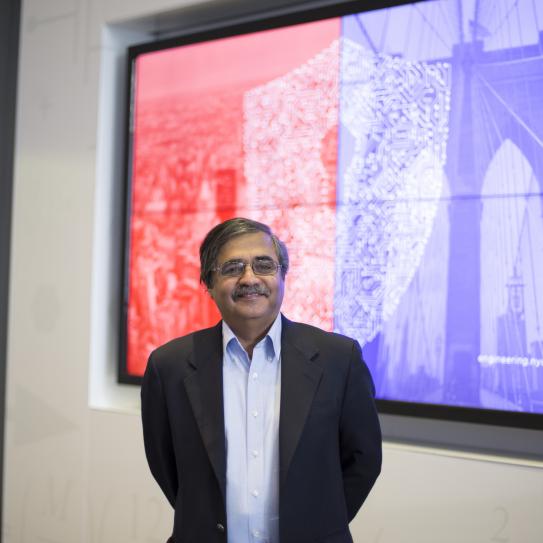
Nasir Memon
VerifiedNew York University · Computer Science
Active 1991–2025
About
Nasir Memon is a professor of Computer Science and Engineering at the New York University Tandon School of Engineering and serves as the Dean of Engineering at NYU Shanghai. He has been a faculty member at NYU Tandon since September 1998. His research interests encompass digital forensics, biometrics, data compression, network security, and security and human behavior. Memon introduced cybersecurity studies to NYU Tandon in 1999, making it one of the first institutions to implement undergraduate cybersecurity programs. He is a co-founder of NYU's Center for Cyber Security (CCS) at New York and NYU Abu Dhabi, and he founded the OSIRIS Lab, CSAW, the NYU Tandon Bridge program, and the Cyber Fellows program at NYU. Memon has received multiple awards for his research and teaching, including best paper awards, the Jacobs Excellence in Education Award, and recognition as an IEEE Fellow and SPIE Fellow for his contributions to image compression and media security and forensics. His professional activities include editorial board memberships and serving as the Editor-In-Chief of the IEEE Transactions on Information Security and Forensics.
Research topics
- Computer Security
- Computer Science
- Political Science
- Business
- Data science
- Internet privacy
- Risk analysis (engineering)
- World Wide Web
- Psychology
- Engineering
- Public relations
- Social psychology
- Advertising
Selected publications
FaceCloak: Learning to Protect Face Templates
2025-05-26
articleSenior authorGenerative models can reconstruct face images from encoded representations (templates) bearing remarkable likeness to the original face, raising security and privacy concerns. We present FACECLOAK, a neural network framework that protects face templates by generating smart, renewable binary cloaks. Our method proactively thwarts inversion attacks by cloaking face templates with unique disruptors synthesized from a single face template on the fly while provably retaining biometric utility and unlinkability. Our cloaked templates can suppress sensitive attributes while generalizing to novel feature extraction schemes and outperform leading baselines in terms of biometric matching and resiliency to reconstruction attacks. FACECLOAK-based matching is extremely fast (inference time =0.28 ms) and light (0.57 MB). We have released our code for reproducible research.
DiffClean: Diffusion-based Makeup Removal for Accurate Age Estimation
ArXiv.org · 2025-07-17
preprintOpen accessSenior authorAccurate age verification can protect underage users from unauthorized access to online platforms and e-commerce sites that provide age-restricted services. However, accurate age estimation can be confounded by several factors, including facial makeup that can induce changes to alter perceived identity and age to fool both humans and machines. In this work, we propose DiffClean which erases makeup traces using a text-guided diffusion model to defend against makeup attacks. DiffClean improves age estimation (minor vs. adult accuracy by 5.8%) and face verification (TMR by 5.1% at FMR=0.01%) compared to images with makeup. Our method is robust across digitally simulated and real-world makeup styles, and outperforms multiple baselines in terms of biometric and perceptual quality. Our codes are available at https://github.com/Ektagavas/DiffClean.
WavePulse: Real-time Content Analytics of Radio Livestreams
2025-04-22
articleOpen accessRadio remains a pervasive medium for mass information dissemination, with AM/FM stations reaching more Americans than either smartphone-based social networking or live television.Increasingly, radio broadcasts are also streamed online and accessed over the Internet.We present WavePulse, a framework that records, documents, and analyzes radio content in real-time.While our framework is generally applicable, we showcase the efficacy of WavePulse in a collaborative project with a team of political scientists focusing on the 2024 Presidential Election.We use WavePulse to monitor livestreams of 396 news radio stations over a period of three months, processing close to 500,000 hours of audio streams.These streams were converted into time-stamped, diarized transcripts and analyzed to answer key political science questions at both the national and state levels.Our analysis revealed how local issues interacted with national trends, providing insights into information flow.Our results demonstrate WavePulse's efficacy in capturing and analyzing content from radio livestreams sourced from the Web.Code and dataset can be accessed at https://wave-pulse.io
Fair GANs through model rebalancing for extremely imbalanced class distributions
2025-09-08
articleDeep generative models require large amounts of training data. This often poses a problem as the collection of datasets can be expensive and difficult, in particular datasets that are representative of the appropriate underlying distribution (e.g. demographic). This introduces biases in datasets which are further propagated in the models. We present an approach to construct an unbiased generative adversarial network (GAN) from an existing biased GAN by rebalancing the model distribution. We do so by generating balanced data from an existing imbalanced deep generative model using an evolutionary algorithm and then using this data to train a balanced generative model. Additionally, we propose a bias mitigation loss function that minimizes the deviation of the learned class distribution from being equiprobable. We show results for the StyleGAN2 models while training on the Flickr Faces High Quality (FFHQ) dataset for racial fairness and see that the proposed approach improves on the fairness metric by almost 5 times, whilst maintaining image quality. We further validate our approach by applying it to an imbalanced CIFAR10 dataset where we show that we can obtain comparable fairness and image quality as when training on a balanced CIFAR10 dataset which is also twice as large. Lastly, we argue that the traditionally used image quality metrics such as Frechet inception distance (FID) are unsuitable for scenarios where the class distributions are imbalanced and a balanced reference set is not available.
PITCH: AI-assisted Tagging of Deepfake Audio Calls using Challenge-Response
2025-08-13 · 6 citations
articleSenior authorClassifier-Free Guidance inside the Attraction Basin May Cause Memorization
2025-06-10 · 2 citations
articleDiffusion models are prone to exactly reproduce images from the training data. This exact reproduction of the training data is concerning as it can lead to copyright infringement and/or leakage of privacy-sensitive information. In this paper, we present a novel perspective on the memorization phenomenon and propose a simple yet effective approach to mitigate it. We argue that memorization occurs because of an attraction basin in the denoising process which steers the diffusion trajectory towards a memorized image. However, this can be mitigated by guiding the diffusion trajectory away from the attraction basin by not applying classifier-free guidance until an ideal transition point occurs from which classifier-free guidance is applied. This leads to the generation of non-memorized images that are high in image quality and well-aligned with the conditioning mechanism. To further improve on this, we present a new guidance technique, opposite guidance, that escapes the attraction basin sooner in the denoising process. We demonstrate the existence of attraction basins in various scenarios in which memorization occurs, and we show that our proposed approach successfully mitigates memorization. Our codebase is publicly available at https://github.com/SonyResearch/mitigating_memorization.
FaceCloak: Learning to Protect Face Templates
ArXiv.org · 2025-04-08
preprintOpen accessSenior authorGenerative models can reconstruct face images from encoded representations (templates) bearing remarkable likeness to the original face, raising security and privacy concerns. We present \textsc{FaceCloak}, a neural network framework that protects face templates by generating smart, renewable binary cloaks. Our method proactively thwarts inversion attacks by cloaking face templates with unique disruptors synthesized from a single face template on the fly while provably retaining biometric utility and unlinkability. Our cloaked templates can suppress sensitive attributes while generalizing to novel feature extraction schemes and outperform leading baselines in terms of biometric matching and resiliency to reconstruction attacks. \textsc{FaceCloak}-based matching is extremely fast (inference time =0.28 ms) and light (0.57 MB). We have released our \href{https://github.com/sudban3089/FaceCloak.git}{code} for reproducible research.
Forging and Removing Latent-Noise Diffusion Watermarks Using a Single Image
ArXiv.org · 2025-04-27
preprintOpen accessWatermarking techniques are vital for protecting intellectual property and preventing fraudulent use of media. Most previous watermarking schemes designed for diffusion models embed a secret key in the initial noise. The resulting pattern is often considered hard to remove and forge into unrelated images. In this paper, we propose a black-box adversarial attack without presuming access to the diffusion model weights. Our attack uses only a single watermarked example and is based on a simple observation: there is a many-to-one mapping between images and initial noises. There are regions in the clean image latent space pertaining to each watermark that get mapped to the same initial noise when inverted. Based on this intuition, we propose an adversarial attack to forge the watermark by introducing perturbations to the images such that we can enter the region of watermarked images. We show that we can also apply a similar approach for watermark removal by learning perturbations to exit this region. We report results on multiple watermarking schemes (Tree-Ring, RingID, WIND, and Gaussian Shading) across two diffusion models (SDv1.4 and SDv2.0). Our results demonstrate the effectiveness of the attack and expose vulnerabilities in the watermarking methods, motivating future research on improving them.
SSRN Electronic Journal · 2025-01-01
preprintOpen accessSenior authorZero-Shot Demographically Unbiased Image Generation From an Existing Biased StyleGAN
IEEE Transactions on Biometrics Behavior and Identity Science · 2024-06-18 · 1 citations
articleFace recognition systems have made significant strides thanks to data-heavy deep learning models, but these models rely on large privacy-sensitive datasets. Recent work in facial analysis and recognition have thus started making use of synthetic datasets generated from GANs and diffusion based generative models. These models, however, lack fairness in terms of demographic representation and can introduce the same biases in the trained downstream tasks. This can have serious societal and security implications. To address this issue, we propose a methodology that generates unbiased data from a biased generative model using an evolutionary algorithm. We show results for StyleGAN2 model trained on the Flicker Faces High Quality dataset to generate data for singular and combinations of demographic attributes such as Black and Woman. We generate a large racially balanced dataset of 13.5 million images, and show that it boosts the performance of facial recognition and analysis systems whilst reducing their biases. We have made our code-base (<uri xmlns:mml="http://www.w3.org/1998/Math/MathML" xmlns:xlink="http://www.w3.org/1999/xlink">https://github.com/anubhav1997/youneednodataset</uri>) public to allow researchers to reproduce our work.
Recent grants
TWC: Medium: Collaborative: Towards Secure, Robust, and Usable Gesture-Based Authentication
NSF · $400k · 2012–2016
ASPIRE: An SFS Program for Interdisciplinary Research and Education
NSF · $2.1M · 2009–2014
CT-ISG Security and Privacy of Biometric Templates: Theory and Practice
NSF · $200k · 2007–2010
NSF · $250k · 2016–2020
CIF: Small: End to End Security-Oriented Optimization of Image Acquisition Pipelines
NSF · $506k · 2019–2023
Frequent coauthors
- 63 shared
Hüsrev Taha Sencar
- 38 shared
Ahmet Emir Dirik
- 34 shared
Bülent Sankur
- 34 shared
Sevinç Bayram
Hitachi (United Kingdom)
- 30 shared
İsmail Avcıbaş
Ostim Technical University
- 25 shared
Paweł Korus
Amazon (United States)
- 23 shared
Tzipora Halevi
Brooklyn College
- 23 shared
Khalid Sayood
University of Nebraska–Lincoln
Labs
OSIRIS LabPI
Awards & honors
- Best Paper Award: DeepMasterPrints: Generating MasterPrints…
- SPIE Fellow 2014
- Best Research in Advanced ID Systems: Online Authentication…
- Best Paper Award: Xiang Liu, Liyun Li, and Nasir Memon (2013…
- Best Paper Award: IEEE Signal Processing Society. Protecting…
- Resume-aware match score
- Save to shortlist
- AI-drafted outreach
See your match with Nasir Memon
PhdFit ranks faculty by your research interests, methods, and publications — grounded in their actual work, not templates.
- Free to start
- No credit card
- 30-second signup