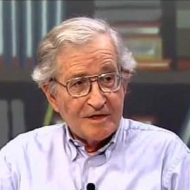
Noam Chomsky
· UndefinedMassachusetts Institute of Technology
Research topics
- Artificial Intelligence
- Computer Science
- Philosophy
- Linguistics
- Sociology
- Economics
- Information Retrieval
- Political Science
- Business
- Environmental ethics
- Economic system
- Cognitive science
- History
- Psychology
- Political economy
- Economy
- Law
Selected publications
Merge and the Strong Minimalist Thesis
2023 · 70 citations
1st authorCorresponding- Computer Science
- Artificial Intelligence
- Computer Science
The goal of this contribution to the Elements series is to closely examine Merge, its form, its function, and its central role in current linguistic theory. It explores what it does (and does not do), why it has the form it has, and its development over time. The basic idea behind Merge is quite simple. However, Merge interacts, in intricate ways, with other components including the language's interfaces, laws of nature, and certain language-specific conditions. Because of this, and because of its fundamental place in the human faculty of language, this Element's focus on Merge provides insights into the goals and development of generative grammar more generally, and its prospects for the future.
Oxford University Press eBooks · 2020 · 103 citations
1st authorCorresponding- Computer Science
- Linguistics
- Artificial Intelligence
In his introductory comments to this volume, Chomsky reviews the historical background surrounding the emergence of <italic>Remarks on Nominalization</italic>, the restrictive view of the syntax which it promoted, and, in that context, the need to separate syntactically predictable constructions, such as gerunds from less predictable formations, and specifically derived nominals, as described in Lees’ (1960) seminal study. It is also in that context that Chomsky reviews the emergence of the X’-scheme, offering, in particular, a contemporary perspective on its merits and drawbacks. <82>
Routledge eBooks · 2020 · 80 citations
1st authorCorresponding- Economics
- Business
The doctrinal system is also known as the "Washington consensus", which suggests something about global order. Prominent economists warned over twenty years ago that the process would lead to a low-growth, low-wage economy, and suggested fairly simple measures that might prevent these consequences. But the principal architects of the Washington consensus preferred the predictable effects, including very high profits. Changes in global order have also made it possible to apply a version of the Washington consensus at home. Profits remain "spectacular" through the mid-1996 figures, with "remarkable" profit growth for the world's largest corporations, though there is "one area where global companies are not expanding much: payrolls", the leading business monthly adds quietly. There is a great deal that is new and significant, but the belief that things are “out of control” is not very credible, even if the people keep to existing mechanisms.
Climate Crisis and the Global Green New Deal: The Political Economy of Saving the Planet
2020 · 98 citations
1st authorCorresponding- Political Science
- Sociology
- Political economy
Can capitalism survive climate change? Can humanity? The environmental crisis under way is unique in human history. It is a true existential crisis. Those alive today will decide the fate of humanity. Meanwhile, the leaders of the most powerful state in human history are dedicating themselves with passion to destroying the prospects for organized human life. At the same time, there is a solution at hand, which is the Green New Deal. Putting meat on the bones of the Green New Deal starts with a single simple idea: we have to absolutely stop burning fossil fuels to produce energy within the next 30 years at most; and we have to do this in a way that also supports rising living standards and expanding opportunities for working people and the poor throughout the world. This version of a Green New Deal program is, in fact, entirely realistic in terms of its purely economic and technical features. The real question is whether it is politically feasible. Chomsky and Pollin examine how we can build the political force to make a global Green New Deal a reality.
- Resume-aware match score
- Save to shortlist
- AI-drafted outreach
See your match with Noam Chomsky
PhdFit ranks faculty by your research interests, methods, and publications — grounded in their actual work, not templates.
- Free to start
- No credit card
- 30-second signup