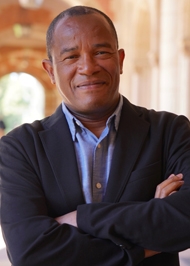
Aomar Boum
· Professor, Maurice Amado Endowed Chair in Sephardic StudiesUniversity of California, Los Angeles · Anatomy and Cell Biology
Active 2001–2025
About
Aomar Boum is a socio-cultural anthropologist with a historical focus, concerned with the social and cultural representation of and political discourse about religious and ethnic minorities in the Middle East and North Africa. His ethnographic work engages the place of religious and ethnic minorities such as Jews, Baha’is, Shias, and Christians in post-independence Middle Eastern and North African states. His multidisciplinary background and academic experience intersect Middle Eastern and North African studies, Islamic studies, Religious studies, African studies, and Jewish studies. Much of his work has concentrated on the anthropology and history of Jewish-Muslim relations from the 19th century to the present, and he has written on topics including Moroccan Jewish historiography, Islamic archives and manuscripts, education, music, youth, Holocaust, anti-Semitism, migration, and sports. He holds the Maurice Amado Endowed Chair in Sephardic Studies at UCLA and has contributed extensively to the understanding of ethnic and religious minorities, Islam, and the history and sociology of Morocco and North Africa.
Research topics
- Political Science
- Sociology
- History
- Social Science
- Law
- Archaeology
- Political economy
- Media studies
- Ancient history
- Geography
- Demography
- Gender studies
Selected publications
From Ominous to Miracle Poems:
2025-11-01
book-chapter1st authorCorrespondingEssaouira’s Atlantic Gateway Transcultural Legacy and King Mohammed VI’s Atlantic Shift
Afrique en mouvement · 2025-01-31
article1st authorCorrespondingInternational Journal Middle East Studies · 2024-02-01
article1st authorCorrespondingAn abstract is not available for this content so a preview has been provided. Please use the Get access link above for information on how to access this content.
L’Afrique du Nord pendant la Seconde Guerre mondiale : une mémoire douloureuse parfois méconnue
2023-01-08
articleSenior authorHistory of the Present · 2023-04-01
article1st authorCorrespondingAfter a year and a half in pandemic exile in Los Angeles, I made it home to a village at the foot of the Bani Mountains, my bled, Lamhamid (fig. 1). Bled connotes a rural expanse, kinship, ancestors, and ways of being. It is the local and the familiar. I was not the only native returnee in the village that summer of 2021. Everywhere I turned I met migrants who had traveled back to the bled. This was unusual for the many villagers who live and work in Morocco’s economic capital, Casablanca, as well as other urban centers in the country and beyond (Adam).Indeed, summers were usually lucrative for migrant villagers, typically enmeshed in urban service economies. Hamid from the province of Tata was one such example. For three decades, Hamid resided in Casablanca, laboring as a personal wash-servant in a public bath in an affluent neighborhood. His tips alone supported the members of his extended clan. This was all to change rapidly in that momentous March of 2020. The state rapidly closed public baths, cafés, and mosques. It shut down its national border. The flow of tourists dropped. The state and its security services implemented a national lockdown. Hamid and thousands like him were in perpetual and intensified precarity. Days of waiting turned into weeks and months. Hamid returned to his village to sustain himself. Others, forced to remain in city centers, relied on their kin in villages for sustenance, both food and cash. A dramatic reversal unfolded as the village became a social refuge and an economic sanctuary from the urban precarities of the pandemic.Amid heightened precarity and uncertainty, experiences of place, communal lifeworlds, and kinship expanded and retracted. Migration took on an ever-elastic character, bending, stretching, retracting, altered by force (Beggs). The social and economic pressures compelling migrants to make arduous and dangerous relocations must be strong; the stronger the forces, the more dramatic the displacement. But when those forces shift, a different sort of return becomes possible.These returns to the village, the bled, shed light on the connections between space, place, and pandemic, but perhaps most crucially, they reveal rural resilience as brittle and fragile, susceptible to shadows of economic development and globalization that managed to tie the once independent village to the capitalist international development project. Shifting dynamics of precarity and resilience between urban centers and rural locales are at the center of the way many countries throughout the world, including the United States, have experienced the pandemic. Though a different population, we should think about the wealthy elite of New York City fleeing Manhattan for rural Montana, Wyoming, and upstate New York. The countryside gains new meanings as social relations in the city contract and feelings of compassion and empathy are replaced by fear and solitude. Villages are “rediscovered” as sources of food and resources as well as a refuge from the raging pandemic. This situation is further complicated by the degree and scale of state intervention and police surveillance.In Morocco, the security apparatus is omnipresent. Checkpoints are scattered throughout the country, even in the remotest areas. Driving without a mask in a car or walking with a mask sliding off your nose incurs a considerable fine. Mobility is restricted. During the pandemic, the Moroccan security apparatus has adhered to the logic that strict confinement could stave off both the virus and the social strife that might result from its economic consequences. But life in villages has differed. While villages certainly have been subject to some measure of control, people have enjoyed more mobility and social life than in urban centers. This difference harkens to an older segmentation when villages enjoyed more freedom from the security grip of an expanding state apparatus. In 2020, officials deemed farming an essential activity. Villagers left their homes and tended their crops while urbanites remained confined inside. The village, long imagined as a place constraining movement and sociability, becomes a site of freedom from bureaucracy and surveillance.Despite the state-initiated COVID-19 fund that drew on contributions from all social classes to support the most vulnerable, for the millions whose livelihoods depended on daily labor, government support would be short-lived. Like Hamid, they turned to their family networks to survive the crisis. Casablanca, an aspirational address for village migration from southeast Morocco since the 1950s, best illustrated these shifts. In the wake of the pandemic, Casablanca was not desirable. It became a source of vulnerability. The threat of catching the virus was matched only by fear of losing basic needs. Hunger became a daily struggle as unemployed women and men found themselves with no food and no funds to support themselves and their families. Unable to pay rent, many lost their homes. They returned to their villages and to the livelihoods they had long abandoned: farming and construction.Southeastern Moroccan villagers have, for decades, migrated to urban centers in Morocco and beyond in search of a better life. My bled, Lamhamid, benefited from the recruitment of workers campaign led by Félix Mora to supply labor for coal mining companies in northern France in the 1960s and early 1970s (El Baz 35). Following intermittent periods of drought and famine, villagers sought work in what they called the West (al-gharb), meaning the city. And yet migration to and dependency on the northwest never severed the social ties with the bled. Migrants returned seasonally, supporting the family, clan, and village. After more than twenty years, I had not escaped these cycles of departure and return to home and family.This seasonal return left imprints of passion and longing. Migrants brought cash to support farming and other activities in the village. They paid for gas to run water pumps or to dig new wells. Villagers began retreating from communal systems of water management; a drive for private property and market-based farming eroded the commons. Communal systems of resource management dried up. Indeed, migration and its remittances at once watered and parched the southeast. The cultivation of watermelon in the past decade is a case in point. Villagers had for decades cultivated henna as a cash crop. Given the laborious process of raising this plant and its meager profits, villagers sought a faster way to make money. The introduction of the watermelon seemed to be the perfect opportunity. It would soon turn into a curse. Coupled with a drought, this cultivation dried up the underground water, turning oases throughout the south into lifeless spaces dotted with dead palm trees. Roots of palm trees dried up. Villagers driven by profit realized only too late that they had exchanged their water, now inside the fruit, for just a few dollars from the European and Moroccan city dwellers who bought their sweet watermelon.On my return to Lamhamid, Hamid lamented the money he had spent on wells and water-pumping machines. The sight of a past grove, now a burial ground of palm trees, pained him. He had built a house overlooking the palm grove and dreamed of returning in his old age to enjoy its sights. But the village had changed since he built that house three decades ago. A proliferation of expanded roads altered the landscape. Phones, televisions, and the Internet eased and accelerated access to news and information. Reliance of farmers on donkeys and mules has been superseded by the introduction of Chinese cargo tricycles in the second decade of the twenty-first century. Yet like so many places all over the world, Lamhamid reveals the power, the potential, and the limits of modernization and mechanization, and its attendant social, political, and environmental crises. The motorcycle, the pesticide, the water pump, and now the pandemic are all physical forces of pressure that produce an elastic migration.This elasticity carries the seeds of new life, a new state of being. It is not a pendulum that swings from a fixed point under gravity. Elasticity is produced through extreme pressure. A global reexamination of the rural as a salutary space cannot reify village life as idyllic. In fact, as the conjuncture persists, social, political, and economic precarity stretch, threatening the social cohesion of the village, especially as old and new social tensions between families resurface. The old system of Jama‘a (tribal council) has faded and is today replaced by the growing power of political parties. Recent local elections held in September 2021 provided a glimpse of what elastic migration can produce as families and clans were divided and broken. The bled itself then takes shape as an elastic space of contracting social bonds just as much as a place of refuge.I am grateful to Sherene Seikaly and Anjali Arondekar for their constructive comments. I also acknowledge Norma Mendoza-Denton and Brahim El Guabli for reading early versions of this essay.
États-nations contre minorités
En toutes lettres eBooks · 2023-04-14
book-chapter1st authorCorrespondingThe Journal of North African Studies · 2023-08-31
article1st authorCorrespondingTrails of Posters: French Colonial Moroccan Tourism Redux
The Jewish Quarterly Review · 2023-01-01
article1st authorCorrespondingStanford University Press eBooks · 2022-11-24 · 3 citations
book1st authorCorrespondingIn this gripping graphic novel, a Jewish journalist encounters an extension of the horrors of the Holocaust in North Africa. In the lead-up to World War II, the rising tide of fascism and antisemitism in Europe foreshadowed Hitler's genocidal campaign against Jews. But the horrors of the Holocaust were not limited to the concentration camps of Europe: antisemitic terror spread through Vichy French imperial channels to France's colonies in North Africa, where in the forced labor camps of Algeria and Morocco, Jews and other "undesirables" faced brutal conditions and struggled to survive in an unforgiving landscape quite unlike Europe. In this richly historical graphic novel, historian Aomar Boum and illustrator Nadjib Berber take us inside this lesser-known side of the traumas wrought by the Holocaust by following one man's journey as a Holocaust refugee. Hans Frank is a Jewish political journalist covering politics in Berlin, who grows increasingly uneasy as he witnesses the Nazi Party consolidate power and decides to flee Germany. Through connections with a transnational network of activists organizing against fascism and anti-Semitism, Hans ultimately lands in French Algeria, where days after his arrival, the Vichy regime designates all foreign Jews as "undesirables" and calls for their internment. On his way to Morocco, he is detained by Vichy authorities and interned first at Le Vernet, then later transported to different camps in the deserts of Morocco and Algeria. With memories of his former life as a political journalist receding like a dream, Hans spends the next year and a half in forced labor camps, hearing the stories of others whose lives have been upended by violence and war. Through bold, historically inflected illustrations that convey the tension of the coming war and the grimness of the Vichy camps, Aomar Boum and Nadjib Berber capture the experiences of thousands of refugees through the fictional Hans, chronicling how the traumas of the Holocaust extended far beyond the borders of Europe.
North Africans’ experiences of World War II often go unheard
2022-11-15
articleSenior author
Frequent coauthors
- 24 shared
Arthur Goldschmidt
- 3 shared
Nouri Gana
- 3 shared
Francesco Cavatorta
Université Laval
- 3 shared
Fabio Merone
Université Laval
- 3 shared
Alice Wilson
- 3 shared
Ricardo René Larémont
Binghamton University
- 3 shared
Osama Abi-Mershed
- 3 shared
Paul A. Silverstein
Reed College
- Resume-aware match score
- Save to shortlist
- AI-drafted outreach
See your match with Aomar Boum
PhdFit ranks faculty by your research interests, methods, and publications — grounded in their actual work, not templates.
- Free to start
- No credit card
- 30-second signup