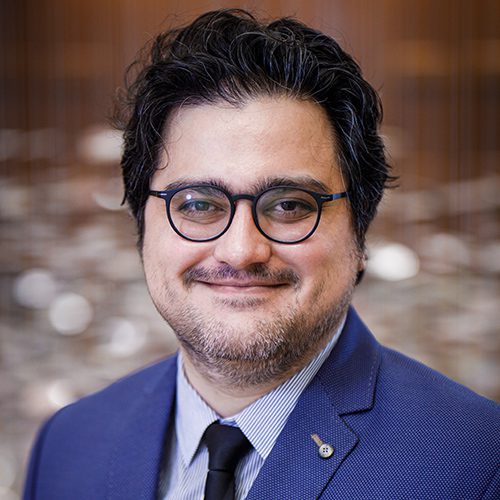
About
Ali Kakhbod is an assistant professor in the Finance Group at the Haas School of Business, UC Berkeley. He has a diverse academic background with two PhDs: one in Economics from the Massachusetts Institute of Technology (MIT) and another in Electrical Engineering and Computer Science (EECS) from the University of Michigan. His research interests are at the intersection of financial economics, machine learning, information frictions, and big data, focusing on how these areas influence financial decision-making and markets. Since joining Haas in 2022, he has contributed to the academic community through teaching and research, including courses on deep learning for finance. His work is recognized through various awards and fellowships, such as the Neekeyfar Fund Award at MIT, the Springer Outstanding PhD Thesis award, and the Richard and Eleanor Towner Prize for Distinguished Academic Achievement.
Research signals
Five dimensions sourced from public faculty / publication signals. Sign in to compare against your own profile and see your match score.
Research topics
- Business
- Computer Science
- Finance
- Political Science
- Financial system
- Nuclear engineering
- Environmental economics
- Public relations
- Economics
- Accounting
- Marketing
- Engineering
- Internal medicine
- Virology
- Market economy
- Natural resource economics
- Microeconomics
- World Wide Web
- Industrial organization
- Ecology
- Medicine
Selected publications
Life after Default: Dealer Intermediation and Recovery in Defaulted Corporate Bonds
SSRN Electronic Journal · 2023 · 5 citations
- Business
- Financial system
- Finance
Advising the Management: A Theory of Shareholder Engagement
Review of Financial Studies · 2022 · 43 citations
1st authorCorresponding- Political Science
- Computer Science
- Business
Abstract We study the effectiveness of shareholder engagement, that is, shareholders communicating their views to management. When shareholders and management have different beliefs, each shareholder engages more effectively when other shareholders engage as well. A limited shareholder base can thus prevent effective engagement. However, a limited shareholder base naturally arises under heterogeneous beliefs because investors who most disagree with management do not become shareholders. Passive funds, which own the firm regardless of their beliefs, can counteract these effects and improve engagement. When shareholders’ and management’s preferences are strongly misaligned, shareholders’ engagement decisions become substitutes and the role of ownership structure declines. Authors have furnished an Internet Appendix, which is available on the Oxford University Press Web site next to the link to the final published paper online.
The Energy Journal · 2020 · 7 citations
1st authorCorresponding- Computer Science
- Business
- Industrial organization
We investigate the strategic behavior of wind producers in the presence of uncertain wind resource availability, where wind availability is correlated across firms. We study how the level of correlation between different firms’ wind resources impacts strategy and market outcomes. The main insight of our analysis is that increasing heterogeneity in resource availability improves social welfare, as a function of its effects both on improving diversification and on reducing withholding by firms. We show that this insight is robust for common assumptions regarding electricity demand. The model is also used to analyze the effect of wind resource heterogeneity on firm profits and opportunities for collusion. Finally, we analyze the impacts of improving public information and weather forecasting; enhanced public forecasting increases welfare, but it is not always in the best interests of strategic producers.
Why did Firms Draw Down their Credit Lines during the COVID-19 Shutdown?
SSRN Electronic Journal · 2020 · 11 citations
Senior authorCorresponding- Business
- Financial system
- Virology
Frequent coauthors
- 26 shared
Demosthenis Teneketzis
- 16 shared
Hao Xing
Citadel
- 10 shared
Kerry Back
- 10 shared
Soheil Mohajer
University of Minnesota
- 8 shared
Joshua Bosshardt
- 8 shared
A. Max Reppen
Boston University
- 8 shared
Ali Jadbabaie
- 6 shared
Uliana Loginova
Awards & honors
- Neekeyfar Fund Award, MIT Office of the Dean for Graduate Ed…
- Hand Foundation MIT Doctoral Fellowship
- Richard and Eleanor Towner Prize for Distinguished Academic…
- Springer Outstanding PhD Thesis award (university wide)
- University of Michigan Doctoral Fellowship
Similar researchers at University of California, Berkeley
- Resume-aware match score
- Save to shortlist
- AI-drafted outreach
See your match with Ali Kakhbod
PhdFit ranks faculty by your research interests, methods, and publications — grounded in their actual work, not templates.
- Free to start
- No credit card
- 30-second signup