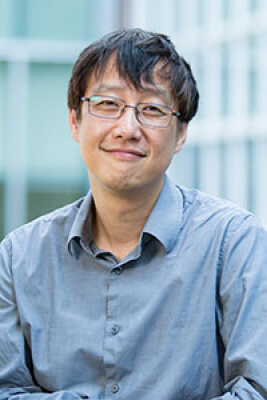
Philip Kim
· Philip KimHarvard University · Applied Physics
Active 1988–2024
About
Philip Kim is a Professor of Physics and of Applied Physics at Harvard University, affiliated with the Harvard John A. Paulson School of Engineering and Applied Sciences. His primary teaching areas include Applied Physics. His research areas encompass applied physics, materials, quantum engineering, surface and interface science, and related fields. Kim's work involves exploring superconducting electrons in twisted graphene, developing fabrication methods to facilitate materials discovery, and tuning electrochemical insertion processes for improved batteries. His contributions focus on advancing understanding in materials science, quantum engineering, and applied physics, with a particular emphasis on superconductivity and nanomaterials.
Research topics
- Materials science
- Condensed matter physics
- Quantum mechanics
- Physics
- Nanotechnology
- Chemistry
- Optoelectronics
- Electrical engineering
- Composite material
- Urology
- Geometry
- Chemical physics
- Optics
- Physical chemistry
- Medicine
- Surgery
- Organic chemistry
Selected publications
Bilayer Wigner crystals in a transition metal dichalcogenide heterostructure
Nature · 190 citations
- Condensed matter physics
- Materials science
- Physics
Abstract One of the first theoretically predicted manifestations of strong interactions in many-electron systems was the Wigner crystal1–3, in which electrons crystallize into a regular lattice. The crystal can melt via either thermal or quantum fluctuations4. Quantum melting of the Wigner crystal is predicted to produce exotic intermediate phases5, 6 and quantum magnetism7, 8 because of the intricate interplay of Coulomb interactions and kinetic energy. However, studying two-dimensional Wigner crystals in the quantum regime has often required a strong magnetic field9–11 or a moiré superlattice potential12–15, thus limiting access to the full phase diagram of the interacting electron liquid. Here we report the observation of bilayer Wigner crystals without magnetic fields or moiré potentials in an atomically thin transition metal dichalcogenide heterostructure, which consists of two MoSe2 monolayers separated by hexagonal boron nitride. We observe optical signatures of robust correlated insulating states at symmetric (1:1) and asymmetric (3:1, 4:1 and 7:1) electron doping of the two MoSe2 layers at cryogenic temperatures. We attribute these features to bilayer Wigner crystals composed of two interlocked commensurate triangular electron lattices, stabilized by inter-layer interaction16. The Wigner crystal phases are remarkably stable, and undergo quantum and thermal melting transitions at electron densities of up to 6 × 10¹² per square centimetre and at temperatures of up to about 40 kelvin. Our results demonstrate that an atomically thin heterostructure is a highly tunable platform for realizing many-body electronic states and probing their liquid–solid and magnetic quantum phase transitions4–8, 17.
A few-layer covalent network of fullerenes
Nature · 2023 · 261 citations
- Materials science
- Nanotechnology
- Chemistry
Journal of Obstetrics and Gynaecology · 2022 · 1 citations
1st authorCorresponding- Medicine
- Urology
- Surgery
Our data can be used by surgeons to counsel patients on the risks of re-operation for SUI for those who would like to undergo concurrent POP repair with or without hysterectomy.
Torsional periodic lattice distortions and diffraction of twisted 2D materials
Nature Communications · 2022 · 44 citations
- Physics
- Condensed matter physics
- Materials science
.
Physical Review Letters · 2020 · 149 citations
- Physics
- Materials science
- Condensed matter physics
The twist degree of freedom provides a powerful new tool for engineering the electrical and optical properties of van der Waals heterostructures. Here, we show that the twist angle can be used to control the spin-valley properties of transition metal dichalcogenide bilayers by changing the momentum alignment of the valleys in the two layers. Specifically, we observe that the interlayer excitons in twisted WSe_{2}/WSe_{2} bilayers exhibit a high (>60%) degree of circular polarization (DOCP) and long valley lifetimes (>40 ns) at zero electric and magnetic fields. The valley lifetime can be tuned by more than 3 orders of magnitude via electrostatic doping, enabling switching of the DOCP from ∼80% in the n-doped regime to <5% in the p-doped regime. These results open up new avenues for tunable chiral light-matter interactions, enabling novel device schemes that exploit the valley degree of freedom.
Tuning Electrical Conductance of MoS<sub>2</sub> Monolayers through Substitutional Doping
Nano Letters · 2020 · 178 citations
- Materials science
- Optoelectronics
- Nanotechnology
in the absence of electrostatic gating is reproducibly tuned over 7 orders of magnitude by controlling the Nb concentration. Our study further indicates that the dopant carriers do not fully ionize in the 2D limit, unlike in their three-dimensional analogues, which is explained by weaker charge screening and impurity band conduction. Moreover, we show that the dopants are stable, which enables the doped films to be processed as independent building blocks that can be used as electrodes for functional circuitry.
Recent grants
NSF · $240k · 2014–2017
NSF · $648k · 2018–2023
DMREF: Collaborative Research: The Search for Novel Superconductors in Moire Flat Bands
NSF · $875k · 2019–2023
NSF · $2.1M · 2015–2019
CAREER: Mesoscopic Thermal and Thermoelectric Transport in Low Dimensional Materials
NSF · $450k · 2004–2009
Frequent coauthors
- 225 shared
Patrick Y. Wen
- 202 shared
Kenji Watanabe
National Institute for Materials Science
- 199 shared
Takashi Taniguchi
- 175 shared
David A. Reardon
Dana-Farber Cancer Institute
- 175 shared
J. Raizer
Columbia University
- 173 shared
Brian Hu
Loma Linda University
- 156 shared
Meng Li
Peking University People's Hospital
- 125 shared
D. Schiff
University of Pittsburgh
Similar researchers at Harvard University
- Resume-aware match score
- Save to shortlist
- AI-drafted outreach
See your match with Philip Kim
PhdFit ranks faculty by your research interests, methods, and publications — grounded in their actual work, not templates.
- Free to start
- No credit card
- 30-second signup