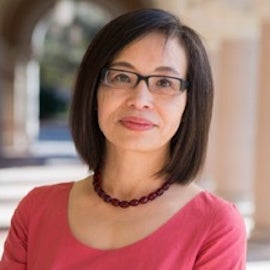
Sonia Ryang
· T.T. and W.F. Chao Professor of Asian StudiesVerifiedRice University · Transnational Asian Studies
Active 1990–2023
About
Sonia Ryang is the T.T. and W.F. Chao Professor of Asian Studies in the Department of Transnational Asian Studies at Rice University. She was born in Japan to Korean parents and grew up bilingual in Korean and Japanese. Ryang earned her Ph.D. in Social Anthropology from the University of Cambridge and has held academic positions at Johns Hopkins University and the University of Iowa, where she was the C. Maxwell and Elizabeth M. Stanley Family and Korea Foundation Chair of Korean Studies and Professor of Anthropology. In 2014, she joined Rice University as the Director of the Chao Center for Asian Studies before transitioning to her current department. Her research primarily focuses on Korea (North and South), Japan, and the Korean diaspora in Japan, exploring themes such as transnational migration, diaspora, totalitarianism, ideology, language, love, food, ethnographic writing, and horror. Her work examines the socio-historical functions and materiality of human-created ideas, rules, codes, and institutions, emphasizing the interplay of imagination, creativity, and error. Ryang's scholarship is interdisciplinary and cross-disciplinary, supported by major grants including from the National Science Foundation, and has resulted in notable publications such as 'Language and Truth in North Korea,' which received the 2023 Hong Yung Lee Book Award in Korean Studies. She has also recently completed a manuscript revisiting her original field site in Japan and is engaged in a multi-year project analyzing the agency of girls and young women in South Korea across four decades.
Research topics
- Sociology
- Political Science
- History
- Social Science
- Ethnology
- Gender studies
- Anthropology
- Law
- Development economics
- Geography
Selected publications
Japan, North Korea, and the Biopolitics of Repatriation
Japan focus · 2023-06-01
articleOpen access1st authorCorrespondingAbstract On December 14, 1959, amidst much fanfare and tears, the first repatriation boat (provided by the Soviet Union) carried thousands of Koreans from Niigata, Japan, to Cheongjin, North Korea. Hailed as a humanitarian project under the intermediation of the International Committee of the Red Cross, the repatriation of Koreans from Japan to North Korea continued until 1984, resulting in a total of more than 93,000 repatriates who relocated from Japan to North Korea amidst the Cold War division of the world with the majority never to return to Japan again. This article addresses multiple aspects of this project, looking into the media portrayal of North Korea at the time of the opening of the repatriation and the more recent academic discussion following the de-classification of the International Committee of the Red Cross papers. Based on these, the article frames the repatriation in a new light with the suggestion of possibly thinking about it as a form of human trafficking without reducing it into a one-dimensional political event or conspiracy by one government or another. Instead, the article emphasizes that the structure of power that sustained the repatriation was complex and so were the lives that repatriates experienced.
Language and Truth in North Korea
University of Hawaii Press eBooks · 2021-05-31 · 1 citations
bookOpen access1st authorCorresponding"In this innovative and persuasive volume, Sonia Ryang offers new ways to think about North Korea and how truth emerges over decades from within a dominant discourse. It explores four discrete yet mutually related domains of discourse: North Korea's literary purge of the 1950s-1960s; its state-initiated linguistic reforms of the 1960s-1980s; stories from a people's chronicle, more than one hundred volumes in length, documenting interactions with the Great Leader, Kim Il Sung; and the multivolume memoirs of the Great Leader himself, published in the 1990s. These texts are heterogeneous in terms of authorship, style, purpose, and genre, and many have never before been explored in Anglophone studies of North Korea. All have contributed to consolidating a North Korean regime of truth, bringing into existence a set of assumptions and shared understandings that have been regarded as true over the last half century. Basing her work on a study of these linguistic and discursive domains, Ryang explores the ways in which power, truth, and self are indissolubly connected by function as well as efficacy and how language plays a key role in sustaining their validity. The Kim Il Sung era, from 1945 to Kim's death in 1994, forms the basis of the book, but the way truth emerged and was sustained during these decades provides important insight into how we can comprehend North Korea today. Rather than view the country as an ideological entity in order to expose its falsehood, so to speak, thinking critically about what it sees as true yields a far more productive outcome for scholarly analysis as well as general understanding. Language and Truth in North Korea will find a ready audience among those interested in North Korea from a wide variety of disciplines, including the social sciences, history, philosophy, and theology"--
Afterword: Transnational Asian Studies—Toward More Inclusive Theory and Practice
The Journal of Asian Studies · 2021 · 2 citations
1st authorCorresponding- Political Science
- Sociology
- Social Science
Based on the articles in this “Global Asias” forum, this essay proposes that in order to build a meaningful bridge between Asian studies and Asian American studies, we must first face what needs to be critically overcome in Asian studies itself: persistent white male domination of the field, on the one hand, and historical role that the United States has played in Asia, on the other. One possibility is to adopt a transnational Asian studies approach, which advocates bringing Asian studies and Asian American studies together while also envisioning radical interdisciplinarity across Asian studies and African American studies, Latino/a studies, and Asian American studies. The key to pursuing such an approach would be to create a teaching and research environment of inclusion and collaboration.
Kimchi’s Transnational Journey
2021-01-01 · 1 citations
other1st authorCorrespondingAnthropology as Method: North Korea at a Distance
The journal of Korean studies · 2021 · 2 citations
1st authorCorresponding- Sociology
- Anthropology
- Sociology
Abstract North Korea is one of a very small number of countries in the world that an anthropologist has not set foot in with the purpose of conducting long-term ethnographic fieldwork. Given the country’s closed nature, anthropology seems to be the least qualified discipline with which to approach North Korea. Upon closer examination, however, this might not be the case; anthropology may offer unexpected advantages, not only permitting us to study North Korea but also to reflect on aspects of our own societies and cultures with a critical eye. This article explores both the challenges to be faced and the rewards to be gained by an anthropologist studying North Korea.
The Transnational (Re)Turn of Korean Studies
2020-09-16 · 1 citations
articleOpen access1st authorCorrespondingWhat new kinds of knowledge are we to envision when an academic trend or a body of scholarship is established with the purpose of studying the culture, history, traditions, and, above all, language, of another nation? Such knowledge would be obtained through the crossing of national boundaries, minimally involving actual physical travel on the part of the scholar, the translation and transmission of printed or electronic data, or combinations of both. Such knowledge would involve skepticism, as well as the recognition of national boundaries. Most importantly, it would call for attentiveness in relation to the uneven power relations between the nations involved. As such, in common with many other intellectual endeavors, one that involves the study of another nation cannot avoid a process of engaging in political reflection and consciousness that is transnationally traversed. It is with this realization in mind that I begin this short essay on rethinking Korean Studies in the US.
Toward a New Anthropology of Japan
2020-10-31
articleOpen access1st authorCorrespondingThe Anglophone anthropology of Japan started as part of the wartime enemy studies. As such, its primary reference frame has been and continues to be the national state; even when the regional or local communities are studied, national characteristics and national culture provided the cross-reference and comparative standard. Against this backdrop, this article argues that the national framework of the Japan anthropology can be useful in studying Japan as biopower and specifically, this article attempts to do so by focusing on the figure of the Korean in Japan in the last one hundred years.
2020-09-17 · 2 citations
articleOpen accessSenior authorTo return to the unified state, which is the original form of the Korean nation—this is the mantra that one hears from many South Korean commentators, professionals, and lay people alike. The return to one Korea, the original form, in this view, is a return also to the normal and true state that reflects the ontological identity of the Korean nation, or so the historical discourse goes. Koreans, as President Moon Jae In stated in front of the 150,000 citizens of Pyongyang on his historic visit to North Korea in June 2018, have lived together for five thousand years and have lived apart, in partition, for seventy years, the assertion being that it is wrong that one nation be divided into two separate states and that, hence, we are required to right this wrong. Emotions aside, the breadth of the range of discussions about the possibility of unification—or the lack thereof—currently evident in South Korea is truly remarkable. Public and academic discussions are filled with propositions concerning how to understand, approach, and attain national unification, reflecting the rapidly changing situation on the Korean peninsula that the world witnessed during 2018. Indeed, since the dawning of that year, the Korean peninsula has seen a series of unprecedented events, events that had been utterly unthinkable even as late as 2017. These have included, but are not limited to: the North’s positive response to the Pyeongchang Winter Olympic Games and the subsequent participation of a team representing the North, headed by dignitaries including Kim Jong Un’s sister Kim Yo-jeong; the historic North-South summit in Panmunjeom in April between Moon Jae-in and Kim Jong Un; the Singapore summit between US President Donald Trump and North Korean supreme leader Kim in June, and; the September visit of President Moon to Pyongyang, which included the unprecedented spectacle of a South Korean leader making a public speech to a jam-packed stadium. Along the way, there were many firsts: the first-ever visit by a sibling of a North Korean leader to the South; the first-ever simultaneous crossing of the DMZ by both leaders; the first-ever official visit by the current North Korean leader to South Korea, and; the first-ever meeting between a sitting US President and a North Korean head of state, etcetera. Behind lots of incredulous optics, the year 2018 demonstrated that that which had once been considered unmovable could in fact move, and that people who used to be enemies could become friends—or could they? This is the question in the minds of many in South Korea today. In this article, we firstly try to assess the current discussion surrounding unification—both in terms of the concept itself and the pragmatism involved in its realization—in South Korea. We then move on to comment on overseas Korean communities and their response to the changing situation on the Korean peninsula, with the focus on Koreans in the greater Houston area of Texas. In order to achieve a more effective comparison, we make brief reference to the situation of Koreans in Japan, as this offers a reference point that will help us to better evaluate the Houston case. Through such endeavors, the authors intend to engage with the issues arising in the historical moment created by the intersection of the continuing Cold War in East Asia, diaspora, nationalism, and globalization, and evaluate the current temperature—both emotional and political—surrounding the possibility (or the lack thereof) of the unification of Korea.
2020-09-16
articleOpen access1st authorCorrespondingHoegorok: Segiwa deobureo(With the Century: The Memoirs), an eight-volume set containing Kim Il Sung’s memoirs, was published in Pyongyang between 1992 and 1996. Given that Kim died in July 1994 upon completion of Volume 6, Volumes 7 and 8 were published posthumously, and were based on drafts and notes that Kim had left. An English translation of the complete set is available in PDF format on North Korea’s official state website ( http://www.korea-dpr.info/lib/202.pdf). The close correspondence between the timing of Kim’s death and the publication of his memoirs is strange, to say the least, as if Kim had anticipated his death and had begun writing them a few years prior to his passing. For, right before his death, Kim Il Sung had virtually re-written his history by way of his memoirs. What I mean is that there is an interesting twist associated with the publication of the memoirs, a twist that makes Kim Il Sung into something that was different from what he had been until 1994. By the time of his death, Kim had been elevated to the status of sacred national symbol. In dying, he acquired eternal life, having been immediately resurrected with the title of Eternal President, an office which no one, not even his son nor grandson, would assume thereafter. In something of a prosaic yet substantial counterbalance to all of this, the memoirs speak to Kim’s humanness – he depicts himself as a man, nothing more and nothing less. Reading Kim’s memoirs at this point in time, his son’s reign having come and gone and his grandson having now assumed power, gives us an interesting glimpse into how North Korea situates and envisions the position of leader vis-à-vis the people. In this article, I would like to explore an example of a shift in the position Kim Il Sung occupies in North Korea’s history (from human to deity) via a close reading of Kim’s memoirs. My strategy of doing so is two-fold: I shall try to approach memoirs with the intent of locating its authenticity on the one hand (section 1 below) and by situating myself as a “native reader” of Kim Il Sung’s words, on the other (section 2). These will be followed by the exploration of memoirs’ key points (section 3).
Introduction: Between the Nations: Diaspora and Koreans in Japan
2019-12-31 · 3 citations
book-chapter1st authorCorresponding
Recent grants
An Anthropological Exploration of Totalitarianism
NSF · $99k · 2014–2018
Frequent coauthors
- 10 shared
Gavan McCormack
- 3 shared
John Lie
- 2 shared
Wendy Smith
Australian Regenerative Medicine Institute
- 1 shared
Elizabeth Branigan
- 1 shared
Kathryn Robinson
Australian National University
- 1 shared
由美 山岡
- 1 shared
Govindan Parayil
- 1 shared
Warren Schmaus
Education
- 1993
Graduate student, Cultural Anthropology
University of Tokyo
Awards & honors
- 2023 Hong Yung Lee Book Award in Korean Studies
- Resume-aware match score
- Save to shortlist
- AI-drafted outreach
See your match with Sonia Ryang
PhdFit ranks faculty by your research interests, methods, and publications — grounded in their actual work, not templates.
- Free to start
- No credit card
- 30-second signup