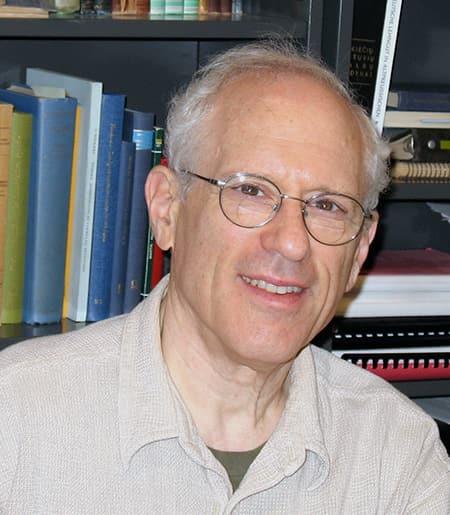
Alan Jeffrey Nussbaum
· ProfessorCornell University · Classics
Active 1909–2020
About
Alan Jeffrey Nussbaum is a professor in the Department of Classics at Cornell University, located in 120 Goldwin Smith Hall. His research has focused on two main areas: Indo-European linguistics and Greek and Latin comparative and historical linguistics. In Indo-European linguistics, he has concentrated on questions related to the inflectional and derivational morphology of nominal forms in the reconstructed protolanguage, working on the morphological and semantic reconstruction of characteristic denominative substantives and adjectives of Proto-Indo-European, such as collectives, 'decasuatives', and the 'Caland system.' His second area of research involves Greek and Latin phonology and morphology, with studies on Greek and Latin phonological and morphological issues, work on Italic dialects, and analysis of Homeric language from the perspective of Greek historical grammar, as well as phonological and morphological aspects of epic composition.
Research signals
Five dimensions sourced from public faculty / publication signals. Sign in to compare against your own profile and see your match score.
Research topics
- Computer Science
Selected publications
Cornell University Press eBooks · 2020
- Computer Science
- Computer Science
Scripta classica Israelica · 2020-03-31
articleOpen access1st authorCorrespondingArcadian (IG 5.2.3, 3) Plus/Miitus \evTovres (IG 5.2.16,10) with an Appendix on , and Proto-Greek *-ki-
Can You Speciate This for Me? A Micro-Comic Strip
Journal of Clinical Microbiology · 2019-06-24 · 1 citations
editorialOpen accessThe Homeric Formulary Template and a Linguistic Innovation in the Epics
2018-04-04 · 2 citations
book-chapter1st authorCorrespondingFeminine, Abstract, Collective, Neuter Plural: Some Remarks on each (Expanded Handout)
2014-01-01 · 40 citations
book-chapter1st authorCorrespondingFeminine, abstract, collective and neuter plural-the four categories of Indo-European (IE) nominal forms singled out explicitly or implicitly in the theme of the conference at which the discussion is presented. Instead, the basis for treating these four things as related is a morphological one, even if the morphological identity over the whole complex of forms now treated as relevant is itself the product of a certain amount of analysis and reconstruction of what is observable on the surface in the various IE languages. A noun classified structured or subdivided, however, does not merely designate something that has parts, but rather something that is made up of units considered to be identical to one another for the purpose of making up the whole thing in question, as illustrated momentarily. The term Collectives is reserved for items that are syntactic ± morphological singulars that make reference to a multiplicity. Keywords: collectives; feminine; Indo-European nominal forms; morphology; neuter plural
2013-01-01
article1st authorCorresponding2007-01-01 · 29 citations
book1st authorCorrespondingHomeric OPHAI (Od. 14.343) and OMEITAI (Il. 9.274): Two of a Kind?
Digital Commons - Colby (Colby College) · 2002-01-01
articleOpen access1st authorCorrespondingThe Greek presents (h)orao/e-, (h)ore-, and (hJoreo/e-"see"l 1.1 The familiar present stem (h)orao/e-"see" reflected in Attic opw, op~, opav, etc. is also found as such not only in relatively dissimilar dialects-Boe.OpaOVTI, (SGDI 860), Lac.0[1 (Alcm.1.40 PMG), Epidaurian pf.ptcpl.{J)paKVl,aV (IG IV 2 .1.122)-but is frequent in Ionic as well, where literary texts appear to provide such instances of this stem as: Archil.op~r; (176.1, 177.2), opa (105.1);Semon.op~(7.15,7.80), opwvTEr; (7.111); Theogn.op~(857+), opciJ7Jr; (93), opwv (747), OPWVT( 1059), E(JOpaV (858); CaHin.opw(J~v (1.20); Tyrt.opwv (12.11);Solon OpaTE (11.7), opw(J~(34.5),Hdl.-to cite a couple of cases without variant-op~(1.119.6), opw(J~(9.66.2), etc.In addition, it is this present stem that appears in Homer, in characteristically "distracted" form,2 of course, as opow (E244+), opaa.:(H448+), OPOCJ,?TE (~347), opaaa-8al, (71"107+), OPOWVTE~(P637), etc.1.It is assumed for the purposes of this discussion that the presents in question simply reflect a Proto-Greek *hor-that goes back in turn to an o-grade *sor-of the root *ser- (so Rix et al. [1998] 483f.).The form that makes difficulties for this reconstruction is the augmented Attic imperfect i.wpwv, which looks as if it ought to come from *~(h)yor-(type indic.i.clAwv < *~(h)yalvs.infin.flAwvaL < *(h)yal-in the aorist of Q.Ai(JKojJ.aL"be seized").But if Attic were to have redone the imperfect of opaw, it would not be a unique example of the extension of augmentation with ~from (h)y-initial roots to others.The ojg-of OLYW/ OLYVVJ.LL "open," which goes back to an *oyig-(cf.especially WiYVVVTO [B809+] < *{Jyig-etc.)beside *oyejg- (Lesb.infin.odYTJv [Schwyzer (1960) no.620.43])-and thus to *hJyejg-/*hJyig-or *o-yejg-/*o-yig-(with preverb *0-)-is another case of an effectively (h)V-initial root that has been given the kind of augmentation (impf.civiqJYov 0221+, aor.civiqJ~a K389+) that looks like it reflects *~yV-.In any event, nothing in the discussion that follows would be affected by a reconstruction of the root initial of opaw etc. as *(h)yor-rather than the *hor-being adopted here.2. See, e.g., Chantraine (1973) 75ff.
Two Studies in Greek and Homeric Linguistics
The Classical World · 2000-01-01 · 1 citations
articleSenior authorO eg regie grammatice: The vocative problems of latin words ending in-ius X
2000-01-01
article
Frequent coauthors
- 2 shared
G. M. Kirkwood
Cornell University
- 2 shared
Judith Ginsburg
Cornell University
- 2 shared
Jeffrey S. Rusten
- 2 shared
Pietro Pucci
Cornell University
- 2 shared
Danuta Shanzer
- 2 shared
Kevin Clinton
- 2 shared
Gordon M. Messing
Cornell University
- 2 shared
Frederick Ahl
Cornell University
- Resume-aware match score
- Save to shortlist
- AI-drafted outreach
See your match with Alan Jeffrey Nussbaum
PhdFit ranks faculty by your research interests, methods, and publications — grounded in their actual work, not templates.
- Free to start
- No credit card
- 30-second signup