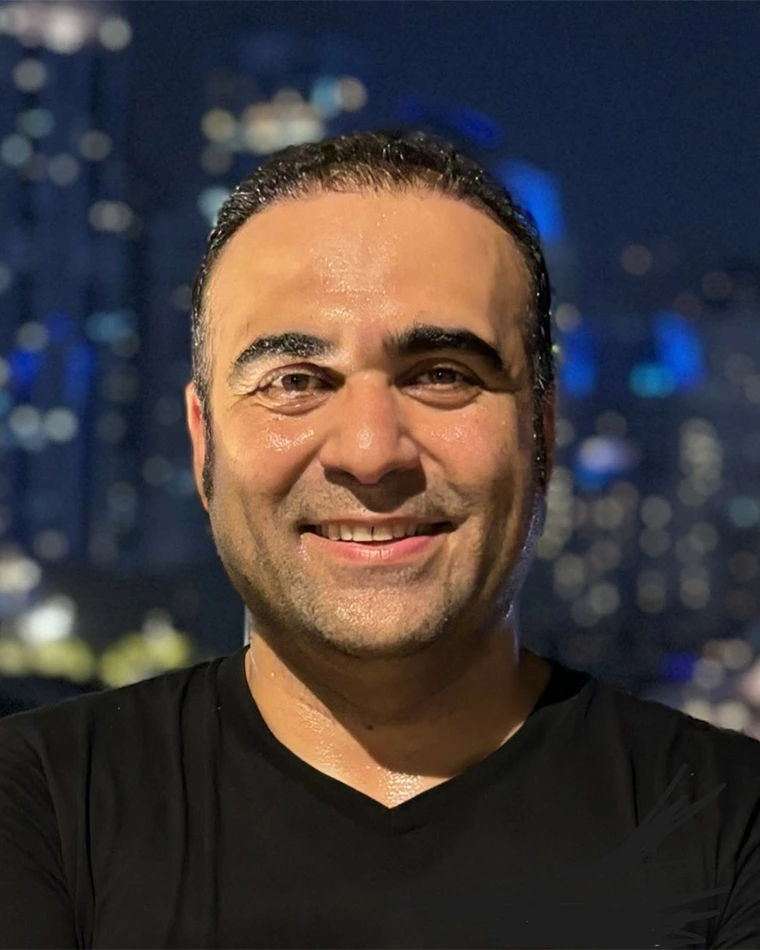
Hossein Rastgoftar
· Assistant Professor of Aerospace and Mechanical Engineering, Assistant Professor of Electrical and Computer EngineeringVerifiedUniversity of Arizona · Electrical & Computer Engineering
Active 2008–2026
About
Hossein Rastgoftar is an assistant professor in the Aerospace and Mechanical Engineering Department at the University of Arizona. He has previously served as an assistant professor of mechanical engineering at Villanova University and an adjunct assistant professor at the University of Michigan. His academic background includes a PhD in mechanical engineering from Drexel University, along with two MS degrees in mechanical systems and solid mechanics, and a BS degree in mechanical engineering-thermo-fluids. His research interests encompass decision-making under uncertainty, human-robotic interaction, swarm robotics, system autonomy, UAS traffic management, intelligent transportation, formal specification and verification, and finite-state abstraction of dynamical systems. Rastgoftar has contributed to the field through various publications and research projects focused on formation control of multi-agent systems, safe human-UAS collaboration, and collision-free continuum deformation coordination, among others.
Research topics
- Computer Science
- Mathematics
- Artificial Intelligence
- Statistical physics
- Geometry
- Engineering
- Arithmetic
- Physics
- Discrete mathematics
- Distributed computing
- Algorithm
- Pure mathematics
- Combinatorics
Selected publications
Online Reinforcement Learning for Safe Gain Scheduling in Nonlinear Quadrotor Control
arXiv (Cornell University) · 2026-04-18
preprintOpen accessSenior authorThis paper presents an online reinforcement-learning framework for safe gain scheduling of a nonlinear quadcopter controller. Rather than learning thrust and torque commands directly, the proposed method selects gain vectors online from a finite library of pre-certified stabilizing controllers, thereby preserving the structure of the underlying snap-based control law. Safety is enforced by restricting the policy to admissible gains that maintain forward invariance of a prescribed safe state set, while dwell-time constraints prevent excessively fast switching. To reduce the action-space dimension, translational gains are shared across spatial axes by exploiting the isotropic structure of the translational dynamics, whereas yaw gains are scheduled independently. A deep Q-network learns to adjust feedback authority according to the current flight condition, using aggressive gains during large transients and milder gains near hover. High-fidelity nonlinear simulations demonstrate accurate trajectory tracking, bounded attitude motion, reduced control effort near convergence, and stable hover regulation under online safe gain scheduling.
RACF: A Resilient Autonomous Car Framework with Object Distance Correction
arXiv (Cornell University) · 2026-04-14
preprintOpen accessAutonomous vehicles are increasingly deployed in safety-critical applications, where sensing failures or cyberphysical attacks can lead to unsafe operations resulting in human loss and/or severe physical damages. Reliable real-time perception is therefore critically important for their safe operations and acceptability. For example, vision-based distance estimation is vulnerable to environmental degradation and adversarial perturbations, and existing defenses are often reactive and too slow to promptly mitigate their impacts on safe operations. We present a Resilient Autonomous Car Framework (RACF) that incorporates an Object Distance Correction Algorithm (ODCA) to improve perception-layer robustness through redundancy and diversity across a depth camera, LiDAR, and physics-based kinematics. Within this framework, when obstacle distance estimation produced by depth camera is inconsistent, a cross-sensor gate activates the correction algorithm to fix the detected inconsistency. We have experiment with the proposed resilient car framework and evaluate its performance on a testbed implemented using the Quanser QCar 2 platform. The presented framework achieved up to 35% RMSE reduction under strong corruption and improves stop compliance and braking latency, while operating in real time. These results demonstrate a practical and lightweight approach to resilient perception for safety-critical autonomous driving
Learning over Forward-Invariant Policy Classes: Reinforcement Learning without Safety Concerns
arXiv (Cornell University) · 2026-04-09
preprintOpen accessSenior authorThis paper proposes a safe reinforcement learning (RL) framework based on forward-invariance-induced action-space design. The control problem is cast as a Markov decision process, but instead of relying on runtime shielding or penalty-based constraints, safety is embedded directly into the action representation. Specifically, we construct a finite admissible action set in which each discrete action corresponds to a stabilizing feedback law that preserves forward invariance of a prescribed safe state set. Consequently, the RL agent optimizes policies over a safe-by-construction policy class. We validate the framework on a quadcopter hover-regulation problem under disturbance. Simulation results show that the learned policy improves closed-loop performance and switching efficiency, while all evaluated policies remain safety-preserving. The proposed formulation decouples safety assurance from performance optimization and provides a promising foundation for safe learning in nonlinear systems.
Learning over Forward-Invariant Policy Classes: Reinforcement Learning without Safety Concerns
arXiv (Cornell University) · 2026-04-09
articleOpen accessSenior authorThis paper proposes a safe reinforcement learning (RL) framework based on forward-invariance-induced action-space design. The control problem is cast as a Markov decision process, but instead of relying on runtime shielding or penalty-based constraints, safety is embedded directly into the action representation. Specifically, we construct a finite admissible action set in which each discrete action corresponds to a stabilizing feedback law that preserves forward invariance of a prescribed safe state set. Consequently, the RL agent optimizes policies over a safe-by-construction policy class. We validate the framework on a quadcopter hover-regulation problem under disturbance. Simulation results show that the learned policy improves closed-loop performance and switching efficiency, while all evaluated policies remain safety-preserving. The proposed formulation decouples safety assurance from performance optimization and provides a promising foundation for safe learning in nonlinear systems.
Finite-State Decentralized Policy-Based Control With Guaranteed Ground Coverage
ArXiv.org · 2026-01-05
articleOpen access1st authorCorrespondingWe propose a finite-state, decentralized decision and control framework for multi-agent ground coverage. The approach decomposes the problem into two coupled components: (i) the structural design of a deep neural network (DNN) induced by the reference configuration of the agents, and (ii) policy-based decentralized coverage control. Agents are classified as anchors and followers, yielding a generic and scalable communication architecture in which each follower interacts with exactly three in-neighbors from the preceding layer, forming an enclosing triangular communication structure. The DNN training weights implicitly encode the spatial configuration of the agent team, thereby providing a geometric representation of the environmental target set. Within this architecture, we formulate a computationally efficient decentralized Markov decision process (MDP) whose components are time-invariant except for a time-varying cost function defined by the deviation from the centroid of the target set contained within each agent communication triangle. By introducing the concept of Anyway Output Controllability (AOC), we assume each agent is AOC and establish decentralized convergence to a desired configuration that optimally represents the environmental target.
Aerial-borne Data Management Center (ADMC)
Proceedings of the AAAI Symposium Series · 2026-05-18
articleOpen accessCrisis management (CM) for critical infrastructures, natural disasters such as wildfires and hurricanes, terrorist actions, or civil unrest requires high-speed communications and connectivity, and access to high-performance computational resources to deliver timely dynamic responses to the crisis being managed by different first responders.CMsystems should detect, recognize, and disseminate huge amounts of heterogeneous dynamic events that operate at different speeds and formats. Furthermore, the processing of crisis events and the development of real-time responses are major research challenges when the communications and computational resources needed by CM stakeholders are not available or severely degraded by the crisis. The main goal of the research presented in this paper is to utilize Unmanned Autonomous Systems (UAS) to provide an Aerial-borne Data Management Center (ADMC) that will provide the required communications services and the computational resources that are critically needed by first responders. In our approach to develop an ADMC architecture, we utilize a set of flexible Unmanned Aerial Systems (UAS) that can be dynamically composed to meet the communications and computational requirements of CM tasks. The ADMC services will be modeled as a deep neural network (DNN) mass transport approach to cover a distributed target in a decentralized manner. Furthermore, our analysis proves the stability and convergence of the proposed DNN-based mass transport for a team of UAS (e.g., quadcopters), where each quadcopter uses a feedback nonlinear control to independently attain the intended coverage trajectory in a decentralized manner.
Affine Transformable Unmanned Ground Vehicle
ArXiv.org · 2026-02-07
articleOpen accessSenior authorThis paper develops the proof of concept for a novel affine transformable unmanned ground vehicle (ATUGV) with the capability of safe and aggressive deformation while carrying multiple payloads. The ATUGV is a multi-body system with mobile robots that can be used to power the ATUGV morphable motion, powered cells to enclose the mobile robots, unpowered cells to contain payloads, and a deformable structure to integrate cells through bars and joints. The objective is that all powered and unpowered cells motion can safely track a desired affine transformation, where an affine transformation can be decomposed into translation, rigid body rotation, and deformation. To this end, the paper first uses a deep neural network to structure cell interconnection in such a way that every cell can freely move over the deformation plane, and the entire structure can reconfigurably deform to track a desired affine transformation. Then, the mobile robots, contained by the powered cells and stepper motors, regulating the connections of the powered and unpowered cells, design the proper controls so that all cells safely track the desired affine transformation. The functionality of the proposed ATUGV is validated through hardware experimentation and simulation.
RACF: A Resilient Autonomous Car Framework with Object Distance Correction
arXiv (Cornell University) · 2026-04-14
articleOpen accessAutonomous vehicles are increasingly deployed in safety-critical applications, where sensing failures or cyberphysical attacks can lead to unsafe operations resulting in human loss and/or severe physical damages. Reliable real-time perception is therefore critically important for their safe operations and acceptability. For example, vision-based distance estimation is vulnerable to environmental degradation and adversarial perturbations, and existing defenses are often reactive and too slow to promptly mitigate their impacts on safe operations. We present a Resilient Autonomous Car Framework (RACF) that incorporates an Object Distance Correction Algorithm (ODCA) to improve perception-layer robustness through redundancy and diversity across a depth camera, LiDAR, and physics-based kinematics. Within this framework, when obstacle distance estimation produced by depth camera is inconsistent, a cross-sensor gate activates the correction algorithm to fix the detected inconsistency. We have experiment with the proposed resilient car framework and evaluate its performance on a testbed implemented using the Quanser QCar 2 platform. The presented framework achieved up to 35% RMSE reduction under strong corruption and improves stop compliance and braking latency, while operating in real time. These results demonstrate a practical and lightweight approach to resilient perception for safety-critical autonomous driving
Affine Transformable Unmanned Ground Vehicle
Open MIND · 2026-02-07
preprintSenior authorThis paper develops the proof of concept for a novel affine transformable unmanned ground vehicle (ATUGV) with the capability of safe and aggressive deformation while carrying multiple payloads. The ATUGV is a multi-body system with mobile robots that can be used to power the ATUGV morphable motion, powered cells to enclose the mobile robots, unpowered cells to contain payloads, and a deformable structure to integrate cells through bars and joints. The objective is that all powered and unpowered cells motion can safely track a desired affine transformation, where an affine transformation can be decomposed into translation, rigid body rotation, and deformation. To this end, the paper first uses a deep neural network to structure cell interconnection in such a way that every cell can freely move over the deformation plane, and the entire structure can reconfigurably deform to track a desired affine transformation. Then, the mobile robots, contained by the powered cells and stepper motors, regulating the connections of the powered and unpowered cells, design the proper controls so that all cells safely track the desired affine transformation. The functionality of the proposed ATUGV is validated through hardware experimentation and simulation.
Online Reinforcement Learning for Safe Gain Scheduling in Nonlinear Quadrotor Control
ArXiv.org · 2026-04-18
articleOpen accessSenior authorThis paper presents an online reinforcement-learning framework for safe gain scheduling of a nonlinear quadcopter controller. Rather than learning thrust and torque commands directly, the proposed method selects gain vectors online from a finite library of pre-certified stabilizing controllers, thereby preserving the structure of the underlying snap-based control law. Safety is enforced by restricting the policy to admissible gains that maintain forward invariance of a prescribed safe state set, while dwell-time constraints prevent excessively fast switching. To reduce the action-space dimension, translational gains are shared across spatial axes by exploiting the isotropic structure of the translational dynamics, whereas yaw gains are scheduled independently. A deep Q-network learns to adjust feedback authority according to the current flight condition, using aggressive gains during large transients and milder gains near hover. High-fidelity nonlinear simulations demonstrate accurate trajectory tracking, bounded attitude motion, reduced control effort near convergence, and stable hover regulation under online safe gain scheduling.
Recent grants
A Continuum Deformation Approach to Unmanned Aircraft Traffic Management
NSF · $452k · 2020–2026
A Continuum Deformation Approach to Unmanned Aircraft Traffic Management
NSF · $500k · 2019–2021
Frequent coauthors
- 49 shared
Ella Atkins
University of Michigan–Ann Arbor
- 22 shared
Harshvardhan Uppaluru
University of Arizona
- 13 shared
Suhada Jayasuriya
- 11 shared
Mohammad Eghtesad
Shiraz University
- 10 shared
Hamid Emadi
Isfahan University of Technology
- 9 shared
Jean-Baptiste Jeannin
University of Michigan–Ann Arbor
- 8 shared
Alireza Khayatian
Shiraz University
- 8 shared
Ilya Kolmanovsky
University of Michigan–Ann Arbor
- Resume-aware match score
- Save to shortlist
- AI-drafted outreach
See your match with Hossein Rastgoftar
PhdFit ranks faculty by your research interests, methods, and publications — grounded in their actual work, not templates.
- Free to start
- No credit card
- 30-second signup