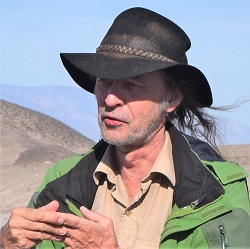
Roger Buick
· Professor, Earth & Space SciencesVerifiedUniversity of Washington · Earth and Space Sciences
Active 1972–2026
About
Professor Roger Buick is a faculty member in the Department of Earth & Space Sciences at the University of Washington, specializing in astrobiology with a focus on the origin and earliest evolution of life on Earth. His research techniques intersect geology, biology, and chemistry, examining the oldest and best-preserved rocks from various locations including the Australian outback, Greenland ice-cap, South African veld, and Canadian woods. His work aims to understand when the main forms of microbial metabolism first arose, how early atmospheric conditions were modulated, and how these factors influenced environmental change in Earth's history. Professor Buick's research encompasses multiple projects such as studying the early evolution of bacterial metabolism through paleontology and stable isotope geochemistry, investigating early atmospheric composition and pressure via mineral and sediment analysis, and analyzing secular trends in marine nutrient fluxes to understand ecosystem evolution. He also explores the early evolution of continental crust through geochemical analysis, and searches for molecular fossils in Precambrian rocks to uncover organic biomarkers that inform the phylogenetic history of microbial ecosystems. His contributions have advanced understanding of Earth's early atmosphere, biosphere, and tectonic development, providing insights into the conditions that fostered the emergence of life and its evolution over billions of years.
Research topics
- Earth science
- Geology
- Geochemistry
- Astrobiology
- Paleontology
- Meteorology
- Physics
- Atmospheric sciences
- Environmental science
- Environmental chemistry
- Chemistry
- Geography
Selected publications
Resurrected nitrogenases recapitulate canonical N-isotope biosignatures over two billion years
Nature Communications · 2026-01-22 · 1 citations
articleOpen accessNitrogen isotope fractionation (ε15N) in sedimentary rocks has provided evidence for biological nitrogen fixation, and thus primary productivity, on the early Earth. However, the extent to which molecular evolution has influenced the isotopic signatures of nitrogenase, the enzyme that catalyzes the conversion of atmospheric nitrogen (N₂) to bioavailable ammonia, remains unresolved. Here, we reconstruct and experimentally characterize a library of synthetic ancestral nitrogenase genes, spanning over 2 billion years of evolutionary history. We assess the resulting ε¹⁵N values under controlled laboratory conditions. All engineered strains exhibit ε15N values within a narrow range comparable to that of modern microbes, suggesting that molybdenum (Mo)-dependent nitrogenase has been largely invariant throughout evolutionary time since the origins of this pathway. The results of this study support the early origin of molybdenum nitrogenase and the resilience of nitrogen-isotope biosignatures in ancient rocks, while also demonstrating their potential as powerful tools in the search for life beyond Earth. The study shows that nitrogenase enzymes have maintained stable isotope signatures over billions of years, revealing how ancient microbes shaped Earth’s nitrogen cycle and offering a new experimental framework for probing early life.
Resurrected nitrogenases recapitulate canonical N-isotope biosignatures over two billion years
bioRxiv (Cold Spring Harbor Laboratory) · 2025-05-26
preprintOpen accessSUMMARY Nitrogen isotope fractionation (ε 15 N) in sedimentary rocks has provided evidence for biological nitrogen fixation, and thus primary productivity, on the early Earth. However, the extent to which molecular evolution has influenced the isotopic signatures of nitrogenase, the enzyme that catalyzes the conversion of atmospheric nitrogen (N 2 ) to bioavailable ammonia, remains unresolved. Here, we reconstruct and experimentally characterize a library of synthetic ancestral nitrogenase genes, spanning over 2 billion years of evolutionary history. By engineering modern microbes to express these ancient nitrogenases, we assess the resulting ε 15 N values under controlled laboratory conditions. All engineered strains exhibit ε 15 N values within a narrow range comparable to that of modern microbes, suggesting that molybdenum (Mo)-dependent nitrogenase has been largely invariant throughout evolutionary time since the origins of this pathway. These results confirm the robustness of N-isotope biosignatures in the ancient rock record and bolster their utility in the search for life in extraterrestrial environments.
Controls of Ancient Geochemical Records: Global Oceans Versus Local Water Masses
2025-01-01
articleMid-Devonian ocean oxygenation enabled the expansion of animals into deeper-water habitats
Proceedings of the National Academy of Sciences · 2025-08-25 · 4 citations
articleOpen accessSenior authorThe oxygenation history of Earth’s surface environments has had a profound influence on the ecology and evolution of metazoan life. It was traditionally thought that the Neoproterozoic Oxygenation Event enabled the origin of animals in marine environments, followed by their persistence in aerobic marine habitats ever since. However, recent studies of redox proxies (e.g., Fe, Mo, Ce, I) have suggested that low dissolved oxygen levels persisted in the deep ocean until the Late Devonian, when the first heavily wooded ligniophyte forests raised atmospheric O 2 to modern levels. Here, we present a Paleozoic redox proxy record based on selenium enrichments and isotope ratios in fine-grained siliciclastic sediments. Our data reveal transient oxygenation of bottom waters around the Ediacaran–Cambrian boundary, followed by predominantly anoxic deep-water conditions through the Early Devonian (419 to 393 Ma). In the Middle Devonian (393 to 382 Ma), our data document the onset of permanent deep-ocean oxygenation, coincident with the spread of woody biomass across terrestrial landscapes. This episode is concurrent with the ecological occupation and evolutionary radiation of large active invertebrate and vertebrate organisms in deeper oceanic infaunal and epifaunal habitats, suggesting that the burial of recalcitrant wood from the first forests sequestered organic carbon, increased deep marine oxygen levels, and was ultimately responsible for the “mid-Paleozoic marine revolution.”
Identification of micrometeorite candidates in altered 1.45 Ga Mesoproterozoic carbonates
2024-01-01
articleOpen accessNitrogen isotopes reveal independent origins of N2-fixing symbiosis in extant cycad lineages
Nature Ecology & Evolution · 2023-11-16 · 14 citations
articleOpen accessSenior authorScience Advances · 2023-04-07 · 23 citations
articleOpen accessMany lines of inorganic geochemical evidence suggest transient “whiffs” of environmental oxygenation before the Great Oxidation Event (GOE). Slotznick et al. assert that analyses of paleoredox proxies in the Mount McRae Shale, Western Australia, were misinterpreted and hence that environmental O 2 levels were persistently negligible before the GOE. We find these arguments logically flawed and factually incomplete.
2023-01-01
articleOpen accessA shale-hosted selenium isotope record of Paleozoic ocean oxygenation
Goldschmidt2022 abstracts · 2022-01-01
articleOpen accessSenior authorProceedings of the National Academy of Sciences · 2021 · 55 citations
Senior authorCorresponding- Geochemistry
- Geology
- Environmental chemistry
sinks, followed by enhanced nutrient supply to the ocean from weathering of volcanic rocks causing increased biological productivity.
Recent grants
COLLABORATIVE RESEARCH: Presaging Paleoproterozoic Global Change: Geobiology of the Late Archean Eon
NSF · $80k · 2004–2008
Selenium biogeochemistry as a deep-time redox proxy and biosignature
NSF · $300k · 2009–2014
Frequent coauthors
- 159 shared
Eva E. Stüeken
University of St Andrews
- 88 shared
Michael A. Kipp
- 81 shared
Ariel D. Anbar
University of Louisiana at Lafayette
- 73 shared
Alan J. Kaufman
- 69 shared
Timothy W. Lyons
- 68 shared
Jessica Garvin
- 68 shared
Gail Lee Arnold
The University of Texas at El Paso
- 65 shared
David C. Catling
Earth and Space Research
Labs
Education
- 2000
Ph.D., Astrobiology
University of Washington
- 1994
M.S., Astronomy
University of Washington
- 1991
B.A., Physics
University of California, San Diego
Awards & honors
- Fellow of the Geological Society of America (2019)
- Resume-aware match score
- Save to shortlist
- AI-drafted outreach
See your match with Roger Buick
PhdFit ranks faculty by your research interests, methods, and publications — grounded in their actual work, not templates.
- Free to start
- No credit card
- 30-second signup