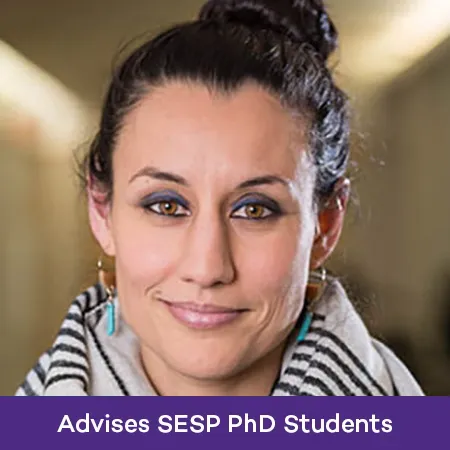
Shirin Vossoughi
· Associate Professor, Learning SciencesVerifiedNorthwestern University · Social Policy Analysis and Evaluation
Active 2009–2026
About
Shirin Vossoughi is an Associate Professor in the Learning Sciences at Northwestern University. As a learning scientist and ethnographer of education, her research is concerned with understanding the social, cultural, political, and ethical dimensions of human learning that contribute to projects of educational justice. She studies the forms of pedagogical mediation, thinking, relationality, and development that take shape within settings that cultivate transformative learning, particularly with migrant, immigrant, diasporic, and other non-dominant youth. Her work seeks to understand micro-interactional processes of human learning as tied to broader social change, and explores the potentials of learning environments as lived arguments for the possible. Her research employs conceptual, methodological, and artistic tools that treat educational inequity as a social and historical problem.
Research topics
- Computer Science
- Sociology
- Political Science
- Psychology
- Social Science
- Pedagogy
- Knowledge management
- Mathematics education
- Engineering
- Epistemology
- Engineering ethics
- Law
- Multimedia
- Medicine
- Neuroscience
- Medical education
- Management science
- Cognitive psychology
- History
- Public relations
- Cognitive science
- Social psychology
Selected publications
Science and Children · 2026-03-04
articleScience and Children · 2026-01-02 · 1 citations
articleA Letter from the Incoming Coeditors
Cognition and Instruction · 2025-08-28
letter1st authorLearning to Attune and Revise: A Response to Silvis, Clarke‐Midura, Lee, and Shumway
Science Education · 2025-09-16 · 1 citations
articleOpen access1st authorCorrespondingABSTRACT In this response to Silvis, Clarke‐Midura, Lee and Shumway as part of the special issue Centering Affect and Emotion Toward Justice and Dignity in Science Education, I discuss some of the key openings and complexities involved in interpreting the affective, powered, embodied, historical, and cultural layers present within the learning processes of young children in a computer science setting. I consider 1) methodology as a process of learning to see and revise our conceptions of embodied learning; 2) the importance of attuning to both power and agency in STEM learning settings; and 3) analytic openings that can draw together the historicized and relational details of learning. I highlight key strengths and contributions of the paper while wrestling with important field‐level challenges raised by the analysis of embodied learning among Theresa and her small group. These include the affordances and constraints of comfort as a construct, and the powered dimensions of intercorporeal dynamics among children. I reflect on the ways rendering the complexity of students’ ingenuity in navigating marginalization and finding comfort alongside attention to power is important both for developing multi‐dimensional views of embodied learning among children in STEM environments and for helping surface possibilities for intervention and change.
Research in the Teaching of English · 2025-11-01
article1st authorCorrespondingWorld‐Making Through a Feminist Abolitionist Lens in a <scp>STEAM</scp> Middle School Program
Reading Research Quarterly · 2024-04-03 · 1 citations
articleABSTRACT The maker movement propagated throughout educational spaces alongside promises that technological and design literacies could be harnessed to shape equitable social futures. However, researchers have highlighted the ways makerspaces can reinforce hierarchies of race, gender, and class. This paper builds on research that seeks to support girls' making through broader sociopolitical and ethical commitments. We consider what an everyday pedagogy of feminist abolition looked like in a makerspace, with a focus on how educators responded to emergent social needs within and across gender lines. Our data sources (extensive field notes, audio–video recordings, photographs, and student interviews) are drawn from Hubspace, a 6‐week summer program serving Black, Latine/x, and South Asian middle school youth and grounded in expansive forms of storytelling, coding, engineering, music, writing, and art. In closely analyzing routine forms of educator reflection alongside the design decisions, pedagogical moves and forms of student sense‐making they supported, we found that student and educator sociopolitical learning emerged together to build what became possible in the culture of the space over time. Across three cases, we show how such pedagogies offered lived models and creative languages for practicing restorative and just social relationships. Each of the cases tell the story of different moments when gender became important to the ways participants were working to recognize and desettle received terms of thought and generate alternate forms of thinking, living, and relating, or the making of new stories and worlds.
Learning for Every Body: Intersectional Dimensions of Embodied Learning
Proceedings. · 2024-06-10 · 2 citations
articleSenior authorDuke University Press eBooks · 2023
- Computer Science
- Computer Science
In the name of Allah, the Most Gracious, the Most Merciful.Poet and Zaytuna College gradu ate Rasheeda Plenty writes in her poem "Book" about the seeds of knowledge that are planted and cultivated within us, how we become "bewildered when a soft rain begins to fall inside of us . . .we stand gazing at our chests to see what will come from our bodies/this strange planting, here."As I write these acknowl edgments in the midst of a decades-long inquiry into questions of knowledge, I
Treading Lightly With Computing Education: Politicized Care as an Intervention of Black Life
Proceedings. · 2023-10-03 · 3 citations
articleOpen accessSenior authorThis paper arises out of a need to take seriously interventions on anti-Black racism in the computing education space.We extend the framework of Politicized Care to an out of school space to explore how Black femme mentors' pedagogy opens up alternative experiences of computing education.We offer another frame for computing teaching and learning that develops protection and care as a part of deep intellectual work.This necessitates our attention to relationships within moment to moment teaching and learning alongside youth.We offer a vignette from a summer STEAM program that highlight aspects of Politicized Care.This paper offers a domain specific example of politicized care that may inform future research design.
Proceedings. · 2023 · 1 citations
- Sociology
- Computer Science
- Political Science
The influence and reach of maker education continues to grow, bringing new possibilities for hands-on, student-centered, design-oriented, and/or transformational learning to more people in more spaces.Maker education has also more recently attended to issues of justice, equity, and culture.What does the future of maker education hold?What materials and practices will these spaces offer next?What support do teachers need to enact pedagogically sound and culturally relevant learning?How will developing technologies respond to teachers' and learners' needs for accessibility and sustainability?How will maker-based learning be documented and assessed?To answer these and other questions, we propose convening a panel on the Future of Maker Education to both solicit panelists' ideas on the future of maker education and foster audience discussion around these issues.
Recent grants
Frequent coauthors
- 9 shared
Megan Bang
Northwestern University
- 7 shared
Meg Escudé
University of California, Berkeley
- 5 shared
Kris D. Gutiérrez
- 5 shared
Paula Hooper
- 4 shared
Katherine C. Rodela
- 4 shared
Ananda Marin
- 4 shared
Natalie Davis
University of Michigan–Ann Arbor
- 4 shared
Angela Booker
University of California, San Diego
Education
- 1995
Ph.D., Education
University of California, Los Angeles
- 1991
M.A., Education
University of California, Los Angeles
- 1987
B.A., English
University of California, Los Angeles
- Resume-aware match score
- Save to shortlist
- AI-drafted outreach
See your match with Shirin Vossoughi
PhdFit ranks faculty by your research interests, methods, and publications — grounded in their actual work, not templates.
- Free to start
- No credit card
- 30-second signup