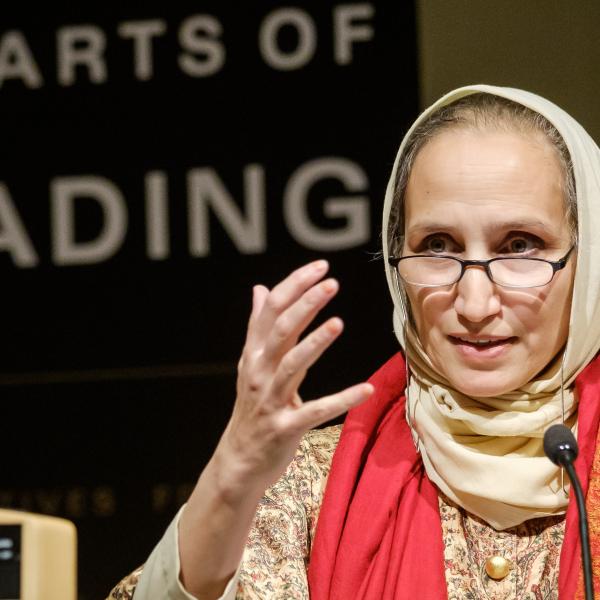
Tahera Qutbuddin
VerifiedUniversity of Chicago · Middle Eastern Studies
Active 2003–2024
About
Tahera Qutbuddin is a Professor Emerita of Arabic Literature who taught at the University of Chicago from 2002 to 2023. She holds a PhD from Harvard University, a Tamhidi Magister and BA from Ain Shams University in Cairo, and a high school diploma from Sophia College in Mumbai. Her research focuses on classical Arabic literature and Islamic studies, particularly on the intersections of the literary, religious, and political in poetry and prose. Her interests include classical Arabic poetry, orations, epistles, aphorisms, narrative, poetics, philology, and the sayings of Imam Ali ibn Abi Talib and Prophet Muhammad, as well as Fatimid and Tayyibi Bohra poetry, history, theology, and law. She has contributed to the understanding of literary features and symbolic exegesis of the Quran, classical Arabic women’s literature, and the history and functions of Arabic in India. Her notable publications include a critical edition and translation of Sharīf Raḍī’s Nahj al-Balāghah, and monographs such as Arabic Oration: Art and Function, which presents a comprehensive theory of Arabic oration, and Al-Muʾayyad al-Shīrāzī and Fatimid Daʿwa Poetry, analyzing a unique religio-political poetic tradition. She is currently working on a book analyzing Ali’s ethical preaching and religio-political biography, supported by a Guggenheim Fellowship. Throughout her career, she has taught a wide range of courses on Arabic literature, Islamic thought, and related topics, and has advised numerous PhD students on topics related to Islamic history, thought, and literature.
Research topics
- Computer science
- Art
- History
- Philosophy
- Literature
Selected publications
2024-04-09
book-chapterOpen access1st authorCorrespondingPeople!We live in a challenging age and a difficult time …".This is one of the many statements that still ring true, and it is not surprising that Nahj al-balāghah (The Way of Eloquence) has remained one of the most revered Arabic texts among both Sunni and Shiʾi Muslims.These speeches, letters, and sayings attributed to ʿAlī ibn Abī Ṭālib, cousin and son-in-law of the Prophet Muḥammad, one of the key figures in Islamic history and considered an outstanding orator, were compiled around ce 1000.This volume, with Tahera Qutbuddin's splendid scholarly edition and masterly translation, is a major achievement.
Appendix of Sources for the Texts of Nahj al-Balāghah
2024-04-09
book-chapterOpen access1st authorCorrespondingThis chronological list enumerates all primary medieval sources I was able to locate for each of the texts of Nahj al-Balāghah, before and after the time of Raḍī's compilation in 400/1010.The list not only provides evidence for the early spread of these texts, but it also offers a guide to a better understanding of their historical context.A large number of texts are found in the earliest extant works of the Arabic-Islamic corpus: books from the early 3rd/9th century by well-known authors, such as Minqarī (d.212/827), Abū ʿUbayd (d.224/838), Ibn Saʿd (d.230/845), Iskāfī (d.240/854), and Ibn Aʿtham (died early 3rd/9th c.), not to mention copious transcriptions by late 3rd/9thcentury and early 4th/10th-century historians such as Balādhurī (d.279/892), Yaʿqūbī (d.284/897), Ṭabarī (d.310/ 923), and Māmaṭīrī (d.ca.360/971).Several scholars have compiled print books and online websites that list sources of Nahj al-Balāghah texts, ʿAbd al-Zahrāʾ's 4-volume Maṣādir Nahj al-balāghah wa-asānīduhu being one of the most important.The present Appendix makes use of earlier inventories, but it also goes beyond them to catalog sources they do not mention-it is possibly the most complete list to date.1 My hope is that yet more sources will be tracked-and compared and analyzed-by future researchers. Logistics
Note on the Edition and Translation: Manuscripts and Methodology
2024-04-09
book-chapterOpen access1st authorCorrespondingThe manuscripts and methodology used to prepare the present volume are described in the following pages.My hope is to have produced a highly accurate critical edition and translation of Nahj al-Balāghah, based on the earliest and most important extant manuscripts, and on a carefully constructed stemma.
2024-04-09 · 1 citations
book-chapterOpen access1st authorCorrespondingJournal of Arabic Literature · 2024-10-16
articleOpen access1st authorCorrespondingAbstract Is oration literature? More specifically, can we read the multi-functional Arabic oration ( khuṭbah ) of the 1st/7th and 2nd/8th centuries as part of the classical prose canon? In this article, I argue that if our definition of literature includes beautiful language, admiration expressed by literary theorists, and masterful articulation of themes to evoke audience response, early Arabic oration is most certainly literature. I demonstrate this claim by analyzing the rhythmic and graphic oral aesthetics of early Arabic oration, the views of medieval theorists regarding its distinguished place and literary nature, and its crucial influence on the development of the chancery epistle ( risālah ), the first written genre of Arabic literary prose. I contend that khuṭbah is the foundational prose genre of Arabic and it has materially influenced the major genres of risālah and maqāmāt that followed. The history of Arabic literature cannot be written without oration.
2024-04-09
book-chapterOpen access1st authorCorresponding2024-04-09
book-chapterOpen access1st authorCorrespondingNahj al-Balāghah: The Wisdom and Eloquence of ʿAlī
2023-09-08
bookOpen accessSenior authorNahj al-Balāghah, the celebrated compendium of orations, letters, and sayings of ʿAlī ibn Abī Ṭālib (d. 40/661) compiled by al-Sharīf al-Raḍī (d. 406/1015), is a masterpiece of Arabic literature and Islamic wisdom studied and memorized avidly and continually for over a thousand years. Showcasing ʿAlī's life and travails in his own words, it also transcribes his profound reflections on piety and virtue, and on just and compassionate governance. Tahera Qutbuddin's meticulously researched critical edition based on the earliest 5th/11th-century manuscripts, with a lucid, annotated facing-page translation, brings to the modern reader the power and beauty of this influential text, and confirms the aptness of Raḍī's title, "The Way of Eloquence."
Medieval Sermon Studies · 2023-10-19 · 1 citations
articleOpen access1st authorCorrespondingThis article discusses classical Islamic oration’s power of persuasion through two lenses, one wide-angled, one focused. First, it introduces topographies of Arabic oration in its foundational oral period in early Islam, addressing notable aspects of its art, function, and provenance. Then, it pivots to speak of major life changes induced by particular orations, or sermon-induced ‘conversion’. Two early Islamic orations that induced such transformations are transcribed and briefly discussed: (1) the ‘sermon describing the truly pious’ by the successor of the Prophet according to the Shia and the fourth caliph according to the Sunnis, Imam Ali ibn Abi Talib (d. 661) in Kufa, Iraq, which is said to have caused his associate Hammam to give up his life spirit, and (2) the battlefield speech addressed to the surrounding Umayyad army by Ali’s son, the Shia Imam Husayn (d. 680), in Karbala, also in Iraq, which is reported to have won over the enemy sub-commander Hurr to Husayn’s side and prompted him to fight for Husayn unto death. Both are striking examples of the life-altering effects of intense and eloquent sermons, manifest here in the ultimate passage — an end to life in this world and entry into the hereafter.
New York University Press eBooks · 2023-03-16
book-chapterOpen access
Frequent coauthors
- 3166 shared
Shawkat M. Toorawa
- 3164 shared
Joseph Lowry
- 3164 shared
James E. Montgomery
Covenant Medical Center
- 3164 shared
Julia Bray
University of Cambridge
- 2952 shared
Sean W. Anthony
Yale University
- 2917 shared
Philip Kennedy
Neural Signals (United States)
- 2777 shared
Maurice Pomerantz
University of Cambridge
- 2689 shared
Devin J. Stewart
Emory University
Labs
Tahera QutbuddinPI
Awards & honors
- Sheikh Zayed Book Award
- Resume-aware match score
- Save to shortlist
- AI-drafted outreach
See your match with Tahera Qutbuddin
PhdFit ranks faculty by your research interests, methods, and publications — grounded in their actual work, not templates.
- Free to start
- No credit card
- 30-second signup