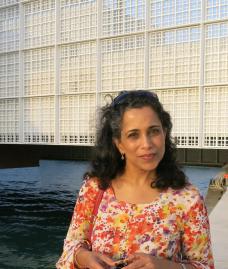
Kishwar Rizvi
· Robert Lehman Professor in the History of Art, Islamic Art and ArchitectureYale University · Art History
Active 2000–2023
About
Kishwar Rizvi is the Robert Lehman Professor in the History of Art, Islamic Art and Architecture at Yale University. She holds a B.A. from Wesleyan University, an M.Arch. from the Graduate School of Fine Arts at the University of Pennsylvania, and a Ph.D. from the Massachusetts Institute of Technology. Her research focuses on Islamic art and architecture, with particular interest in the history, religion, and architecture of Iran, the Middle East, and the broader Islamic world. Her fieldwork includes research in Turkey, Saudi Arabia, Iran, and the United Arab Emirates. Professor Rizvi's scholarly contributions include publications on topics such as the Safavid dynastic shrine, transnational mosque architecture, and modernism in Middle Eastern architecture. Her recent work explores contemporary museums in the Gulf and a new book on the Safavid ruler Shah Abbas and global early modernity. She teaches undergraduate courses on Islamic art and architecture, as well as seminars on art historical methods, representations of kingship, and art and politics in a transnational context. Her courses cover modern and contemporary architecture in the Middle East, the global Renaissance, Ottoman, Safavid, and Mughal art and architecture, Persianate painting and poetry, and illustrated travel literature from the medieval period to the present.
Research topics
- Sociology
- Computer Science
- Philosophy
- Art
- Epistemology
- Computer Security
- Aesthetics
- History
- Archaeology
- Business
- Gender studies
- Art history
- Literature
- Advertising
Selected publications
A Questionnaire on Diaspora and the Modern
October · 2023
- Sociology
- History
- Literature
Abstract The twentieth century was deeply grooved with the trodden pathways of mass migrations. These journeys were propelled by violence and historical cataclysm: pogroms and genocides; natural and unnatural famines and disasters; land dispossession, regimes of apartheid and forced labor; revolution, war, and occupation; colonization and decolonization; and the realignments that followed in their wake. The pioneering sociologist W. E. B. Du Bois may have been the first to herald the character of the new century: Already in 1903, in his treatise The Souls of Black Folk, he situated “the color line” as the defining “problem of the twentieth century” in relation to diaspora. Theorists and writers as diverse as Georg Simmel, Paul Gilroy, E?douard Glissant, Kobena Mercer, Tony Judt, Brent Hayes Edwards, Fred Moten, Krista Thompson, Huey Copeland, and Saidiya Hartman have offered frameworks for understanding diaspora as a cultural formation inextricable from modernity itself. As their work suggests, diasporic thinking puts pressure on the ways that we have understood—and often continue to understand—both modernism and the modern. It counters linear narratives of time, geography, and memory; identities defined by national boundaries; the absence of concerns about race and the complicity that modernisms have had with regimes of power; and a vision of the modern severed from heritage or tradition. Yet despite the diasporic displacements that define the modern period, modernist studies within art history have often favored bounded narrative formations still fundamentally shaped by ideas of the individual and the nation-state as well as taxonomic categorizations according to style, movement, medium, and period. In part, these narrative choices both produce and are symptomatic of a deeply siloed field, cleaved into regional micro-domains (Americanists, Mexicanists); medium specialists (photo people and print people); and the imagined ruptures between the mod- ern and the contemporary, the modern and the postmodern, and the Western and the non-Western. Departmental structures, journals, job markets, museums, and galleries are still siloed by race, siphoned into forms of intellectual segregation that are normalized to an extraordinary degree. Art history, in other words, is divided. Given this, what should we do with the modern? The questions are many: How does attention to diasporic thinking shift our understanding of the modern—or does such thinking invalidate its historical and epistemological claims? How do we create space for the unseen and unthought? How do we write history in a mode skeptical of grand narratives that takes account of darkness as well as light? Or, following Fred Moten's explorations regarding a Black avant-garde: How do notions of avant-gardism put pressure on the ways in which we continue to understand modernism? Does the term “modernism” itself have continued viability and usefulness? If so, to what degree is diaspora—the propulsive vectors and cultural effects of multiple mass migrations—integral to it? Or are modernism and the interests of diaspora antithetical frameworks for the history of art, given what the former has historically enabled and repressed? And, finally, what methodological approaches might reveal its structuring forces in our approach to the cultural objects of the modern period? (Leah Dickerman for the Editors.)
What Trump’s tweet threatening Iran’s cultural sites could mean for Shiite Muslims
2020-01-09
articleOpen access1st authorCorrespondingContingency and Architectural Speculation
Comparative Studies of South Asia Africa and the Middle East · 2020 · 11 citations
1st authorCorresponding- Sociology
- Computer Science
- History
Abstract The afterword to the special section “Architecture as a Form of Knowledge” considers the effect of transnational religious and commercial networks in transforming urban histories in Pakistan, with a focus on Karachi. The essay discusses the renovations of the shrine of Abdullah Shah Ghazi by the developer of the adjacent Bahria Icon Tower and the ways in which both structures evince the speculative and contingent nature of contemporary architecture in Karachi as well as the region as a whole.
2017-11-24
book-chapter1st authorCorresponding2017-06-20 · 2 citations
other1st authorCorrespondingIntroduction: Affect, Emotion, and Subjectivity in the Early Modern Period
2017-09-08 · 8 citations
book-chapter1st authorCorrespondingWhat’s missing in the teaching of Islam
2017-01-11
preprint1st authorCorresponding2017-11-13
book-chapter1st authorCorrespondingAffect, Emotion and Subjectivity in Early Modern Muslim Empires presents new approaches to Ottoman Safavid and Mughal art and culture. Taking artistic agency as a starting point, the authors consider the rise in status of architects, the self-fashioning of artists, the development of public spaces, as well as new literary genres that focus on the individual subject and his or her place in the world. They consider the issue of affect as performative and responsive to certain emotions and actions, thus allowing insights into the motivations behind the making and, in some cases, the destruction of works of art. The interconnected histories of Iran,Turkey and India thus highlight the urban and intellectual changes that defined the early modern period. Contributors are: Sussan Babaie, Chanchal Dadlani, Jamal Elias, Emine Fetvaci, Christiane Gruber, Sylvia Hougteling, Kishwar Rizvi, Sunil Sharma, and Marianna Shreve Simpson.
2017-11-13
paratext1st authorCorrespondingAffect, Emotion and Subjectivity in Early Modern Muslim Empires presents new approaches to Ottoman Safavid and Mughal art and culture. Taking artistic agency as a starting point, the authors consider the rise in status of architects, the self-fashioning of artists, the development of public spaces, as well as new literary genres that focus on the individual subject and his or her place in the world. They consider the issue of affect as performative and responsive to certain emotions and actions, thus allowing insights into the motivations behind the making and, in some cases, the destruction of works of art. The interconnected histories of Iran,Turkey and India thus highlight the urban and intellectual changes that defined the early modern period. Contributors are: Sussan Babaie, Chanchal Dadlani, Jamal Elias, Emine Fetvaci, Christiane Gruber, Sylvia Hougteling, Kishwar Rizvi, Sunil Sharma, and Marianna Shreve Simpson.
Review: Complexity and Contradiction in Architecture by Robert Venturi
Journal of the Society of Architectural Historians · 2016-12-01
article1st authorCorrespondingBook Review| December 01 2016 Review: Complexity and Contradiction in Architecture by Robert Venturi: History and Representation: Venturi's Engagement with Modern “Islamic” Architecture Kishwar Rizvi Kishwar Rizvi Yale University Search for other works by this author on: This Site PubMed Google Scholar Journal of the Society of Architectural Historians (2016) 75 (4): 494–497. https://doi.org/10.1525/jsah.2016.75.4.494 Views Icon Views Article contents Figures & tables Video Audio Supplementary Data Peer Review Share Icon Share Facebook Twitter LinkedIn MailTo Tools Icon Tools Get Permissions Cite Icon Cite Search Site Citation Kishwar Rizvi; Review: Complexity and Contradiction in Architecture by Robert Venturi: History and Representation: Venturi's Engagement with Modern “Islamic” Architecture. Journal of the Society of Architectural Historians 1 December 2016; 75 (4): 494–497. doi: https://doi.org/10.1525/jsah.2016.75.4.494 Download citation file: Ris (Zotero) Reference Manager EasyBib Bookends Mendeley Papers EndNote RefWorks BibTex toolbar search Search Dropdown Menu toolbar search search input Search input auto suggest filter your search All ContentJournal of the Society of Architectural Historians Search In Complexity and Contradiction Robert Venturi presents a critique of modernism, with its rigid systems and fetishization of the functional. Mining the past and utilizing examples as diverse as Borromini's churches and Frank Furness's houses, Venturi addresses the complexity of architectural form, made visible through unexpected juxtapositions and scalar manipulations. He considers intricate baroque ornament and heavy Egyptian columns alongside Le Corbusier's Villa Savoye to impress upon the reader that the study of architecture requires close analysis and historical breadth. The perspective is that of a designer, however, not a historian, a point Venturi makes clear from the outset. The book ends with twelve of the architect's own projects, seven of which were unrealized. The same black-and-white photography that caresses the façades of Roman churches documents Venturi's Guild House housing project for the elderly in Philadelphia. The implicit connection is that of form and memory, and a blending of everyday... You do not currently have access to this content.
Frequent coauthors
- 2 shared
Sandy Isenstadt
University of Delaware
- 1 shared
Chon A. Noriega
- 1 shared
Roberto Tejada
- 1 shared
N. S. Lobo
- 1 shared
Joseph M. Pierce
- 1 shared
David J. Roxburgh
- 1 shared
Simon Gikandi
- 1 shared
Saloni Mathur
Awards & honors
- Carnegie Foundation Scholar
- Resume-aware match score
- Save to shortlist
- AI-drafted outreach
See your match with Kishwar Rizvi
PhdFit ranks faculty by your research interests, methods, and publications — grounded in their actual work, not templates.
- Free to start
- No credit card
- 30-second signup