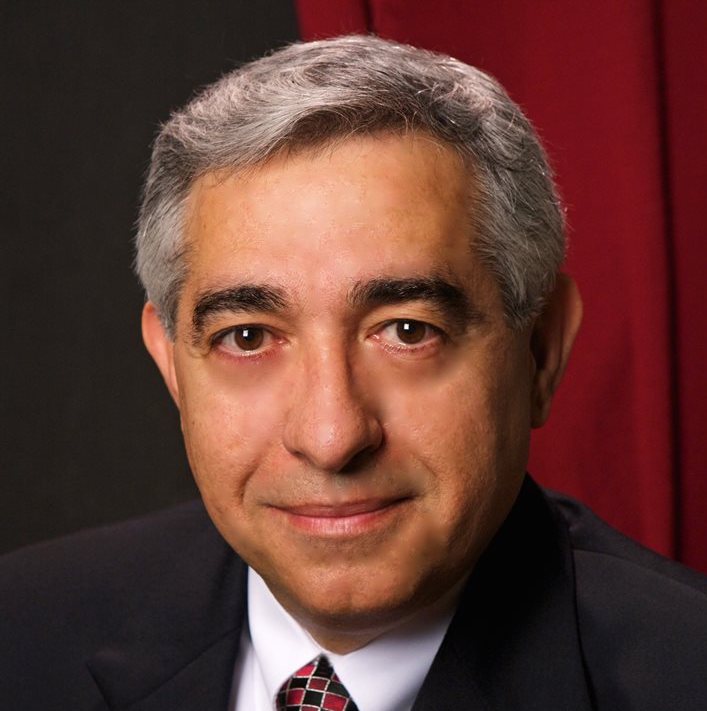
Demetrios Christodoulides
· Steven and Kathryn Sample Chair in Engineering, and Professor of Electrical and Computer Engineering and Physics and AstronomyVerifiedUniversity of Southern California · Ming Hsieh Department of Electrical and Computer Engineering
Active 1984–2026
About
Demetrios Christodoulides received his Ph.D. degree from Johns Hopkins University in 1986 and subsequently joined Bellcore as a post-doctoral fellow at Murray Hill. Between 1988 and 2002, he was with the faculty of the Department of Electrical Engineering at Lehigh University. In 2002, he joined the College of Optics and Photonics (CREOL) at the University of Central Florida (UCF), where he held the Cobb Family Endowed Chair and served as a Pegasus Professor of Optics. Since 2022, he has been a faculty member in the Department of Electrical and Computer Engineering at the University of Southern California (USC). Dr. Christodoulides’ research interests include linear and nonlinear optical beam interactions, synthetic optical materials, optical solitons, and quantum electronics. He has authored and co-authored more than 450 papers. He is a Fellow of the Optical Society of America and the American Physical Society. In 2011, he received the R.W. Wood Prize of OSA, and in 2018, the OSA Max Born Award. In 2023, he received the Arthur L. Schawlow Prize in Laser Science.
Research topics
- Physics
- Mathematics
- Quantum mechanics
- Optics
- Computer Science
- Theoretical physics
- Classical mechanics
- Computer Security
- Telecommunications
- Statistical physics
- Mathematical analysis
Selected publications
APL Photonics · 2026-02-01
articleOpen accessMethods for simultaneously controlling the spatial, spectral, and temporal properties of ultrashort pulses after propagation through a disordered multimode fiber are presented. By leveraging the dispersion and strong mode-mixing within a disordered fiber, multidimensional control over the output pulse is achieved by tailoring only the spatial wavefront of the input pulse. The ability to generate reconfigurable spatiotemporal foci at single or multiple points in space and time is demonstrated experimentally. The control is extended to the spectral domain, as demonstrated by the successful creation of spectrally-dependent foci, with different wavelength bands focused to distinct spatial locations and times. An approach for time-averaged wavefront shaping is also introduced and is shown to enable the creation of complex spatial intensity patterns with tailored properties.
Chern topological lasing via gain modulation
Physical review. B./Physical review. B · 2026-01-20
articleNature Communications · 2025-02-27 · 10 citations
articleOpen accessSpace-time wave packets (STWPs) with correlated spatial and frequency degrees of freedom exhibit time-dependent spatial interference, thereby giving rise to interesting dynamic evolution behaviors. While versatile spatiotemporal phenomena have been demonstrated in freely propagating fields, coupling spatiotemporal light into multimode fibers remains a fundamental experimental challenge. Whereas synthesizing freely propagating STWPs typically relies on a continuum of plane-wave modes, their multimode-fiber counterparts must be constructed from the discrete set of fiber modes whose propagation constants depend on fiber structures. Here, we demonstrate STWPs with axially controllable motion of the transverse profile and reconfigurable group velocity in graded-index multimode fibers. This is accomplished by introducing a linear association between frequency comb lines and corresponding fiber modes. The synthesized STWPs present dynamic rotation and translation with a 4.8-ps period. Simultaneously, the group velocity can be tuned from positive subluminal and superluminal to negative values (e.g., 0.870, 1.35, 10, and –3.3 × 10⁸ m/s, respectively). Su et al. demonstrate ultra-fast light pulses in multimode fiber with dynamically evolving spatial profiles and tunable group velocities ranging from subluminal to superluminal and negative values, achieved through correlated space-time wave packets.
Non-Hermitian Entanglement Filter
2025-01-01
articleWe experimentally demonstrate a fully integrated photonic entanglement filter based non-Hermitian anti-parity-time (APT) symmetry. Our filter exhibits near-unity fidelity and scalability across photon-number subspaces.
Universal routing of light via optical thermodynamics
Nature Photonics · 2025-09-25 · 1 citations
articleOpen accessObservation of Joule–Thomson photon-gas expansion
Nature Physics · 2025-01-14 · 8 citations
articleOpen accessSenior authorPhoton–photon chemical thermodynamics of frequency conversion processes in highly multimode systems
Light Science & Applications · 2025-05-12 · 2 citations
articleOpen accessSenior authorFrequency generation in highly multimode nonlinear optical systems is inherently a complex process, giving rise to an exceedingly convoluted landscape of evolution dynamics. While predicting and controlling the global conversion efficiencies in such nonlinear environments has long been considered impossible, here, we formally address this challenge even in scenarios involving a very large number of spatial modes. By utilizing fundamental notions from optical statistical mechanics, we develop a universal theoretical framework that effectively treats all frequency components as chemical reactants/products, capable of undergoing optical thermodynamic reactions facilitated by a variety of multi-wave mixing effects. These photon-photon reactions are governed by conservation laws that directly determine the optical temperatures and chemical potentials of the ensued chemical equilibria for each frequency species. In this context, we develop a comprehensive stoichiometric model and formally derive an expression that relates the chemical potentials to the optical stoichiometric coefficients, in a manner akin to atomic/molecular chemical reactions. This advancement unlocks new predictive capabilities that can facilitate the optimization of frequency generation in highly multimode photonic arrangements, surpassing the limitations of conventional schemes that rely exclusively on nonlinear optical dynamics. Notably, we identify a universal regime of Rayleigh-Jeans thermalization where an optical reaction at near-zero optical temperatures can promote the complete and entropically irreversible conversion of light to the fundamental mode at a target frequency. Our theoretical results are corroborated by numerical simulations in settings where second-harmonic generation, sum-frequency generation and four-wave mixing processes can manifest.
Spatiotemporal control of ultrafast pulses in multimode optical fibers
Nature Communications · 2025-07-02 · 6 citations
articleOpen accessMultimode optical fibers represent the ideal platform for transferring multidimensional light states. However, dispersion degrades the correlations between the light’s degrees of freedom, thus limiting the effective transport of ultrashort pulses between distant nodes of optical networks. Here, we demonstrate that tailoring the spatiotemporal structure of ultrashort light pulses can overcome the physical limitations imposed by both chromatic and modal dispersion in multimode optical fibers. We synthesize these light states with predefined spatial and chromatic dynamics through applying a sequence of transformations to shape the optical field in all its dimensions. Similar methods can also be used to overcome dispersion processes in other physical settings like acoustics and electron optics. Our results will enable advancements in laser-based technologies, including multimode optical communications, imaging, ultrafast light-matter interactions, and high brightness fiber sources. The authors demonstrate mitigation of both chromatic and modal dispersion in multimode optical fibers via spatiotemporal tailoring of ultrashort light pulses. This holds potential for applications such as in multimode imaging, long-distance communications, ultrafast light-matter interactions, optical fiber amplifiers, and multidimensional information encoding.
Fundamental mode excitation via Joule–Thomson light expansion in nonlinear optical lattices
Optics Letters · 2025-01-22 · 1 citations
articleOpen accessSenior authorUnder linear conditions, power injected from a single waveguide into a multi-core fiber array results in multimode propagation, progressively diminishing the spatial coherence of light. In this work, we introduce a comprehensive approach to mitigate this coherence loss by means of a nonlinear thermodynamic Joule-Thomson expansion. By leveraging the tools of optical thermodynamics, we demonstrate that as light undergoes a sudden transition from a small to a larger nonlinear optical array, it can abruptly drop its optical temperature to near-zero values. During this cooling process, light irreversibly flows into the system's fundamental mode with very high efficiency, synchronizing all elements of the lattice with the input port. We show that this nonlinear effect is highly predictable even in systems of arbitrary geometry and shape and can be controlled precisely by the initial conditions at the input of the array. In particular, for a single injection point, the reduction in optical temperature can be directly determined by the total power, irrespective of the input location.
Nonlinear Topological Photonics: Capturing Nonlinear Dynamics and Optical Thermodynamics
ACS Photonics · 2025-04-29
reviewOpen accessCombining multiple optical resonators or engineering dispersion of complex media has provided an effective method for demonstrating topological physics controlling photons in unprecedented ways such as unidirectional light propagation and spatially localized modes between an interface or on a corner. Further, adding nonlinear responses to those topological photonic systems has enabled achieving diverse phases of photons in both space and time, allowing for more functionalities in photonic devices that provide a new playground for studying dynamic features of nonlinear topological systems. However, most methods for describing nonlinear topological photonic systems rely on linear topological theories, making it challenging to accurately characterize the topology of nonlinear systems. Thus, substantial efforts have focused on rigorously describing nonlinear topological phases and developing effective tools to analyze nonlinear topological effects. Meanwhile, coupled multimode optical waveguides with nonlinear dynamic responses provide an excellent platform for the statistical description of photons, opening a new paradigm called "optical thermodynamics". This review will introduce the basic concepts of nonlinear topological photonics and the recent development of theoretical approaches focusing on data-driven approaches for creating phase diagrams as well as the spectral localizer framework and the pseudospectrum method for understanding optical nonlinearities in topological systems. In addition, the new concept of optical thermodynamics will be introduced with some recent theoretical works.
Recent grants
Frequent coauthors
- 192 shared
Mercedeh Khajavikhan
University of Southern California
- 189 shared
Mordechai Segev
- 120 shared
Zhigang Chen
- 85 shared
Alexander Szameit
University of Rostock
- 85 shared
Mohammad‐Ali Miri
- 85 shared
Nikolaos K. Efremidis
- 78 shared
Ramy El‐Ganainy
- 77 shared
K. G. Makris
FORTH Institute of Electronic Structure and Laser
Education
- 1991
Ph.D., Electrical Engineering
University of Southern California
- 1987
M.S., Electrical Engineering
University of Southern California
- 1985
B.S., Electrical Engineering
University of Cyprus
Awards & honors
- R.W. Wood Prize of OSA (2011)
- OSA Max Born Award (2018)
- Arthur L. Schawlow Prize in Laser Science (2023)
- Resume-aware match score
- Save to shortlist
- AI-drafted outreach
See your match with Demetrios Christodoulides
PhdFit ranks faculty by your research interests, methods, and publications — grounded in their actual work, not templates.
- Free to start
- No credit card
- 30-second signup