Resume-aware faculty matching

Find professors who actually fit you

Upload your resume. Four AI agents analyze your background, rank the faculty who fit, inspect their recent research, and help you draft outreach — grounded in their actual work, not templates.

Free to startNo credit cardCancel anytime
Top matches Balanced preset
Dr. Sarah Chen
Stanford · Interpretability · NLP
91
Dr. Marcus Holloway
MIT · Robotics · RL
84
Dr. Aisha Okonkwo
CMU · Fairness · HCI
82
Nova · Professor Researcher · re-ranking top 20…
A. Ozzie Abaye

A. Ozzie Abaye

· Distinguished Alumni

Virginia Tech · Soil, Environmental, and Atmospheric Sciences

Active 1994–2020

h-index12
Citations557
Papers561 last 5y
Funding
See your match with A. Ozzie Abaye — sign in to PhdFit.Sign in

About

A. Ozzie Abaye is a professor in the School of Plant and Environmental Sciences at Virginia Tech, with a two-way appointment covering 75% teaching and 30% global outreach. He has over 18 years of involvement in intentional research and development work, primarily in West Africa, focusing on improving the livelihoods of smallholder farmers to combat hunger and poverty. His research and outreach activities include developing linkages between research institutions and farmers in Senegal, creating interaction through hands-on outreach services, and addressing production and management issues related to crops such as mung bean. He is actively involved in food security initiatives, including the Food for Education Program in Senegal, aimed at strengthening farmer groups and improving nutrition through school feeding programs. Abaye teaches courses related to agriculture, global food security, and cropping systems, and coaches the crops judging team. His educational background includes a Ph.D. in Agronomy from Virginia Tech, an M.S. in Animal and Dairy Science from Penn State University, and a B.A. in Biological Science from Wilson College. His key contributions include developing sustainable agricultural practices, fostering international research collaborations, and enhancing capacity building in developing countries.

Research signals

Five dimensions sourced from public faculty / publication signals. Sign in to compare against your own profile and see your match score.

Research topics

  • Agronomy
  • Environmental science
  • Horticulture
  • Biology

Selected publications

  • Mung bean (Vigna radiata L.): For Food/Feed/Cover Crop

    2020 · 1 citations

    1st authorCorresponding
    • Agronomy
    • Environmental science
    • Biology

    In west Africa, particularly in Senegal, cowpea leaf is among the African indigenous vegetables that have been recommended for possible alleviation of food and nutrition insecurity. This is extremely important where leafy green vegetables are hard to come by especially during the rainy season where all resources (labor, land etc.) are allocated to row-crops. According to research findings from India, mung bean leaves and immature seed pod are rich in micronutrients, including iron and vitamin A where deficiencies are prevalent in Sub-Sahara Africa (include Senegal). Cultivation of cowpea is not common in the northern part of Senegal (St. Louis) where we have currently introduced mung bean. Among the 10 local communities and schools where we introduced mung bean in 2019, at least seven communities and schools are currently growing and consuming mung bean. While the communities are happy with the mung bean seed, they have been asking if they can consume the mung bean leaves. Therefore, we want to investigate the contribution of mung bean leaves to food and nutrition security.

  • Senegalese Professors’ Intention to Engage in Learner-Centered Instructional Strategies in Agriculture Courses

    Journal of International Agricultural and Extension Education · 2019-04-15 · 5 citations

    articleOpen accessSenior author

    The Senegalese agricultural sector suffers from an inadequate number of skilled workers. On January 24, 2011, the United States Agency for International Development (USAID) launched the Education and Research in Agriculture (ERA) project to increase the number of skilled workers entering the agriculture supply pipeline. To achieve this goal, ERA provided professors with materials, resources, and the knowledge for incorporating learner-centered strategies in their curriculum. The purpose of this study is to describe the intentions of Senegalese agriculture professors in engaging in learner-centered instructional strategies. The theoretical framework guiding this study is Ajzen’s (1991) Theory of Planned Behavior, which identifies predictors that leads to an individual’s intention to engage in a certain behavior. Data were collected using survey questionnaire. Agriculture professors (n = 40) from three public universities and two training institutes affiliated with the universities completed the survey questionnaire. Purposive sampling was used to select professors from schools that had close involvement with the USAID-ERA project. Findings suggest that Senegalese professors are engaging or intend to engage in a few learner-centered (LC) instructional strategies; have a positive attitude but still suffer from cognitive dissonance; have some challenges with subjective norms; and lack adequate self-efficacy that is necessary for engaging in LC instructional strategies. Continuous trainings that delineate the positive outcomes of engaging in LC instructional strategies is recommended to resolve the cognitive dissonance that many still have. We recommend future studies to investigate the degree of influence as measured by attitude, subjective norms, and perceived behavioral control. Keywords: Senegalese professors, higher education, training and development, learner-centered instruction

  • Report on mung bean field activities – Oct 17-Nov. 2, 2019 Mung bean (Vigna radiata L.): Protein-rich legume for diet diversification and malnutrition reduction in Senegal

    VTechWorks (Virginia Tech) · 2019-11-01

    articleOpen access1st authorCorresponding

    Lessons learned from the first round of mung bean cultivation from “Why mung bean for Senegal”.<ul> <li>Mung bean’s appealing quality for Senegal includes its quick and aggressive start, short season or early maturing (50-65 days from planting to harvest), its dual use for food and livestock feed, and high market value.</li> <li>Mung bean is well adapted to Senegal’s climate and growing conditions include drought tolerance, and adaptation to marginal soils, relatively low nutrient requirements, and low management requirements. </li> <li>Mung bean can be used as a food, livestock feed, or cover crop. As a food, dried beans (whole or split) may be consumed with staple crops such as rice or millet. Mung bean, thus, represents a major addition to the limited legume crops and supplement to cereal-based diets in Senegal.</li> <li>Mung bean producers from Senegal’s river valley (floodplain recession), may have competitive advantage compared to those growing mung bean under rain-fed and/or irrigation regimes. This is due to the high water-holding capacity of the heavy clay soil.</li> <li>Positive feedback on new/alternative crop (mung bean) as a means to diversify the cropping systems, add potential income to the household and contribute to dietary diversification of the community.</li> <li>Positive feedback from women included the ease and desirability of mung bean harvest, food preparation, and utilization (taste good).</li> <li>The meetings and field visits provided opportunity for the farmers to interact with each other, school officials, reginal and local facilitators and VT/CPI project leaders. Mung bean also provided a platform for all the stakeholders involved to discuss diet diversification and malnutrition reduction at the community level.</li> <li>Overall, the excitement surrounding the introduction, production and consumption of mung bean in the St. Louis region of Senegal has been incredibly exciting and encouraging.</li> <li>We observed no reservation or uncertainty on how to handle/manage a new and unfamiliar crop like mung bean.</li></ul>

  • Recognizing Women’s Needs: A Key in Agriculture Production and Food Security

    VTechWorks (Virginia Tech) · 2018-11-08

    article1st authorCorresponding

    The Women and Gender in International Development discussion series offers an opportunity for scholars and practitioners to share their research and knowledge surrounding gender and international development. Dr. Ozzie Abaye will talk about her research in the developing world. Women have been denied access to both financial and land resources throughout history. Yet, they contribute more than their share to agriculture and food security on a daily basis. Through USAID-ERA (United States Agency for International Development – Education and Research in Agriculture (USAID-ERA) a project that aimed (delivered) to revitalize the agricultural sector through education, research, and discovery, and outreach, implemented several agricultural interventions at the community, private, and public sector levels using the land-grant model. Some of the agricultural interventions focus on those that have the explicit goal of improving food security by supporting women at the village levels. Two of such projects are a small-scale silage project designed to conserve forages to feed small ruminants during the dry season and the introduction mungbean, to diversify the diets mainly composed of cereal crops. Mung bean is a greater source of protein and fiber when compared to its cultural counterpart, cowpeas, and other staple grains. The presentation will focus on the initial contribution of these two women targeted projects on perceived women’s health and productivity.

  • Effects of Mung Bean Consumption on Dietary Diversity of Women and Children in Senegal

    Journal of Nutritional Ecology and Food Research · 2018-06-01 · 1 citations

    articleSenior author
  • Grasses and Sedges

    Elsevier eBooks · 2018-09-28 · 1 citations

    book-chapter1st authorCorresponding
  • SmartPlants and SmartFarms for Global Food, Feed, and Fiber Security

    VTechWorks (Virginia Tech) · 2017-05-15

    articleOpen access1st authorCorresponding

    Meeting the food, feed, and fiber needs of a growing world population represents one of the signature challenges of this century. The UN FAO estimates that food production alone must increase by 70 percent by 2050 to meet the needs of a projected nine billion people. Demand will also increase for livestock feed, biofuel feedstocks, fiber for paper products, and construction materials. Meeting these demands will require implementation of advanced technologies, sustainable management of natural resources, and coordination of political forces. We must think beyond the boundaries of traditional agriculture, to integrate breakthroughs in plant science, engineering, environmental sciences, and other disciplines...

  • The Mid-Atlantic Nutrient Management Handbook

    VTechWorks (Virginia Tech) · 2015-06-09 · 26 citations

    articleOpen access

    This handbook is a revision and update of a nutrient management training manual for Chesapeake Bay watershed published in 2000. This handbook includes the latest information on managing soils, crops and nutrients in order to better protect surface and ground water in the Mid-Atlantic region.

  • Dung Beetle (Coleoptera: Scarabaeidae) Abundance and Diversity in Alpaca Pastures of Virginia USA

    Journal of Entomological Science · 2014-04-01 · 4 citations

    articleSenior authorCorresponding

    Dung-baited pitfall traps were used to conduct a survey of dung beetles (Coleoptera: Scarabaeidae) in alpaca pastures located at Virginia State University, Petersburg, VA, from May to September in 2010 and 2011. Beetles were collected weekly and identified to species. Of the 3,136 beetles collected, 11 species were represented: Onthophagus taurus Schreber, O. pennsylvanicus Harold, O. hecate hecate Panzer, Copris minutus Drury, Phanaeus vindex MacLeay, Dichotomius carolinus L., Sphaeridium scarabaeoides L., Aphodius erraticus L., A. fimetarius L., A. (Nialaphodius) nigrita F., and A. (Labarrus) lividus Olivier. The most common species found in both years was O. taurus, which accounted for 43% and 59% of the populations in 2010 and 2011, respectively. Paracoprid tunneler beetles dominated the collection in both years. Both native and exotic species were abundant, indicating that the introduction of exotic dung beetle species has not been detrimental to native populations. The species abundance and diversity fluctuated throughout the summer, likely related to weather patterns.

  • Nutrient Composition and Consumer Acceptance of Teff Flour in Sugar Cookies

    Journal of Nutritional Ecology and Food Research · 2013-06-01 · 1 citations

    article

Frequent coauthors

  • G. Scaglia

    Louisiana State University Agricultural Center

    11 shared
  • William S. Swecker

    Virginia–Maryland College of Veterinary Medicine

    10 shared
  • J. P. Fontenot

    9 shared
  • H.T. Boland

    Mississippi State University

    8 shared
  • Carl E. Zipper

    Virginia Tech

    5 shared
  • M. M. Alley

    Virginia Tech

    5 shared
  • Wade E. Thomason

    Virginia Tech

    4 shared
  • Wangui C. Gichane

    Virginia Tech

    4 shared

Awards & honors

  • Excellence in College and University Teaching Awards for Foo…
  • Alumni Award for Excellence in International Outreach, 2017
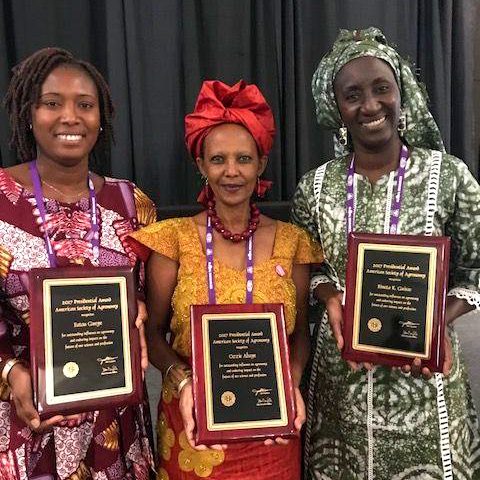
  • ASA (American Society of Agronomy) - Presidential Award - pr…
  • American Forage and Grassland Council – Vivien Allen Illumin…
  • Outstanding Alumina in International Programs award - CALS,…
  • Resume-aware match score
  • Save to shortlist
  • AI-drafted outreach

See your match with A. Ozzie Abaye

PhdFit ranks faculty by your research interests, methods, and publications — grounded in their actual work, not templates.

  • Free to start
  • No credit card
  • 30-second signup