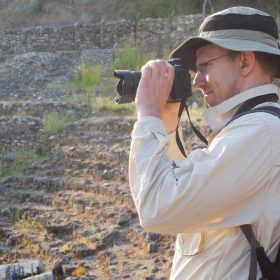
Christopher Johanson
VerifiedUniversity of California, Los Angeles · Classics
Active 1956–2015
About
Christopher Johanson is an Associate Professor in the UCLA Department of Classics, where he is also a founding faculty member and former chair of the UCLA Digital Humanities Program. He serves as Faculty Director of Innovative Applications and Creative Activity for UCLA DataX. His research explores the ancient Graeco-Roman world through the analysis of extant literature, texts of all kinds, and the material record, utilizing data visualization, network analysis, 2D and 3D representation, and real-time interaction. He directs RomeLab, a multidisciplinary research group that uses the physical and virtual city of Rome to study the interrelationship between historical phenomena and the spaces and places of the ancient city. Johanson has collaborated on mapping and visualization projects across various countries including Bolivia, Peru, Albania, Iceland, Spain, Turkey, and Italy. His work has been supported by funding from prominent organizations such as the Mellon Foundation, the National Endowment for the Humanities, the National Science Foundation, the MacArthur Foundation, the Ahmanson Foundation, and Google.
Research topics
- Psychology
- Medicine
- Pharmacology
- Anesthesia
- Chemistry
Selected publications
2015-11-27 · 1 citations
other1st authorCorresponding2015-12-31 · 2 citations
book-chapter1st authorCorrespondingDigital Cultural Mapping: Transformative Scholarship and Teaching in the Geospatial Humanities
Humanities Commons CORE (Modern Language Association / Columbia University) · 2014-01-01
articleOpen access"Digital Cultural Mapping: Transformative Scholarship in the Geospatial Humanities" is a proposal for a three-week summer institute at UCLA for an interdisciplinary group of 12 humanities scholars and advanced graduate students to learn how to develop innovative publications and courses that harness the theoretical and practical approaches of the "geospatial humanities." Situated at the intersection of critical cartography and information visualization, the Institute will combine a survey of the state of the art in interoperable geospatial tools and publication models, with hands-on, studio-based training in how to integrate GIS data into humanities scholarship, develop robust spatial visualizations, and deploy a suite of mapping tools in the service of creating publication- ready research articles and short monographs. The Institute will culminate in an "impact and evaluation" seminar of these publications with representatives from major university presses and journals.
Steps Physicians Report Taking to Reduce Diversion of Buprenorphine
American Journal on Addictions · 2013-04-25 · 22 citations
articleSenior authorCorrespondingBACKGROUND AND OBJECTIVES: Physicians are challenged to effectively treat opioid dependent patients while minimizing diversion of potentially abusable medications, such as buprenorphine. The present study was designed to obtain information on steps physicians report taking to reduce diversion of buprenorphine. METHOD: National quarterly surveys from 2008 to 2009 of qualified physicians who have prescribed buprenorphine were analyzed (N = 2,330). One part of the survey queried physicians about what steps they had taken to reduce abuse and diversion of buprenorphine from a pre-specified list of 12 steps. Other parts of the survey included questions on the physicians' training and experience. RESULTS: Physicians reported taking a mean of 4.4 steps. Longer experience prescribing buprenorphine, more buprenorphine-related educational training, and concern about diversion as a limitation on using buprenorphine for maintenance were associated with higher number of steps taken. CONCLUSIONS AND SCIENTIFIC SIGNIFICANCE: Physicians are currently taking multiple steps to reduce diversion. Future research needs to verify if these steps are effective or are instead reducing access to treatment.
PROCEDURAL MODELING FOR RAPID-PROTOTYPING OF MULTIPLE BUILDING PHASES
The international archives of the photogrammetry, remote sensing and spatial information sciences/International archives of the photogrammetry, remote sensing and spatial information sciences · 2013-02-13 · 19 citations
articleOpen accessSenior authorAbstract. RomeLab is a multidisciplinary working group at UCLA that uses the city of Rome as a laboratory for the exploration of research approaches and dissemination practices centered on the intersection of space and time in antiquity. In this paper we present a multiplatform workflow for the rapid-prototyping of historical cityscapes through the use of geographic information systems, procedural modeling, and interactive game development. Our workflow begins by aggregating archaeological data in a GIS database. Next, 3D building models are generated from the ArcMap shapefiles in Esri CityEngine using procedural modeling techniques. A GIS-based terrain model is also adjusted in CityEngine to fit the building elevations. Finally, the terrain and city models are combined in Unity, a game engine which we used to produce web-based interactive environments which are linked to the GIS data using keyhole markup language (KML). The goal of our workflow is to demonstrate that knowledge generated within a first-person virtual world experience can inform the evaluation of data derived from textual and archaeological sources, and vice versa.
Teaching Digital Humanities through Digital Cultural Mapping
Open Book Publishers · 2012-12-20 · 5 citations
book-chapter1st authorCorrespondingTeaching Digital Humanities through Digital Cultural Mapping
Open Book Publishers · 2012-12-01 · 4 citations
book-chapterOpen access1st authorCorresponding“The Emerald Buddha: Politics, Religion and Buddhist Imagery in Southeast Asia;” “High Line New York City: An Economical and Cultural Revival;” “Mapping Mami Wata: The African Water Goddess;” “Mapping the Bilbao Effect”—all of these were final project proposals by undergraduate students in UCLA’s three-year Digital Culture Mapping Program sponsored by the http://www.keckdcmp.ucla.edu/.howcase how students envision harnessing digital technologies to address a broad range of questions in the ar...
Virtual Cities/Digital Histories.
DH · 2011-01-01
articleSenior authorGeo-Temporal Argumentation: The Roman Funeral Oration.
DH · 2011-01-01
article1st authorCorrespondingDeath in Motion: Funeral Processions in the Roman Forum
Journal of the Society of Architectural Historians · 2010-03-01 · 160 citations
articleSenior authorScientifically accurate, three-dimensional digital representations of historical environments allow architectural historians to explore viewsheds, movement, sequencing, and other factors. Using real-time interactive simulations of the Roman Forum during the mid-Republic and the early third century CE, Diane Favro and Christopher Johanson examine the visual and sequential interrelationships among audience, actors, and monuments during funeral rituals. Death in Motion: Funeral Processions in the Roman Forum presents a hypothetical reconstruction of the funeral of the Cornelii family in the early second century BCE and argues that the conventional understanding of the staging of the funeral oration may be incorrect. It then reviews the imperial funerals of the emperors Pertinax and Septimius Severus to compare the ways that later building in the Roman Forum altered the ritual experience, controlled participant motion, and compelled the audience to submit to an imperial program of viewing.
Recent grants
NIH · $420k · 1993
NIH · $594k · 2000
NIH · $2.2M · 2001
Determinants of Drug Preference in Humans
NIH · $13.8M · 1981–2026
Frequent coauthors
- 22 shared
E. H. Uhlenhuth
- 18 shared
Charles R. Schuster
- 15 shared
Harriet de Wit
University of Chicago
- 12 shared
Suzette M. Evans
- 12 shared
L. D. Chait
- 8 shared
René de la Garza
- 6 shared
C. R. Schuster
- 5 shared
William L. Woolverton
Education
- 2008
Ph.D., Classics
University of California, Los Angeles
- Resume-aware match score
- Save to shortlist
- AI-drafted outreach
See your match with Christopher Johanson
PhdFit ranks faculty by your research interests, methods, and publications — grounded in their actual work, not templates.
- Free to start
- No credit card
- 30-second signup