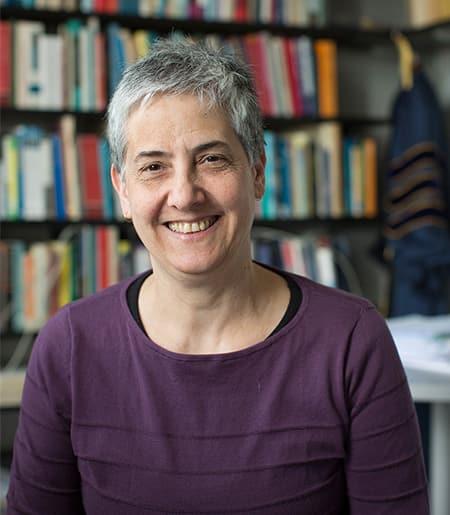
Abigail C Cohn
· ProfessorVerifiedCornell University · Linguistics
Active 1987–2022
About
Abigail C. Cohn is a professor in the Department of Linguistics at Cornell University, with a focus on phonetics and phonology and their interaction through a laboratory phonology approach. Her research investigates the relationship between phonology—the abstract patterning of sounds within a sound system—and phonetics—the physical output of speech. She explores the processes and representations within both fields, emphasizing the mapping between physical sound and abstract sound patterns. In addition to her theoretical work, Cohn focuses on the documentation and analysis of Austronesian languages of Indonesia. Her recent research examines issues of language use and language shift among local Indonesian languages, particularly in the context of increased use of Indonesian. She was a Fulbright Senior Research Scholar during 2012-13, conducting research on language contact and structural shifts in Indonesia. Her scholarly contributions include editing the Oxford Handbook of Laboratory Phonology and authoring chapters and articles on phonological theory, language shift, and the interface between phonetics and phonology.
Research signals
Five dimensions sourced from public faculty / publication signals. Sign in to compare against your own profile and see your match score.
Research topics
- Political Science
- Sociology
- Linguistics
- Anthropology
- Natural Language Processing
- Economic growth
- Geography
- Computer Science
- Economic geography
- Economics
- Psychology
Selected publications
Urbanization, ethnic diversity, and language shift in Indonesia
Journal of Multilingual and Multicultural Development · 2022 · 17 citations
Senior authorCorresponding- Sociology
- Political Science
- Geography
Cross-nationally, urbanization is associated with the decline of minority languages and a shift towards national and official languages. But the processes that link urbanization with language shift have not been adequately documented. In this paper we consider the relationship between cities and language shift from a sociolinguistic perspective, focusing our attention on the issue of language use and language shift in Indonesia – a large, ethnically and linguistically diverse, rapidly urbanising country. We use census data to examine how ethnic diversity shapes language shift in the context of urbanicity. We find that in ethnically homogenous regions, urbanicity itself has little relationship with language shift. By contrast, ethnic diversity is consistently associated with a greater probability of speaking Indonesian both among urban and rural Indonesians and in urban and rural areas. These findings contribute to our understanding of language shift and linguistic vitality in diverse, urbanising societies, and highlight the need to distinguish between the process of urbanization and the state of being urban.
Language labeling and ideology in Indonesia
International Journal of the Sociology of Language · 2022-08-11 · 6 citations
articleAbstract As part of a large survey project designed to examine language shift in Indonesia, we examine speakers’ categorization and labeling of the language varieties in their repertoire with respect to language ideologies and the language ecology of Indonesia. This paper is both a methodological paper – arguing for the usefulness of surveys in the investigation of language shift scenarios – as well as an initial report of findings from those surveys, focusing on how speakers in different parts of Indonesia name language varieties. We demonstrate the benefits of a survey with open-ended questions about linguistic repertoire in investigating the use of particular language labels as markers of local and national identity and discuss these in terms of differences in local language ecologies on the islands of Bali, Java, and Sumatra. In addition, we report on how language labels are used in different communities in Indonesia in the context of different local ecologies, and against a backdrop of widespread reported language shift from the local languages of the Indonesian archipelago to the national language Indonesian ( Bahasa Indonesia ), following decades of successful language planning efforts promoting Indonesian as a unifying language in a linguistically diverse nation.
Jakarta Indonesian first-person singular pronouns
Asia-Pacific Language Variation · 2021-10-06 · 8 citations
articleAbstract Jakarta Indonesian is a colloquial variety of Indonesian spoken primarily in Indonesia’s capital, where it was originally a contact variety between Betawi, the local variety of Malay, and Standard Indonesian. Like other varieties of Indonesian, Jakarta Indonesian is a language with a relatively open system of pronominal reference and multiple forms for self-reference. In this paper we focus on variation in the use of first-person pronouns in Jakarta Indonesian, using two corpora of spoken data collected three decades apart. We employ both quantitative and qualitative methods to examine the form, function and social meaning of 1 sg pronouns in Jakarta Indonesian, investigating both inter- and intra-speaker variation over time.
Embracing multidimensionality in phonological analysis
The Linguistic Review · 2021 · 5 citations
1st authorCorresponding- Computer Science
- Linguistics
- Natural Language Processing
Abstract We pursue the idea, implicit in much current phonological research, that understanding the multiple factors that shape speech production and perception is within the purview of phonology. In particular, increased access to naturalistic data has highlighted the multidimensional reality of variation in spoken language. At the same time, longstanding methods of doing phonology – including impressionistic analysis, and laboratory and experimental studies – remain crucial to understanding native speaker competence and grammar. We advocate for an expanded methodological toolbox in phonological analysis, using an iterative approach that crucially includes naturalistic corpus data. Integrating across multiple data sources offers fuller insight into the nature of the phonological system and native speaker-hearer ability. Several case studies highlight findings gained through linked, iterative studies, showing the importance of naturalistic data for a richer understanding of phonological phenomena, and leading us to reflect on desiderata for corpora to reveal speaker-specific patterns in fine phonetic detail and variability, which we argue are part of a speaker-hearer’s phonological competence. Phonological analysis that embraces the full spectrum of variation in spoken language data (from categorical to gradient, and systematic to sporadic) contributes to a deeper understanding of phonology in this richer sense.
Variation and change in the languages of Indonesia
Asia-Pacific Language Variation · 2021-10-06
articlePreview this article: Variation and change in the languages of Indonesia, Page 1 of 1 < Previous page | Next page > /docserver/preview/fulltext/aplv.00015.int-1.gif
Urbanization, Ethnic Diversity, and Language Shift in Indonesia
SSRN Electronic Journal · 2020 · 59 citations
Senior authorCorresponding- Political Science
- Sociology
- Geography
The Internal Structure of Nasal-Stop Sequences: Evidence from Austronesian
Zenodo (CERN European Organization for Nuclear Research) · 2020-03-25 · 15 citations
articleOpen access1st authorCorrespondingThe phonological and phonetic structure of nasal-stop sequences has elicited much attention. Yet, less is known about the internal timing of nasal-stop sequences than often assumed. This includes clusters, both nasal voiced-stop clusters (ND) and nasal voiceless-stop clusters (NT); and unary cases, most commonly prenasalized stops (ND) but also so-called postploded nasals (ND ).1 The latter are cases that have been described as being in some sense the mirror image of prenasalized stops, where the segment is taken to be primarily nasal, but with an oral release. (Nasal-stop sequence, or NC sequence, is used here to refer to both unary and cluster cases.) Based on impressionistic phonological descriptions, we would expect the phonetic timing relationships schematized in Figure 1. First, in terms of overall duration, prenasalized stops (a) and postploded nasals (b) are expected to have roughly the overall duration of a single segment and nasal-stop clusters (c & d) should be longer, in line with the duration of other clusters in the language (Riehl 2008). In terms of relative duration of the nasal and oral components, in the case of prenasalized stops (a), the nasal component is expected to be quite brief, taking up just the beginning of the total duration. While in the case of postploded nasals (b), the converse is expected, with the nasal closure taking up the majority of the total duration and only a brief period of oral closure. In the case of nasal voiced-stop and nasal voiceless-stop clusters (c & d), the total duration is expected to be roughly evenly divided between the nasal component and oral component for both cases. Phonetic data addressing the realization of these phonological types is quite limited, but the available data suggest quite different realizations than expected. In a cross-linguistic study of nasals and nasalization in English, French, and Sundanese, Cohn (1990) observed a systematic asymmetry in the relative timing of the nasal and oral portions in nasal voiceless-stop vs. nasal voiced-stop clusters: For the NT cases, the nasal and oral components each take up about half of the total duration, as expected; while in the ND cases, the sequence is nasal for all but a very brief period. While others have since noted a similar asymmetry, no full account has been offered. As far as unary cases, claims have been made about there being different types based on relative timing of the nasal and oral portions. First, do the prenasalized stops exhibit the expected pattern? Second, in the case of postploded nasals, are they indeed the mirror image of prenasalized stops? Are they actually unary segments or clusters? Finally are they a phonologically distinct type of NC sequence? The goal of this paper is to bring to bear a more extensive body of phonetic data in order to better understand the phonological structure and phonetic realization of this range of nasal-stop sequences. We present data from six Austronesian languages to investigate these questions. The Austronesian language family is known for its rich array of nasal-stop sequences, including nasal-obstruent clusters and cases of both prenasalized stops and what have been described as postploded nasals In §2, we present some background on the question of prenasalized stops vs. nasal-stop clusters, reviewing relevant results from Riehl (2008) and in §3, the methodology of the present study. In §4, we investigate the asymmetry between the voiced and voiceless NCs and in §5 & §6, we consider the phonological status and phonetic realization of postploded nasals. We will see that to address each of these points the central issue is timing. This includes total duration, the relative timing of the nasal and oral components, and finally what we call microtiming, that is, the structure of the transition from nasal to oral and the nature of the oral component.
The status of schwa in Indonesian
Linguistik aktuell · 2018-11-29 · 1 citations
book-chapter1st authorCorrespondingCross-linguistically, the distribution of schwa is often different from other vowels. This is the case in Indonesian: While contrastive, schwa’s distribution is more restricted than the other vowels and the realization of schwa is variable. Most prior work on schwa in Indonesian has focused on Standard Indonesian; however as a formal standard, there are many normative aspects of pronunciation potentially affecting observed patterns. To understand actual patterns of usage, we investigate schwa in Jakarta Indonesian, an emerging colloquial variety spoken in Indonesia’s capital, based on a naturalistic spoken corpus. We conclude that observed patterns are due to optional deletion of underlying schwa conditioned by multiple factors including phonological and morphological structure, orthography, and stylistic factors.
Indonesian: Language, Linguistics, and Literature
Cornell University Press eBooks · 2018-12-31
book-chapter1st authorCorresponding2017-12-14 · 43 citations
book-chapter1st authorCorrespondingLaboratory phonology (LP) draws on theories and tools from various branches of the sciences to elucidate the linguistic, cognitive, and communicative nature of speech. This chapter introduces LP: its key questions, methodologies, and critical results. The history of LP can be roughly divided into two phases. The first phase encompasses LP's inception and early work revolving around the relationship between phonology and phonetics as understood by the two disciplines at the time. The second phase developed since the mid-90s as the questions were increasingly defined in terms of speech as cognitive science, embedded in a broadly defined communicative system. From its outset, the development of LP was very strongly driven by the work done on the prosodic structure of speech. One of the core questions in Intonational Phonology is the mapping of phonologically relevant tonal targets with segmental strings. Social-indexical variation poses some of the same challenges to phonological theory that language-specific phonetic detail in phoneme contrasts has presented.
Frequent coauthors
- 7 shared
Maya Ravindranath Abtahian
University of Rochester
- 7 shared
Cécile Fougeron
Laboratoire de Phonétique et Phonologie
- 4 shared
Marie K. Huffman
Stony Brook University
- 4 shared
Thomas B. Pepinsky
- 3 shared
Ioana Chițoran
- 2 shared
Sam Tilsen
- 2 shared
Anastasia K. Riehl
- 2 shared
Maya Ravindranath
University of New Hampshire
Education
- 1990
PhD, Linguistics
UCLA
Awards & honors
- Fulbright Senior Research Scholar (2012-13)
- Resume-aware match score
- Save to shortlist
- AI-drafted outreach
See your match with Abigail C Cohn
PhdFit ranks faculty by your research interests, methods, and publications — grounded in their actual work, not templates.
- Free to start
- No credit card
- 30-second signup