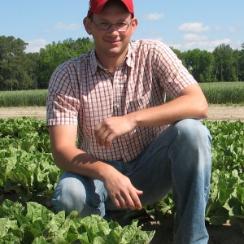
Peter J. Dittmar
· Associate Professor Extension SpecialistVerifiedUniversity of Florida · Horticultural Sciences
Active 1984–2026
About
Peter J. Dittmar is an Associate Professor in the Department of Horticultural Sciences at the University of Florida, Institute of Food and Agricultural Sciences. His research focuses on weed science related to vegetables, deciduous fruit, and nut crops. He collaborates with county and state Extension faculty to provide growers with information on weed management in fruit and vegetable crops, presenting research results and recommendations at field days and commodity meetings. Dittmar holds a Ph.D. and M.S. in Horticultural Sciences from North Carolina State University and a B.S. in Plant and Soil Sciences from Southern Illinois University-Carbondale. His professional experience includes roles as an Assistant Professor and Associate Professor at the University of Florida, as well as research and graduate assistant positions at North Carolina State University. He has received awards such as the Future Leader Award from the Southern IPM Center and the Outstanding Weed Scientist award from the Florida Weed Science Society.
Research topics
- Agronomy
- Biology
- Environmental science
- Engineering
- Economics
- Agricultural engineering
- Horticulture
- Chemistry
- Agricultural science
- Soil science
- Botany
Selected publications
Weed Technology · 2026-03-04
articleOpen accessAbstract Green kyllinga is a perennial sedge that forms dark green mats that can hinder production activities in specialty crop fields. Seeds of this species are highly viable, and seed dispersal can cause rapid increases in population density. In addition, new shoots are produced from each stem node of the underground rhizomes. Green kyllinga is primarily a weed of turf; however, it has increasingly been observed in the row middles (space between raised beds) in Florida small fruit and vegetable crop fields. Trials were conducted to identify the most effective herbicide options from active ingredients registered for use in row middles. Lactofen PRE (404 g ai ha -1 ) was the most effective at controlling green kyllinga emergence followed by pendimethalin (868 g ai ha -1 ). Glufosinate at rates of 189, 378, and 755 g ai ha -1 caused 75 to 93% control on 1 cm tall vegetative green kyllinga shoots. Glufosinate applied at rates of 378 and 755 g ai ha -1 , delivered 96 and 100% control, respectively, on 9 cm tall vegetative shoots. Glufosinate was less effective on flowering green kyllinga, with >90% control only achieved at rates of 755 g ai ha -1 . Shoot dry weight following glufosinate applications did not consistently decrease at the flowering stage until the highest glufosinate rate was applied. We conclude that PRE applications of lactofen or pendimethalin followed by POST applications of glufosinate prior to flowering are effective management options for green kyllinga.
Transitioning Away from Fossil Fuels Will Drive Repositioning of Horticulture
HortScience · 2024-03-26 · 3 citations
articleOpen accessLike everything for the past 2 centuries, agriculture has depended increasingly on fossil fuel energy. Pressures to shift to renewable energy and changes in the fossil fuel industry are set to massively alter the energy landscape over the next 30 years. Two near-certainties are increased overall prices and/or decreased stability of energy supplies. The impacts of these upheavals on specialty crop production and consumption are unknowable in detail but the grand lines of what will likely change can be foreseen. This foresight can guide the research, extension, and teaching needed to successfully navigate a future very unlike the recent past. Major variables that will influence outcomes include energy use in fertilizer manufacture, in farm operations, and in haulage to centers of consumption. Taking six increasingly popular fruit and vegetable crops and the top two horticultural production states as examples, here we use simple proxies for the energy requirements (in gigajoules per ton of produce) of fertilizer, farm operations, and truck transport from Florida or California to New York to compare the relative sizes of these requirements. Trucking from California is the largest energy requirement in all cases, and three times larger than from Florida. As these energy requirements themselves are all fairly fixed, but in future will likely rise in price and/or be subject to interruptions and shortages, this pilot study points to two commonsense inferences: First, that fruit and vegetable production and consumption are set to reposition to more local/regional and seasonal patterns due to increasing expenses associated with fuel, and second, that coast-to-coast produce shipment by truck will become increasingly expensive and difficult.
EDIS · 2023-08-22 · 1 citations
articleOpen accessChapter 14 of the Vegetable Production Handbook of Florida
Chapter 12. Onion, Leek, and Chive Production in Florida
EDIS · 2023-08-22
articleOpen accessChapter 12 of the Vegetable Production Handbook of Florida
Chapter 6. Cole Crop Production
EDIS · 2023-08-22
articleOpen accessChapter 6 of the Vegetable Production Handbook of Florida
Chapter 15. Root Crop Production in Florida
EDIS · 2023-08-22 · 1 citations
articleOpen accessChapter 15 of the Vegetable Production Handbook of Florida
Chapter 4. Integrated Pest Management
EDIS · 2023-08-24 · 6 citations
articleOpen access1st authorCorrespondingChapter 4 of the Vegetable Production Handbook of Florida
EDIS · 2023-08-22 · 1 citations
articleOpen accessChapter 11 of the Vegetable Production Handbook of Florida
Chapter 1. Commercial Vegetable Production in Florida
EDIS · 2023-08-24 · 1 citations
articleOpen access1st authorCorrespondingChapter 1 of the Vegetable Production Handbook of Florida
EDIS · 2022-08-16 · 1 citations
articleOpen accessChapter 14 of the Vegetable Production Handbook of Florida.
Frequent coauthors
- 38 shared
Jason K. Norsworthy
University of Arkansas at Fayetteville
- 38 shared
Johan Desaeger
- 38 shared
Nathan S. Boyd
University of Florida
- 34 shared
Lincoln Zotarelli
- 34 shared
Steve Fennimore
Directorate of Weed Research
- 30 shared
Tracy Candelaria
Directorate of Weed Research
- 22 shared
Jonathan R. Schultheis
North Carolina State University
- 22 shared
Kevin W. Bradley
University of Missouri
Education
- 2010
Doctor of Philosophy, Horticultural Sciences Department
North Carolina State University
- 2006
Masters of Science, Horticultural Sciences Department
North Carolina State University
Awards & honors
- Future Leader Award, Southern IPM Center (2017)
- Outstanding Weed Scientist, Florida Weed Science Society (20…
- John Hutchinson Extension Award for Young Professionals, Ame…
- Resume-aware match score
- Save to shortlist
- AI-drafted outreach
See your match with Peter J. Dittmar
PhdFit ranks faculty by your research interests, methods, and publications — grounded in their actual work, not templates.
- Free to start
- No credit card
- 30-second signup