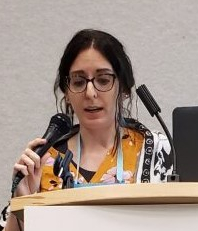
Amanda Batarseh
· Associate Professor of LiteratureVerifiedUniversity of California, San Diego · Literature
Active 2019–2023
About
Amanda Batarseh is an Assistant Professor of Literature at UC San Diego, whose teaching and research focus on Palestinian literature, Arabic literature, Arab American and Arab diaspora literature, Indigenous studies, Mediterranean studies, and comparative literature. Her work has been supported by various prestigious fellowships and research programs, including the UC Humanities Research Institute, Hellman Fellowship, Faculty Career Development Program, and the UC President's Postdoctoral Fellowship Program. She is affiliated with multiple departments and programs such as Middle East Studies, Ethnic Studies, Black Diaspora and African American Studies, Italian Studies, and Study of Religion. Batarseh's scholarly contributions include articles and book chapters that explore themes of place, land, resistance, and narrative in Middle Eastern and Indigenous contexts, as well as translations and public humanities work that engage with Palestinian history and literature. Her academic background includes a Ph.D. in Comparative Literature from UC Davis, an M.B.A. from the University of Buckingham, and a B.A. in Art History and Italian Studies from Scripps College.
Research signals
Five dimensions sourced from public faculty / publication signals. Sign in to compare against your own profile and see your match score.
Research topics
- Sociology
- Social Science
- Literature
- Art
- Anthropology
- Archaeology
- Humanities
- History
- Aesthetics
- Geography
- Ancient history
Selected publications
Love, Countryside, and the Fellah: Tawfiq Canaan’s Romantic Translation
Studies in Romanticism · 2023
1st authorCorresponding- Sociology
- Literature
- Art
Abstract: Early-twentieth-century Palestinian ethnographer, Tawfiq Canaan, reflects in his posthumously published autobiography that a “love of the countryside and the fellah [peasantry]” was instilled in him from a young age. As an adult, Canaan negotiated the parameters of Orientalist Romantic discourse immanent to the ethnographic field in which he produced his work through this “love” of the “fellah.” Interrogating Canaan’s Romanticism exposes how he countered Palestinian erasure by mobilizing the discourse familiar to his target Western audience, and through this translation process, how a genre of Palestinian Romanticism emerged.
2023-05-11
report1st authorCorrespondingOn the seventy-fifth anniversary of the Nakba, Amanda Batarseh explores the works of Palestinian writers Mourid Barghouti and Radwa Ashour.
Centering Place in Tawfiq Canaan’s Literary Cartography
Journal of Palestine Studies · 2023
1st authorCorresponding- Sociology
- Social Science
- History
In the early-twentieth century, Palestinian physician and ethnographer Tawfiq Canaan published roughly forty-five studies on the cultural and narrative traditions of the largest section of Palestinian society, the fellaheen (peasantry). In this article, the author examines how Canaan’s expansive collection of stories related to holy sites across Palestine in Mohammedan Saints and Sanctuaries in Palestine (1927) produces a provocative literary cartography—a narrative that operates much like a map. In so doing, she contends that Canaan both contests orientalist constructions of the Holy Land as frozen in biblical time and, critically, unsettles the very spatiotemporal logic governing dominant colonial narrations of place. This epistemic shift, the author concludes, is the result of Canaan’s recentering of Indigenous Palestinian place-based knowledge as both the subject and method of his study. This approach offers instructive lessons applicable within and beyond the disciplinary, regional, and temporal boundaries that have so far circumscribed the study and reception of Canaan’s work.
Freedom to Imagine: Reflections on the First Palestine Writes Literature Festival
Jerusalem Quarterly · 2021-09-20
articleOpen access1st authorCorrespondingThe Cambridge Journal of Postcolonial Literary Inquiry · 2021 · 4 citations
1st authorCorresponding- Humanities
- Sociology
- Geography
In the 1920s, the Palestinian ethnographer Tawfiq Kan‘an examined the physical and narrative construction of Palestinian space by cataloguing the living archive of Palestinian sanctuaries. His collection of narratives, imbued in the sacred space of the “shrine, tomb, tree, shrub, cave, spring, well, rock [or] stone” is suggestive of cultural anthropologist Keith Basso’s elaboration of “place-making” as learned from the Western Apache. Articulating two modes of disruption, place-making narratives preserve indigenous culture in the face of colonial conquest and unsettle colonial paradigms of spatial belonging and exclusion. Despite the efforts of settler colonial erasure, this interpolative practice has been carried through Palestinian narrative traditions into the present. Raja Shehadeh’s Palestinian Walks: Notes on a Vanishing Landscape (2007) illustrates an indigenous mode of seeing, creating, and contesting spatial narratives, disclosing the role of place-making in contemporary Palestinian literature.
California Italian Studies · 2020-04-15
articleOpen access1st authorCorrespondingCanto XXIII marks a tragicomic turning point in the Orlando Furioso , as the tension sustaining the titular character’s epic stoicism and romantic chivalry falls away to reveal a maniacal anti-hero. This canto’s staging of Orlando’s madness signals a significant extra-textual literary transition, unsettling the binary of medieval and classical literary traditions that Ariosto draws on, and suggesting a novel genre of literary expression. This article explores one avenue by which Ariosto disrupts such ostensible polarities through the dynamic intertextual practice of writing and rewriting the “Orient.” A close reading of Canto XXVIII’s resounding echoes of the Thousand and One Nights’ and the lesser-known Hundred and One Nights’ frame tales, illuminates the Furioso ’s double focus upon movement toward and away from Muslim-Arab cultural affiliation, a push-pull that opens a space of difference where literary traditions can converge neither in reconciliation nor domination of one another. In particular, this paper examines how Ariosto’s poem captures the ambiguous hybridity of the medieval Mediterranean as an ever-shifting terrain defined not only by oppositionality and hostility, but also by curiosity, exchange, and alliance.
Education
- 2018
Ph.D., Comparative Literature
University of California, Davis
- 2009
MBA
University of Buckingham
- 2005
BA
Scripps College
Awards & honors
- Hellman Fellowship
- Faculty Career Development Program
- UC President's Postdoctoral Fellowship Program
- Resume-aware match score
- Save to shortlist
- AI-drafted outreach
See your match with Amanda Batarseh
PhdFit ranks faculty by your research interests, methods, and publications — grounded in their actual work, not templates.
- Free to start
- No credit card
- 30-second signup