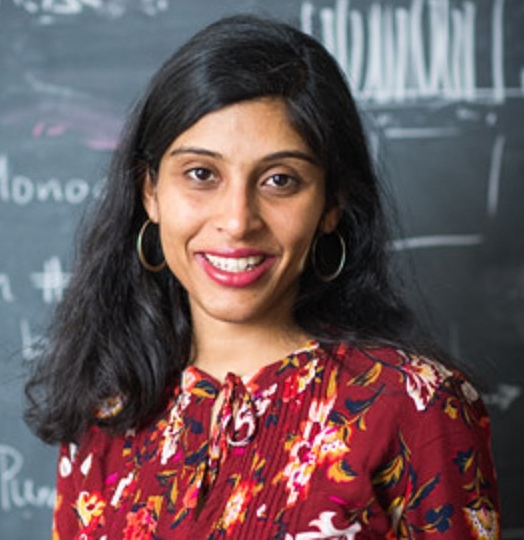
Anushya Chandran
· Associate ProfessorVerifiedBoston University · Physics
Active 2007–2026
About
Anushya Chandran is an Associate Professor of Physics at Boston University. She is a condensed matter theorist with broad research interests in quantum many-body systems in and out-of-equilibrium, including driven quantum matter, thermalization, localization, topological systems, quantum entanglement, and the physics of near-term quantum devices. Her group develops organizing principles at the non-equilibrium frontier, applies them to understand experiments in current quantum hardware, and uses these principles to design novel near-term quantum devices and state preparation protocols. Additionally, her research has a long-standing focus on quantum entanglement, exploring its uses and misuses in characterizing quantum matter and its importance as a quantum resource. Dr. Chandran obtained her B.Tech degree in Electrical Engineering from the Indian Institute of Technology in Madras in 2008 and completed her PhD in Physics from Princeton University in 2013. Following a postdoctoral position at the Perimeter Institute, she joined Boston University, where she currently serves as an Associate Professor. She is a recipient of the Gutzwiller Fellowship, the Sloan Research Fellowship, and the Faculty Early Career Award from the National Science Foundation.
Research topics
- Quantum mechanics
- Physics
- Statistical physics
- Artificial Intelligence
- Theoretical physics
- Condensed matter physics
- Computer Science
- Mathematics
- Combinatorics
- Classical mechanics
- Mathematical analysis
- Algorithm
- Engineering
- Materials science
- Electrical engineering
Selected publications
Resonance Proliferation Across Localization Transitions
ArXiv.org · 2026-05-06
articleOpen accessSenior authorModels of many-body localization (MBL) exhibit slow numerical drifts towards delocalization with increasing system size, for which no satisfactory theory exists. Numerics indicates that these drifts are driven by the proliferation of many-body resonances at intermediate disorder strengths. We develop a statistical method to predict the distribution of resonance oscillation frequencies which captures how the formation of resonances at larger frequency scales subsequently affects the formation of resonances at lower frequencies. Working within the statistical Jacobi approximation (SJA), we derive a flow equation for a power-law exponent $θ(w)$ characterizing the density of resonances at frequency scale $w$. A localized phase is described by a line of fixed points with $θ(w)>0$, while an instability of the flow signals resonance proliferation and the onset of thermalization. The predicted $θ(w)$ matches numerics on the Anderson model on random regular graphs and the Lévy-Rosenzweig-Porter random matrix ensemble, both of which host resonance-driven delocalization transitions. We further connect the flow to eigenstate properties such as the participation ratio and to dynamical observables such as the return probability. The predicted $θ(w)$ also matches what is numerically measured in real-space models of MBL at intermediate disorder strengths, representing a significant step towards explaining the finite-size drifts observed in MBL.
The moving Born–Oppenheimer approximation
Proceedings of the National Academy of Sciences · 2026-02-13 · 2 citations
articleOpen accessWe develop a mixed quantum-classical framework, dubbed the moving Born-Oppenheimer approximation (MBOA), to describe the dynamics of slow degrees of freedom (DOFs) coupled to fast ones. As in the Born-Oppenheimer approximation (BOA), the fast degrees of freedom adiabatically follow a state that depends on the slow ones. Unlike the BOA, this state depends on both the positions and the momenta of the slow DOFs. We study several model systems: a spin-1/2 particle and a spinful molecule moving in a spatially inhomogeneous magnetic field, and a gas of fast particles coupled to a piston. The MBOA reveals rich dynamics for the slow degree of freedom, including reflection, dynamical trapping, and mass renormalization. It also significantly modifies the state of the fast DOFs. For example, the spins in the molecule are entangled and squeezed, while the gas of fast particles develops gradients that are synchronized with the motion of the piston for a long time. The MBOA can be used to describe both classical and quantum systems and has potential applications in quantum chemistry, correlated materials, atomic physics, molecular dynamics, and quantum sensing.
Resonance Proliferation Across Localization Transitions
arXiv (Cornell University) · 2026-05-06
preprintOpen accessSenior authorModels of many-body localization (MBL) exhibit slow numerical drifts towards delocalization with increasing system size, for which no satisfactory theory exists. Numerics indicates that these drifts are driven by the proliferation of many-body resonances at intermediate disorder strengths. We develop a statistical method to predict the distribution of resonance oscillation frequencies which captures how the formation of resonances at larger frequency scales subsequently affects the formation of resonances at lower frequencies. Working within the statistical Jacobi approximation (SJA), we derive a flow equation for a power-law exponent $θ(w)$ characterizing the density of resonances at frequency scale $w$. A localized phase is described by a line of fixed points with $θ(w)>0$, while an instability of the flow signals resonance proliferation and the onset of thermalization. The predicted $θ(w)$ matches numerics on the Anderson model on random regular graphs and the Lévy-Rosenzweig-Porter random matrix ensemble, both of which host resonance-driven delocalization transitions. We further connect the flow to eigenstate properties such as the participation ratio and to dynamical observables such as the return probability. The predicted $θ(w)$ also matches what is numerically measured in real-space models of MBL at intermediate disorder strengths, representing a significant step towards explaining the finite-size drifts observed in MBL.
Strong-driving toolkit for topological Floquet energy pumps with superconducting circuits
Physical review. A/Physical review, A · 2025-10-06
articleTopological Floquet energy pumps, which use periodic driving to create a topologically protected quantized energy current, have been proposed and studied theoretically, but have never been observed directly. Previous work [D. M. Long et al., Phys. Rev. Lett. 128, 183602 (2022)] proposed that such a pump could be realized with a strongly driven superconducting qubit coupled to a cavity. Here, we experimentally demonstrate that the proposed hierarchy of energy scales and drive frequencies can be realized using a transmon qubit. We develop an experimental toolkit to realize the adiabatic driving field required for energy pumping using coordinated frequency modulation of the transmon and amplitude modulation of an applied resonant microwave drive. With this toolkit, we measure adiabatic evolution of the qubit under the applied field for times comparable to ${T}_{1}$, which far exceed the bare qubit dephasing time. This result paves the way for direct experimental observation of topological energy pumping.
Probing Hilbert space fragmentation using controlled dephasing
Physical review. B./Physical review. B · 2025-10-09 · 1 citations
articleOpen accessSenior authorDynamical constraints in many-body quantum systems can lead to Hilbert space fragmentation, wherein the system's evolution is restricted to small subspaces of Hilbert space called Krylov sectors. However, unitary dynamics within individual sectors may also be slow or nonergodic, which limits experiments' ability to measure the properties of the entire sector. We show that additional controlled dephasing reliably mixes the system within a single Krylov sector, and that simple observables can differentiate these sectors. For example, in the strongly interacting XXZ chain with dephasing, the spin imbalance between even and odd sublattices distinguishes sectors. For appropriate choices of initial states, the imbalance begins positive, decays to a negative minimum value at intermediate times, and eventually returns to zero. The minimum reflects the average imbalance of the Krylov sector associated to the initial state. We compute the size of the minimum analytically in the limit of strong interactions, and validate our results with simulations at experimentally relevant interaction strengths.
Autonomous Stabilization of Floquet States Using Static Dissipation
Physical Review X · 2025-07-07 · 2 citations
articleOpen accessFloquet engineering, in which the properties of a quantum system are modified through the application of strong periodic drives, is an indispensable tool in atomic and condensed matter systems. However, it is inevitably limited by intrinsic heating processes. We describe a simple autonomous scheme, which exploits a coupling between the driven system and a lossy auxiliary, to cool large classes of Floquet systems into desired states. We present experimental and theoretical evidence for the stabilization of a chosen state in a strongly modulated transmon qubit coupled to an auxiliary microwave cavity with fixed frequency and photon loss. The scheme naturally extends to Floquet systems with multiple degrees of freedom. As an example, we demonstrate the stabilization of topological photon pumping in a driven cavity-QED system numerically. The coupling to the auxiliary cavity increases the average photon current and the fidelity of nonclassical states, such as high-photon-number Fock states, that can be prepared in the system cavity.
Symmetry Rebreaking in an Effective Theory of Quantum Coarsening
Physical Review Letters · 2025-12-22 · 1 citations
articleOpen accessWe present a simple theory accounting for two central observations in a recent experiment on quantum coarsening and collective dynamics on a programmable quantum simulator [Manovitz et al., Nature (London) 638, 86 (2025).NATUAS0028-083610.1038/s41586-024-08353-5]: an apparent speeding up of the coarsening process as the phase transition is approached and persistent oscillations of the order parameter after quenches within the ordered phase. Our theory, based on the Hamiltonian structure of the equations of motion in the classical limit of the quantum model, finds a speeding up already deep within the ordered phase, with subsequent slowing down as the domain wall tension vanishes upon approaching the critical line. Further, the oscillations are captured within a mean-field treatment of the order parameter field. For quenches within the ordered phase, small spatially varying fluctuations in the initial mean field lead to a remarkable long-time effect, wherein the system dynamically destroys its long-range order and has to coarsen to re-establish it. We term this phenomenon symmetry rebreaking, as the resulting late-time magnetization can have a sign opposite to the initial magnetization.
Physical Review X · 2025-04-21 · 8 citations
articleOpen accessLocal random circuits scramble efficiently and, accordingly, have a range of applications in quantum information and quantum dynamics. With a global U(1) charge, however, the scrambling ability is reduced; for example, such random circuits do not generate the entire group of number-conserving unitaries. We establish two results using the statistical mechanics of <a:math xmlns:a="http://www.w3.org/1998/Math/MathML" display="inline"><a:mi>k</a:mi></a:math>-fold replicated circuits. First, we show that finite moments cannot distinguish the ensemble that local random circuits generate from the Haar ensemble on the entire group of number-conserving unitaries. Specifically, the circuits form a <c:math xmlns:c="http://www.w3.org/1998/Math/MathML" display="inline"><c:msub><c:mi>k</c:mi><c:mi>c</c:mi></c:msub></c:math>-design with <e:math xmlns:e="http://www.w3.org/1998/Math/MathML" display="inline"><e:msub><e:mi>k</e:mi><e:mi>c</e:mi></e:msub><e:mo>=</e:mo><e:mi>O</e:mi><e:mo stretchy="false">(</e:mo><e:msup><e:mi>L</e:mi><e:mi>d</e:mi></e:msup><e:mo stretchy="false">)</e:mo></e:math> for a system in <i:math xmlns:i="http://www.w3.org/1998/Math/MathML" display="inline"><i:mi>d</i:mi></i:math> spatial dimensions with linear dimension <k:math xmlns:k="http://www.w3.org/1998/Math/MathML" display="inline"><k:mi>L</k:mi></k:math>. Second, for <m:math xmlns:m="http://www.w3.org/1998/Math/MathML" display="inline"><m:mi>k</m:mi><m:mo><</m:mo><m:msub><m:mi>k</m:mi><m:mi>c</m:mi></m:msub></m:math>, we derive bounds on the depth <o:math xmlns:o="http://www.w3.org/1998/Math/MathML" display="inline"><o:mi>τ</o:mi></o:math> required for the circuit to converge to an approximate <q:math xmlns:q="http://www.w3.org/1998/Math/MathML" display="inline"><q:mi>k</q:mi></q:math>-design. The depth is lower bounded by diffusion <s:math xmlns:s="http://www.w3.org/1998/Math/MathML" display="inline"><s:mi>k</s:mi><s:msup><s:mi>L</s:mi><s:mn>2</s:mn></s:msup><s:mi>ln</s:mi><s:mo stretchy="false">(</s:mo><s:mi>L</s:mi><s:mo stretchy="false">)</s:mo><s:mo>≲</s:mo><s:mi>τ</s:mi></s:math>. In contrast, without number conservation <w:math xmlns:w="http://www.w3.org/1998/Math/MathML" display="inline"><w:mi>τ</w:mi><w:mo>∼</w:mo><w:mrow><w:mi>poly</w:mi></w:mrow><w:mo stretchy="false">(</w:mo><w:mi>k</w:mi><w:mo stretchy="false">)</w:mo><w:mi>L</w:mi></w:math>. The convergence of the circuit ensemble is controlled by the low-energy properties of a frustration-free quantum statistical model which spontaneously breaks <ab:math xmlns:ab="http://www.w3.org/1998/Math/MathML" display="inline"><ab:mi>k</ab:mi></ab:math> U(1) symmetries. We conjecture that the associated Goldstone modes set the spectral gap for arbitrary spatial and qudit dimensions, leading to an upper bound <cb:math xmlns:cb="http://www.w3.org/1998/Math/MathML" display="inline"><cb:mi>τ</cb:mi><cb:mo>≲</cb:mo><cb:mi>k</cb:mi><cb:msup><cb:mi>L</cb:mi><cb:mrow><cb:mi>d</cb:mi><cb:mo>+</cb:mo><cb:mn>2</cb:mn></cb:mrow></cb:msup></cb:math>.
Chiral quantum state circulation from photon lattice topology
ArXiv.org · 2025-10-01
preprintOpen accessChiral quantum state circulation is the unidirectional transfer of a quantum state from one subsystem to the next. It is essential to the working of a quantum computer; for instance, for state preparation and isolation. We propose a cavity-QED architecture consisting of three cavities coupled to a qubit, in which \emph{any} photonic state of cavity 1 with sufficiently many photons circulates to cavity 2 after a fixed time interval, and then to cavity 3 and back to 1. Cavity-state circulation arises from topologically protected chiral boundary states in the associated photon lattice and is thus robust to perturbation. We compute the circulation period in the semi-classical limit, demonstrate that circulation persists for time-scales diverging with the total photon number, and provide a Floquet protocol to engineer the desired Hamiltonian. Superconducting qubits offer an ideal platform to build and test these devices in the near term.
Physical Review X · 2025-12-23
articleOpen access
Recent grants
CAREER: Topology and symmetry in non-equilibrium quantum systems
NSF · $575k · 2018–2024
Frequent coauthors
- 32 shared
Philip J. D. Crowley
Harvard University
- 30 shared
Chris R. Laumann
Boston University
- 27 shared
Joshua Combes
- 18 shared
Howard M. Wiseman
Centre for Quantum Computation and Communication Technology
- 18 shared
Alexandr Sergeevich
ARC Centre of Excellence for Engineered Quantum Systems
- 18 shared
Stephen D. Bartlett
- 16 shared
David M. Long
University of Maryland, College Park
- 14 shared
S. L. Sondhi
University of Oxford
Awards & honors
- Gutzwiller Fellowship
- Sloan Research Fellowship
- Faculty Early Career Award from the National Science Foundat…
- Resume-aware match score
- Save to shortlist
- AI-drafted outreach
See your match with Anushya Chandran
PhdFit ranks faculty by your research interests, methods, and publications — grounded in their actual work, not templates.
- Free to start
- No credit card
- 30-second signup