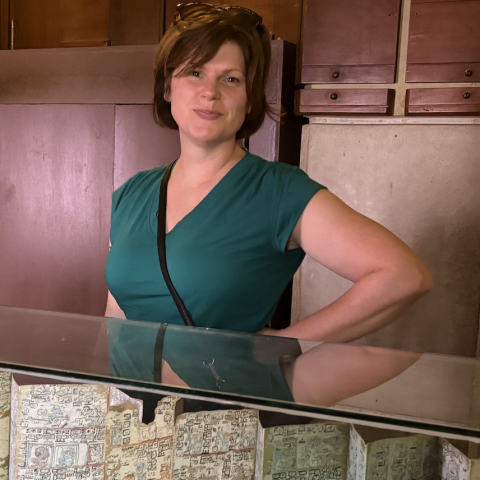
Amara Solari
· Professor of Art History and AnthropologyPennsylvania State University · Pathology
Active 2009–2024
About
Amara Solari is a Professor of Art History and Anthropology at Penn State, specializing in Latin American Art and Architectural History. Her research focuses on the processes of cultural, visual, and theological interchange between Indigenous groups of Mesoamerica and Spanish settler-colonists of New Spain, with particular attention to material and visual culture. She has written multiple articles, several co-authored books, and three monographs that span the precontact and early colonial periods. Employing an interdisciplinary approach that includes art historical, ethnohistorical, and technical methods, she investigates a wide variety of material such as architecture, urban design, cartographic documents, religious statuary, wall paintings, and pigments used in mural production. Her recent work involves a collaboration with scholars across the United States, Mexico, and the United Kingdom on the project 'Maya Christian Murals of Early Modern Yucatán,' which explores Maya murals painted during the first two centuries of Catholic evangelism through scientific analysis of pigments and mural execution techniques. She is currently writing a monograph titled 'Missions Impossible: The Art of Franciscan Failure and Puebloan Perseverance in Nuevo México,' examining how Indigenous art and architecture were co-opted by colonial actors during evangelical campaigns prior to the 1680 Pueblo Revolt. Her academic career includes teaching a broad range of courses on Mesoamerican and colonial art history, and she is dedicated to mentoring undergraduate and graduate students.
Research topics
- Political Science
- Archaeology
- History
- Art
- Ancient history
- Law
- Literature
- Sociology
- Philosophy
- Genealogy
- Ethnology
- Geography
- Theology
- Art history
- Demography
- Classics
- Medicine
- Virology
Selected publications
: <i>Códice Maya de México: Understanding the Oldest Surviving Book of the Americas</i>
Renaissance Quarterly · 2024-09-01
article1st authorCorrespondingUniversity Press of Colorado eBooks · 2023-01-01
bookAztec and Maya Apocalypses: Old World Tales of Doom in a New World Setting by Mark Z. Christensen
The Catholic historical review · 2023-01-01
article1st authorCorrespondingReviewed by: Aztec and Maya Apocalypses: Old World Tales of Doom in a New World Setting by Mark Z. Christensen Amara Solari Aztec and Maya Apocalypses: Old World Tales of Doom in a New World Setting. By Mark Z. Christensen (Norman, OK: University of Oklahoma Press. 2022. Pp. xii, 252. $55.00. ISBN: 978-0-806-19035-8.) Writing amid our current apocalypse, the global COVID-19 pandemic, historian Mark Z. Christensen has offered a complete reimagining of the fundamental role the idea of “Doomsday” played in the Christianization of the Indigenous populations [End Page 223] of the American continents in the early modern period. The author—an ethnohistorian who is renowned for his translation abilities in both colonial Nahuatl (the Aztec language) and Yucatec Mayan (the Mayan dialect spoken in most of the Yucatan Peninsula)—clearly outlines in his Introduction three goals for his tome. His overarching goal is to translate and analyze relatively obscure eschatological texts, composed in these two Indigenous languages, to convey their creative adaptation to serve the idiosyncratic spiritual needs of the evangelical endeavors in New Spain. Secondly, Christensen strives to complicate the historiographical tendency to approach native responses to Christianity in one of two modes: to assume the wholesale adoption of the European religion, or on the more extreme end of this continuum, envision that all Indigenous interpretations of Christianity were inherently subversive. Christensen’s approach is much more nuanced than either of these, as he stresses the importance of a scholarly appreciation of both contributing religious traditions, an academic method that ultimately allows for Indigenous Christianity to be the result of active and ongoing negotiations between Indigenous neophytes and their resident friars. The importance of Christensen’s approach cannot be overstated as it serves to reinscribe agency onto native communities of New Spain. His final articulated goal is to offer his readers English translations of his textual source base. After providing an overview of Spanish and Mesoamerican worldviews of the early modern period, Christensen spends his first body chapter succinctly synthesizing contemporaneous eschatology, explaining how and why millenarianism was a pragmatic worldview for the Spaniards responsible for New World conquests of both territory and of souls. Thereafter, Christensen craftily organizes the remaining chapters along an eschatological chronology. Chapter 2 turns to the topics of the first judgement, limbo, and purgatory, using Juan Bautista Viseo’s Confesario (1599), Ignacio de Paredes’s Promptuario (1759), Juan Coronel’s Discursos (1620), and the anonymous Sermones en lengua Maya (18th century) to analyze how these moments of “personal apocalypses” were conveyed to Nahuatl and Mayan-speaking audiences. Chapter 3 moves on to the Apocalypse proper, providing translations of such important texts as the “Fifteen Signs” from an anonymous Maya sermons copybook (which can be partially correlated with texts and images from the 15th-century German book, Der Antichrist und die fünfzehn Zeichen) and Bautista’s Nahuatl Sermonario (1606). Personal resurrection following the Final Judgement is the topic of the next Chapter, which analyzes the Seven Articles in the Dominican Martín de León’s Camino de cielo (1611) and in Coronel’s Discursos predicables. Chapter 5 finishes the body chapters, focused on four texts (Fabián de Aquino’s 16th-century copybook, Coronel’s Discursos and Discursos predicables, and the “Teabo Manuscript”), which describe heaven and hell. This book is a welcome and overdue addition to the academic subfields of Latin American religious studies and ethnohistory; Christensen’s analytically rich translations of Nahuatl and Mayan documents are a true gift. It also bears noting that beyond the relatively small circle of Mesoamerican ethnohistorians, this book speaks to the larger field of Catholic studies, evidencing, as it does, one of the most [End Page 224] creative examples of religious localization and native negotiation in global history. Moreover, this text could be easily incorporated into an undergraduate or graduate syllabus as Christensen’s conversational writing style makes for a very enjoyable read, despite his apocalyptic subject matter. [End Page 225] Amara Solari The Pennsylvania State University Copyright © 2023 The Catholic University of America Press
The Art Bulletin · 2023-10-02
article1st authorCorrespondingThe Maya Apocalypse and Its Western Roots
Rowman & Littlefield eBooks · 2021-01-01
bookSenior author<JATS1:p>This fascinating history explores the cultural roots of our civilization's obsession with the end of the world. Busting the myth of the ancient Maya prediction that time would end in 2012, Matthew Restall and Amara Solari build on their previous book, 2012 and the End of the World, to use the Maya case to connect such seemingly disparate historical events as medieval European millenarianism, Moctezuma's welcome to Cortés, Franciscan missionizing in Mexico, prophetic traditions in Yucatan, and the growing belief today in conspiracies and apocalypses. In demystifying the 2012 phenomenon, the authors draw on their decades of scholarship to provide an accessible and engaging explanation of what Mayas and Aztecs really believed, how Judeo-Christian apocalypticism became part of the Indigenous Mesoamerican and modern American worlds, and why millions continue to anticipate an imminent Doomsday.</JATS1:p>
Maya Blue and Franciscan Evangelism
Latin American and Latinx Visual Culture · 2021
1st authorCorresponding- Political Science
- Art
- Archaeology
In the first decades of the Franciscan evangelical campaign in Yucatán, Mexico (1540–90), Maya builders and artists directed the construction and pictorial decoration of hundreds of Christian edifices, ranging from small-scale chapels to larger churches and entire monastic complexes, offering a material record of the peninsula’s religious transformation. Strategic color selection and the deployment of Maya blue pigment in particular architectural, iconographic, and liturgical contexts enabled Indigenous catechumens to reconcile post-Tridentine conceptions of divinity with precontact sacred ideologies. By weaving diverse methodologies from the study of visual sources, textual documents, and material characterization techniques, we demonstrate how colonial Maya color theory actively engineered localized Catholicism.
Oxford University Press eBooks · 2020-10-22
book-chapterSenior author“The divine king” begins with a short biography of the Maya <italic>k’uhul ajaw</italic> (supreme lord or king) known as 18-Rabbit. During the Classic period, rulers were viewed as divine kings or queens, like 18-Rabbit and Lady K’abel (“Waterlily-Hand”). The ancient Maya used a combination of a cyclical calendar and a linear calendar called the “Long Count.” The Maya area experienced regular intrusions from imperial Teotihuacan, often leading to economic and diplomatic partnerships. Most Mayas experienced war in their lifetimes. The “Collapse” at the end of the Classic period could more accurately be called a transition, with major regional variations. Some well-known Maya sites flourished after the Collapse.
Oxford University Press eBooks · 2020-10-22
book-chapterSenior authorImpressive architectural hallmarks and historians’ focus on the elite created a distorted view of the Maya as peaceful, stargazing priest-kings. “A day in the life” looks at nonelite Maya, who grew up in groups and endured a challenging farming environment. Their ecological success stemmed from balancing innovation with restraint and respect. The central dietary staple of maize, sacred to the Maya, was supplemented by beans, squash, chili peppers, root crops, and fruits. Maya cities were more like modern cities than previously thought, with opportunities for elite and nonelite Mayas alike to observe the art, architecture, and cultural contributions of their ancestors every day in the city centers.
Oxford University Press eBooks · 2020-10-22
book-chapterSenior author“Creating ‘the Maya’” begins with the paradox that the people we call <italic>Maya</italic> never thought of themselves as such. There was no unified Maya state, empire, or language. Historically, scholars have divided ancient Maya history into three periods: Preclassic, Classic, and Postclassic. The ancient Maya were repeatedly “discovered” by the West since Columbus in 1502, and despite widespread beliefs about the decline of the Maya at the end of the Classic era and the real impact on population wrought by disease and invasions, Maya communities and cultures persisted. The recent disaster film <italic>2012</italic> rekindled interest in the belief attributed to the Maya that the apocalypse would happen in that year.
Oxford University Press eBooks · 2020-10-22
book-chapterSenior authorBy the first millennium <sc>bce</sc>, Maya civilization was manifesting itself in art, architecture, agriculture, and social structure. “Maya Genesis” looks at the birth of this civilization. The manuscript known as the <italic>Popul Vuh</italic> gives a detailed version of Maya creation, telling the stories of two mythical Hero Twins, bookended by tales of the creation of the earth and humans. Impressive structures such as the sites at Palenque linked creation myths and divinity to the visions and ambitions of ruling elites. New architectural and agricultural developments such as the “nixtamalization” of corn helped in the formation of denser communities and the emergence of a hierarchical and multilayered social organization.
Frequent coauthors
- 10 shared
Matthew Restall
Pennsylvania State University
- 1 shared
Traci Ardren
University of Miami
- 1 shared
John F. Chuchiak
Missouri State University
- 1 shared
Linda K. Williams
Awards & honors
- National Endowment for the Humanities Collaborative Research…
- Samuel M. Kress Fellow at the National Gallery of Art
- John H. Guggenheim Fellowship
- Resume-aware match score
- Save to shortlist
- AI-drafted outreach
See your match with Amara Solari
PhdFit ranks faculty by your research interests, methods, and publications — grounded in their actual work, not templates.
- Free to start
- No credit card
- 30-second signup