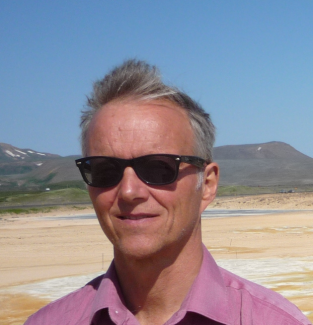
Bjorn Birnir
· ChairVerifiedUniversity of California, Santa Barbara · Mathematics
Active 1981–2025
About
Bjorn Birnir is a faculty member in the Department of Mathematics at the University of California, Santa Barbara. His specialization is in Non-linear Partial Differential Equations (PDEs). He is based in South Hall, Room 6607, and his office hours are Monday through Friday from 9-12 and 1-4. His research focuses on the mathematical analysis and applications of nonlinear PDEs, contributing to the understanding of complex mathematical phenomena within this field.
Research topics
- Environmental science
- Aerospace engineering
- Medicine
- Physics
- Engineering
- Meteorology
- Biology
- Virology
Selected publications
Data Analysis Predicting Accelerated Melting of the Greenland Ice Sheet
Quantitative geology and geostatistics · 2025-01-01
book-chapter1st authorCorrespondingExistence theorems for PDEs modeling erosion and the optimal transportation of sediment
Analysis and Mathematical Physics · 2025-07-15
articleOpen access1st authorCorrespondingAbstract We prove the existence of unique global weak solutions to equations describing the sediment flow in the evolution of fluvial land surfaces, with constant water depth. These equations describe the so-called transport-limited situation, where all the sediment can be transported away given enough water. This is in distinction to the detachment-limited situation where we must wait for rock to weather (to sediment) before it can be transported away. Earlier work shows that these equations describe the optimal transport of sediment and the evolution of the surfaces in optimal transport theory. The existence theory is also extended to include diffusion in the water and the land surfaces.
Scaling of Lagrangian structure functions
Physical Review Research · 2025-06-03
articleOpen access1st authorCorrespondingWe use stochastic closure theory and generalized Green-Kubo relations to show that the velocity structure functions have two distinct scaling regimes connected by a passover. Initially, after a brief ballistic (Batchelor) scaling, the structure functions exhibit a Lagrangian scaling regime with no intermittency, and then pass over to a regime with Eulerian scaling, with intermittency. This transition time for the passover region is controlled by the second structure function, through a generalization of Green-Kubo-Obukhov relations. The ultimate time interval of decay seems to be controlled by the scaling of free eddies, analogous to the scaling in the buffer layer of boundary layer turbulence [B. Birnir, L. Angheluta, J. Kaminsky, and X. Chen, Spectral link of the Generalized Townsend-Perry constants in turbulent boundary layers, ]. The dip observed in the log-derivatives of the structure function [L. Biferale, E. Bodenschatz, M. Cencini, A. S. Lanotte, N. T. Ouellette, F. Toschi, and H. Xu, Lagrangian structure functions in turbulence: A quantitative comparison between experiment and direct numerical simulation, ], with respect to the second structure function <a:math xmlns:a="http://www.w3.org/1998/Math/MathML"><a:msub><a:mi>S</a:mi><a:mn>2</a:mn></a:msub></a:math>, is caused only by the time scales probed by <b:math xmlns:b="http://www.w3.org/1998/Math/MathML"><b:msub><b:mi>S</b:mi><b:mn>2</b:mn></b:msub></b:math>. It seems better to take the log-derivative with respect to <c:math xmlns:c="http://www.w3.org/1998/Math/MathML"><c:mi>t</c:mi></c:math>, instead of <d:math xmlns:d="http://www.w3.org/1998/Math/MathML"><d:msub><d:mi>S</d:mi><d:mn>2</d:mn></d:msub></d:math>, to fully understand the different scaling regimes of Lagrangian turbulence.
The Statistical Theory of the Angiogenesis Equations
Journal of Nonlinear Science · 2024-01-22 · 1 citations
articleOpen access1st authorCorrespondingAbstract Angiogenesis is a multiscale process by which a primary blood vessel issues secondary vessel sprouts that reach regions lacking oxygen. Angiogenesis can be a natural process of organ growth and development or a pathological one induced by a cancerous tumor. A mean-field approximation for a stochastic model of angiogenesis consists of a partial differential equation (PDE) for the density of active vessel tips. Addition of Gaussian and jump noise terms to this equation produces a stochastic PDE that defines an infinite-dimensional Lévy process and is the basis of a statistical theory of angiogenesis. The associated functional equation has been solved and the invariant measure obtained. The results of this theory are compared to direct numerical simulations of the underlying angiogenesis model. The invariant measure and the moments are functions of a Korteweg–de Vries-like soliton, which approximates the deterministic density of active vessel tips.
2022-12-31
preprintOpen access1st authorBecause of its responsiveness to changes in the marine environment, it has been suggested by Rose in 2005 that the capelin, a small pelagic fish that is key to the ecology and fisheries of the North Atlantic, could be seen as a "canary in the coalmine" to detect signals of changes in the Arctic and sub-Arctic Ocean. We describe the historical data that make possible a quantitative assessment of the geographical shift capelin migration-paths and spawning grounds undergo, with increasing temperature, and the time it takes to make these shifts long-lasting. Then we introduce recent data that make these quantitative measurements more accurate and predictive. Direct measurements made in the fall expeditions of Iceland's Marine and Freshwater Research Institute along the East Coast of Greenland, and the Copernicus database of the European Union, are used to examine the evolution of the returning Atlantic water (from Svalbard) that is forming a warmer and saltier boundary current under the colder and fresher East Greenland polar current. The returning Atlantic water has a temperature range (1 to 4 degrees Centigrade) suitable for feeding migrations of the capelin. This current is reaching further north along the coast of North East Greenland and we use simulated data from Copernicus to monitor this evolution. We calibrate the Copernicus data with the direct measurements made by the Marine and Freshwater Research Institute, in Iceland. A trend emerges, both in the direct measurements and in Copernicus data, showing that the returning Atlantic water boundary current may reach Greenland's major Northeastern glacier streams, draining the bulk of the Greenland Glacier in the relatively near future We use the capelin data to predict when this may happen.
The statistical theory of the angiogenesis equations
arXiv (Cornell University) · 2022-10-27
preprintOpen access1st authorCorrespondingAngiogenesis is a multiscale process by which a primary blood vessel issues secondary vessel sprouts that reach regions lacking oxygen. Angiogenesis can be a natural process of organ growth and development or a pathological induced by a cancerous tumor. A mean field approximation for a stochastic model of angiogenesis consists of partial differential equation (PDE) for the density of active tip vessels. Addition of Gaussian and jump noise terms to this equation produces a stochastic PDE that defines an infinite dimensional Lévy process and is the basis of a statistical theory of angiogenesis. The associated functional equation has been solved and the invariant measure obtained. The results are compared to a direct numerical simulation of the stochastic model of angiogenesis and invariant measure multiplied by an exponentially decaying factor. The results of this theory are compared to direct numerical simulations of the underlying angiogenesis model. The invariant measure and the moments are functions of the Korteweg-de Vries soliton which approximates the deterministic density of active vessel tips.
Earthquakes and Volcanic Eruptions Driven by Magma Solitons
2021-11-16
preprintSenior authorEarth and Space Science Open Archive This is a preprint and has not been peer reviewed. ESSOAr is a venue for early communication or feedback before peer review. Data may be preliminary.Learn more about preprints preprintOpen AccessYou are viewing the latest version by default [v1]Earthquakes and Volcanic Eruptions Driven by Magma SolitonsAuthorsCadenLiniDBjornBirnirSee all authors Caden LiniD• Submitting AuthorUC Santa BarbaraiDhttps://orcid.org/0000-0003-0249-0771view email addressThe email was not providedcopy email addressBjorn BirnirCorresponding AuthorUC Santa Barbaraview email addressThe email was not providedcopy email address
Earthquakes and Volcanic Eruptions Driven by Magma Solitons
2021-12-16
preprintOpen accessSenior authorA magma soliton is used to compute the timing of earthquakes on the Reykjanes ridge, in Iceland, and the occurrence and duration of the volcanic eruption in Geldingadalir by Fagradalsfjall, in February 2021. The velocity of the magma soliton is computed using earthquakes observed underwater on the Reykjanes ridge in November 2019 and earthquakes that occurred by Fagradalsfjall in October 2020. This velocity also determines the shape, height and spatial extent, of the magma soliton. The volume of lava in the Geldingadalur-Fagradalsfjall eruption is computed, depending of the width of the magma soliton, and compared to measurements. The timing of subsequent earthquake clusters is then predicted, caused by the magma soliton passing by the remining three volcanic zones on the Reykjanes peninsula.
Spectral link of the generalized Townsend-Perry constants in turbulent boundary layers
Physical Review Research · 2021-10-21 · 10 citations
articleOpen access1st authorCorrespondingWe propose a first minimal theory for boundary layer turbulence that captures very well the profile of the mean-square velocity fluctuations in the streamwise direction and give a quantitative prediction of the Townsend-Perry constants. Our theory is based on connecting all moments of velocity fluctuations as a function of the distance to the wall with the turbulent energy spectrum. A similar spectral theory was proposed in G. Gioia and P. Chakraborty [Phys. Rev. Lett. 96, 044502 (2006)] to explain the friction factor and the von Krmn law in G. Gioia, N. Guttenberg, N. Goldenfeld, and P. Chakraborty [Phys. Rev. Lett. 105, 184501 (2010)]. We generalized it by including fluctuations in the wall-shear stress and the streamwise velocity. The theoretical predictions for the mean velocity and mean-square fluctuations reproduce the shape of the velocity profiles in the buffer and inertial layer obtained from wind tunnel experiments.
AGU Fall Meeting 2021 · 2021-12-16
article
Recent grants
Stochastic Theory of Turbulent Combustion
NSF · $64k · 2004–2007
Frequent coauthors
- 72 shared
Hannah Murphy
Delft University of Technology
- 72 shared
Alethea B T Barbaro
University of California, Santa Barbara
- 72 shared
Warsha Singh
Marine and Freshwater Research Institute
- 72 shared
Salah Alrabeei
- 72 shared
Sam Subbey
Norwegian Institute of Marine Research
- 14 shared
Mark S. Sherwin
University of California, Santa Barbara
- 12 shared
Adriano A. Batista
- 10 shared
Brittany A. Erickson
University of Oregon
Education
- 1981
Ph.D., Mathematics
New York University Courant Institute of Mathematical Sciences
- 1979
Postgraduate, Mathmatics
University of Oxford
- 1978
MS, Mathematics
New York University Courant Institute of Mathematical Sciences
- 1976
BS Physics, Physica and Mathematics
Union College
- Resume-aware match score
- Save to shortlist
- AI-drafted outreach
See your match with Bjorn Birnir
PhdFit ranks faculty by your research interests, methods, and publications — grounded in their actual work, not templates.
- Free to start
- No credit card
- 30-second signup