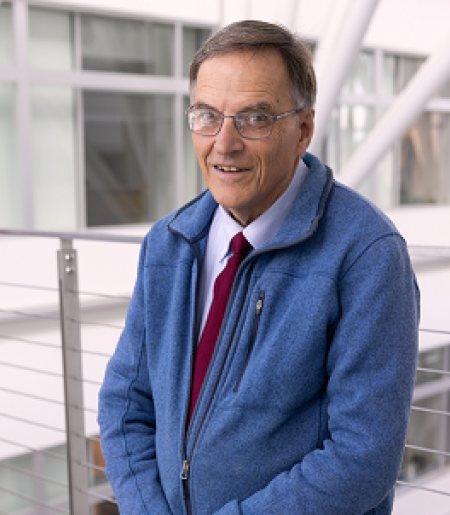
Carl Franck
· Associate Professor PhysicsVerifiedCornell University · Physics
Active 1978–2022
About
Carl Franck is an Associate Professor in the Department of Physics at Cornell University, affiliated with the College of Arts and Sciences. His research focuses on experimental condensed matter and atomic physics, biological physics, and liquid physics. He has been exploiting and developing x-ray techniques to test the fundamentals of photon-electron interactions in atoms and correlated electron dynamics in solids. Additionally, his work explores cooperative behavior in microbial life and the intercellular signaling that facilitates it. His research group investigates these areas through various experimental approaches, contributing to a deeper understanding of fundamental physical interactions and biological processes.
Research topics
- Computer Science
- Physics
- Nuclear physics
- Optics
- Mechanical engineering
- Biology
- Operating system
- Atomic physics
- Biophysics
- Engineering
- Mathematics
- Biological system
- Genetics
- Thermodynamics
Selected publications
Search for the Expected Radiation due to Photoejection of an Inner Shell Electron
2022
1st authorCorresponding- Computer Science
- Physics
- Computer Science
The 53rd Annual Meeting of the APS Division of Atomic, Molecular and Optical Physics will take place from May 30 – June 3, 2022 in Orlando, Fl, USA. <a href="https://morressier.zoom.us/j/89880865272?pwd=SWxTRGhra1ZOSDBrSkhVZDBzVDR6UT09/">Virtual Presenter Help Desk</a>
Physical Biology · 2021 · 2 citations
Senior authorCorresponding- Computer Science
- Biology
- Biological system
) causes cells to grow slower on average and exhibit a large degree of variability: sometimes a sample does not lag at all, while sometimes it takes many moderate density cell cycle times to recover back to fast growth. We perform conditioned media experiments to demonstrate that a chemical signal mediates this endogenous phenomenon. Finally, we argue that while simple models involving fluid transport of signal molecules or cluster-based signaling explain typical behavior, they do not capture the high degree of variability between samples but nevertheless favor an intra-cluster mechanism.
Intense monochromatic photons above 100 keV from an inverse Compton source
Physical Review Accelerators and Beams · 2021 · 12 citations
- Physics
- Nuclear physics
- Atomic physics
Quasimonochromatic x rays are difficult to produce above 100 keV, but have a number of uses in x-ray and nuclear science, particularly in the analysis of transuranic species. Inverse Compton scattering (ICS) is capable of fulfilling this need, producing photon beams with properties and energies well beyond the limits of typical synchrotron radiation facilities. We present the design and predicted output of such an ICS source at CBETA, a multiturn energy-recovery linac with a top energy of 150 MeV, which we anticipate producing x rays with energies above 400 keV and a collimated flux greater than 10 8 photons per second within a 0.5% bandwidth. At this energy, the anticipated flux exceeds that attainable from storage ring sources of synchrotron radiation, even though CBETA is a significantly smaller accelerator system. We also consider the consequences of extending the CBETA ICS source performance to higher electron energies, exploring achievable parameters and applications for MeV-scale photons. We foresee that future energy-recovery linacs may serve as ICS sources, capable of providing high energy photons unavailable at synchrotron radiation facilities or photon beams above approximately 300 keV which outperform sources at synchrotron radiation facilities in both flux and average brilliance.
A Hard X-Ray Compton Source at CBETA
ODU Digital Commons (Old Dominion University) · 2021-01-01
articleOpen accessInverse Compton scattering (ICS) holds the potential for future high flux, narrow bandwidth x-ray sources driven by high quality, high repetition rate electron beams. CBETA, the Cornell-BNL Energy recovery linac (ERL) Test Accelerator, is the world’s first superconducting radiofrequency multi-turn ERL, with a maximum energy of 150 MeV, capable of ICS production of x-rays above 400 keV. We present an update on the bypass design and anticipated parameters of a compact ICS source at CBETA. X-ray parameters from the CBETA ICS are compared to those of leading synchrotron radiation facilities, demonstrating that, above a few hundred keV, photon beams produced by ICS outperform those produced by undulators in term of flux and brilliance.
Physical review. A/Physical review, A · 2021-10-14
articleOpen accessSenior authorEchoing classical physics, quantum electrodynamics predicts the release of a spectral continuum of electromagnetic radiation upon the sudden acceleration of charged particles in quantum matter. Despite apparent theoretical success in describing sister nuclear processes, known as internal bremsstrahlung, following nuclear beta decay and $K$ capture, the situation of the photoejection of an electron from an inner shell of an atom, intra-atomic bremsstrahlung (IAB), is far from settled. In this paper we present fresh measurements which rely on contemporary signal processing as well as the high flux available from a synchrotron radiation source to revisit the problem by photoejecting electrons from the innermost shell of copper. We have sufficient sample statistics to measure the expected spectra at the level expected by contemporary theory. Furthermore, we employ sufficiently thin targets to overcome secondary scattering artifacts. Our approach applies the fluorescence coincidence method to guard against extraneous scattering and multiple incident photon processes. Our observations set a severe upper limit on the rate for IAB: We conclude that current theory overpredicts, by at least 5 sigma, the measured rate for $K$-shell IAB in copper in the range of detected energies below the $K$ fluorescence energy.
A Hard X-Ray Compact Compton Source at CBETA
JACOW · 2019-01-01 · 2 citations
articleOpen accessCompton backscattering at energy recovery linacs (ERLs) promises high flux, high energy x-ray sources in the future, made possible by high quality, high repetition rate electron beams produced by ERLs. CBETA, the Cornell-BNL ERL Test Accelerator currently being built and commissioned at Cornell, is an SRF multi-turn ERL using Non-Scaling Fixed Field Alternating-gradient (NS-FFA) arcs. CBETA has high quality design parameters with an anticipated top energy of 150 MeV on the fourth pass. The expected parameters of a Compton source at CBETA include a top x-ray energy of over 400 keV with a flux on the order of 10¹² ph/s. In this paper, we present anticipated parameters and potential applications in science and engineering for this source.
Crystals · 2019-07-31 · 10 citations
articleOpen accessSenior authorA set of 20 single crystal diamond plates synthesized using chemical vapor deposition (CVD) was studied using X-ray diffraction imaging to determine their applicability as side-bounce (single-reflection) Laue monochromators for synchrotron radiation. The crystal plates were of optical grade (as provided by the supplier) with (001) nominal surface orientation. High dislocation density was found for all samples. Distortions in the crystal lattice were quantified for low-index Laue reflections of interests using rocking curve topography. Maps of effective radius of curvature in the scattering plane were calculated using spline interpolation of the rocking curve peak position across the studied plates. For several selected plates, nearly flat regions with large effective radius of curvature were found ( R 0 ≳ 30 − 70 m, some regions as large as 1 × 4 mm 2 ). The average width of the rocking curve for these regions was found to be about 150 μ rad (r.m.s.). These observations suggest that the selected CVD diamond plates could be used as intermediate-bandwidth monochromators refocusing the radiation source to a specific location downstream with close to 1:1 distance ratio.
Physical Review Letters · 2017-12-14 · 9 citations
articleSenior authorEukaryotic cells sense molecular gradients by measuring spatial concentration variation through the difference in the number of occupied receptors to which molecules can bind. They also secrete enzymes that degrade these molecules, and it is presently not well understood how this affects the local gradient perceived by cells. Numerical and analytical results show that these enzymes can substantially increase the signal-to-noise ratio of the receptor difference and allow cells to respond to a much broader range of molecular concentrations and gradients than they would without these enzymes.
CBETA Design Report, Cornell-BNL ERL Test Accelerator
arXiv (Cornell University) · 2017-06-13 · 14 citations
preprintOpen accessThis design report describes the construction plans for the world's first multi-pass SRF ERL. It is a 4-pass recirculating linac that recovers the beam's energy by 4 additional, decelerating passes. All beams are returned for deceleration in a single beam pipe with a large-momentum-aperture permanent magnet FFAG optics. Cornell University has been pioneering a new class of accelerators, Energy Recovery Linacs (ERLs), with a new characteristic set of beam parameters. Technology has been prototyped that is essential for any high brightness electron ERL. This includes a DC electron source and an SRF injector Linac with world-record current and normalized brightness in a bunch train, a high-current linac cryomodule, and a high-power beam stop, and several diagnostics tools for high-current and high-brightness beams. All these are now being used to construct a novel one-cryomodule ERL in Cornell's Wilson Lab. Brookhaven National Laboratory (BNL) has designed a multi-turn ERL for eRHIC, where beam is transported more than 20 times around the 4km long RHIC tunnel. The number of transport lines is minimized by using two arcs with strongly-focusing permanent magnets that can control many beams of different energies. A collaboration between BNL and Cornell has been formed to investigate this multi-turn eRHIC ERL design by building a 4-turn, one-cryomodule ERL at Cornell. It also has a return loop built with strongly focusing permanent magnets and is meant to accelerate 40mA beam to 150MeV. This high-brightness beam will have applications beyond accelerator research, in industry, in nuclear physics, and in X-ray science.
Cell Size Clues for the Allee Effect in Vegetative Amoeba Suspension Culture
Bulletin of the American Physical Society · 2016-03-17
article1st authorCorresponding
Frequent coauthors
- 11 shared
Albert Bae
- 10 shared
Igor Šegota
University of California, San Diego
- 8 shared
S. E. Schnatterly
University of Virginia
- 8 shared
Eberhard Bodenschatz
- 7 shared
Richard V. Durand
Cornell University
- 7 shared
Archana Rachakonda
Cornell University
- 6 shared
F. B. Hicks
- 6 shared
D. J. Durian
Labs
N/A
Awards & honors
- Member, American Physical Society
- Resume-aware match score
- Save to shortlist
- AI-drafted outreach
See your match with Carl Franck
PhdFit ranks faculty by your research interests, methods, and publications — grounded in their actual work, not templates.
- Free to start
- No credit card
- 30-second signup