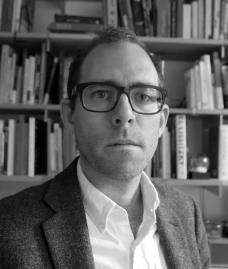
Craig Buckley
· Associate Professor of History of ArtYale University · Art History
Active 1970–2025
About
Craig Buckley is a historian of modern architecture and its intersections with the visual arts and media. He holds a B.A. from Trent University, an M.A. from the University of Western Ontario, and a Ph.D. from Princeton University. His research explores the cultural techniques of montage and collage in architectural culture, emphasizing their role in fostering experimental approaches to industrial assembly during the 1960s through new media such as offset-lithographic printing, portable film cameras, slide projectors, and video recorders. Buckley's work includes a book titled 'Graphic Assembly: Montage, Media and Experimental Architecture in the 1960s,' which offers a new understanding of these techniques, and he is engaged in a second book project examining the proliferation of screens from an interdisciplinary perspective over the last five centuries. His current research focuses on cinema architectures in major cities during the first half of the twentieth century, analyzing buildings' roles in the circulation of audio-visual media and their conflicting functions as sites of sociability, technical innovation, and social categorization. Buckley is interested in supervising dissertations on topics related to twentieth-century architecture, including its relationship with avant-gardes, socio-political movements, print culture, visual arts, and optical media. He has contributed to numerous publications and edited collections, and teaches courses on modern architecture, critical art history, and media in architecture, among other subjects.
Research topics
- Political Science
- Law
- Physics
- Mechanics
Selected publications
2025-11-12
book-chapter1st authorCorrespondingDie Provenienz von Kunstwerken stellt ein hochaktuelles Thema in Forschung und Politik dar. Auf die Architektur übertragen, eröffnet der Begriff der Provenienz neue Dimensionen im kulturellen, sozialen und materiellen Leben von Gebäuden und architektonischen Artefakten, indem er Fragen der Bewegung, Migration und Zirku
Provenance in Architecture: A Dictionary
2025-11-12
bookThe provenance of artworks is a burning issue in current scholarship and politics. Transpose provenance into architecture and it reveals new and surprising dimensions in the social, material and cultural lives of buildings and architectural artefacts, reframing questions of migration, movement and circulation. Provenance in architecture illuminates the intricate trajectories of fundamentally composite objects from their complex origins to their uncertain destinations. This dictionary examines architectural provenance across 101 key concepts from “Acquisition” to “Will”. The entries provide new ways of writing architectural history, highlighting how architecture moves, is destroyed, survives and is transformed.
Routledge eBooks · 2021
1st authorCorresponding- Political Science
- Political Science
- Mechanics
For the better part of the twentieth century, buildings like Casablanca’s Cinéma Vox (Marius Boyer, 1935) were one of the most conspicuous typologies of global modernism, yet they have remained absent from canonical histories of modern architecture, as well as from more recent postcolonial efforts to rethink these histories. Reconstructing the histories of the Vox together with other cinemas in Casablanca, this chapter seeks to expand histories of colonial modernity, which have in the Moroccan context, as elsewhere, been overwhelmingly associated with the architecture of state administration and housing. Cinema architecture was never homogenous, nor simply diffused from Western centers to non-Western peripheries. Rather than theaters of illusion, cinemas might be conceptualized as theaters of circulation, three-dimensional architectural mechanisms designed to incite, direct, sort, and control everything from flows of capital and reels of celluloid, to pulses of electricity, currents of air, and crowds of spectators. Drawing on anthropological research into commodities as sites of global relationship, the essay theorizes this architecture of circulation as a site of friction rather than one of unimpeded movement.
2021-02-16
book-chapter1st authorCorrespondingAgainst the grain of the growing literature on screens, Screen Genealogies argues that the present excess of screens cannot be understood as an expansion and multiplication of the movie screen nor of the video display. Rather, screens continually exceed the optical histories in which they are most commonly inscribed. As contemporary screens become increasingly decomposed into a distributed field of technologically interconnected surfaces and interfaces, we more readily recognize the deeper spatial and environmental interventions that have long been a property of screens. For most of its history, a screen was a filter, a divide, a shelter, or a camouflage. A genealogy stressing transformation and descent rather than origins and roots emphasizes a deeper set of intersecting and competing definitions of the screen, enabling new thinking about what the screen might yet become.
Face and Screen: Toward a Genealogy of the Media Façade
2021-02-16 · 1 citations
book-chapter1st authorCorrespondingCraig Buckley questions the tendency to see the multi-media façade as paradigmatic of recent developments in illumination and display technologies by reconsidering a longer history of the conflicting urban roles in which façades, as media have been cast. Over the course of the nineteenth century, façades underwent an optical redefinition parallel to that which defined the transformation of the screen. Buildings that sought to do away with a classical conception of the façade also emerged as key sites of experimentation with illuminated screening technologies. Long before the advent of the technical systems animating contemporary media envelopes, the façades of storefronts, cinemas, newspaper offices, union headquarters, and information centres were conceived as media surfaces whose ability to operate on and intervene in their surroundings became more important than the duty to express the building’s interior.
Graphic Assembly: Montage, Media, and Experimental Architecture in the 1960s
2019-01-29 · 6 citations
book1st authorCorrespondingUniversity of Minnesota Press eBooks · 2019-01-29 · 25 citations
book1st authorCorrespondingEnvisioning Assembly: Archigram and the Light/Sound Workshop
Grey Room · 2018-12-01
article1st authorCorrespondingDecember 01 2018 Envisioning Assembly: Archigram and the Light/Sound Workshop Craig Buckley Craig Buckley Craig Buckley is Assistant Professor of Modern and Contemporary Architecture in Department of the History of Art at Yale University. He is the author of Graphic Assembly: Montage, Media, and Experimental Architecture in the 1960s (forthcoming from University of Minnesota Press). Search for other works by this author on: This Site Google Scholar Author and Article Information Craig Buckley Craig Buckley is Assistant Professor of Modern and Contemporary Architecture in Department of the History of Art at Yale University. He is the author of Graphic Assembly: Montage, Media, and Experimental Architecture in the 1960s (forthcoming from University of Minnesota Press). Online Issn: 1536-0105 Print Issn: 1526-3819 © 2018 by Grey Room, Inc. and the Massachusetts Institute of Technology.2018Grey Room, Inc. and the Massachusetts Institute of Technology. Grey Room (2018) (73): 26–53. https://doi.org/10.1162/grey_a_00255 Cite Icon Cite Permissions Share Icon Share Facebook Twitter LinkedIn MailTo Views Icon Views Article contents Figures & tables Video Audio Supplementary Data Peer Review Search Site Citation Craig Buckley; Envisioning Assembly: Archigram and the Light/Sound Workshop. Grey Room 2018; (73): 26–53. doi: https://doi.org/10.1162/grey_a_00255 Download citation file: Ris (Zotero) Reference Manager EasyBib Bookends Mendeley Papers EndNote RefWorks BibTex toolbar search Search Dropdown Menu toolbar search search input Search input auto suggest filter your search All ContentAll JournalsGrey Room Search Advanced Search This content is only available as a PDF. © 2018 by Grey Room, Inc. and the Massachusetts Institute of Technology.2018Grey Room, Inc. and the Massachusetts Institute of Technology. Article PDF first page preview Close Modal You do not currently have access to this content.
Graphic Apparatuses: Architecture, Media, and the Reinvention of Assembly 1956-1973
2013-01-01
article1st authorCorrespondingPost-ductility : metals in architecture and engineering
Princeton Architectural Press eBooks · 2012-01-01
bookSenior authorMetals, as surface or structure- as the generators of space, play a role in nearly every strain of modernisation in architecture. They define complete geographies of work, production, and political life. Non-architectural metals delivered in cars, and hard goods in the United States and worldwide have all been sourced as the engines of the sprawling late twentieth-century city in all of its forms. But in the received aspects of architectural history, metals, and in particular steel, remain less diluted; they are presented as intrinsic to the profession as material precedes concepts- they are carriers of architectural meaning.
Frequent coauthors
- 19 shared
Beatriz Colomina
Princeton University
- 17 shared
Francesco Casetti
- 17 shared
Rüdiger Campe
Freie Universität Berlin
- 16 shared
Thomas M. Donnelly
Cappagh National Orthopaedic Hospital
- 16 shared
Rüdiger
University of Iowa
- 16 shared
Francesco Campe
University of Minnesota System
- 16 shared
Martha Mohr
University of Iowa
- 16 shared
Gundula Kreuzer
- Resume-aware match score
- Save to shortlist
- AI-drafted outreach
See your match with Craig Buckley
PhdFit ranks faculty by your research interests, methods, and publications — grounded in their actual work, not templates.
- Free to start
- No credit card
- 30-second signup