Resume-aware faculty matching

Find professors who actually fit you

Upload your resume. Four AI agents analyze your background, rank the faculty who fit, inspect their recent research, and help you draft outreach — grounded in their actual work, not templates.

Free to startNo credit cardCancel anytime
Top matches Balanced preset
Dr. Sarah Chen
Stanford · Interpretability · NLP
91
Dr. Marcus Holloway
MIT · Robotics · RL
84
Dr. Aisha Okonkwo
CMU · Fairness · HCI
82
Nova · Professor Researcher · re-ranking top 20…
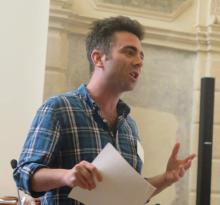
Dan Korman

Dan Korman

· Professor, Director of Graduate StudiesVerified

University of California, Santa Barbara · Philosophy

Active 1999–2024

h-index16
Citations735
Papers5010 last 5y
Funding
See your match with Dan Korman — sign in to PhdFit.Sign in

About

Dan Korman is a Professor and the Director of Graduate Studies in the Department of Philosophy at the University of California, Santa Barbara. His areas of specialization include Metaphysics, Epistemology, Philosophy of Mind, and Philosophy of Language. He is based in South Hall 5716 and can be contacted via email at dkorman@ucsb.edu. His office hours are by appointment, and he is actively involved in graduate education and departmental leadership.

Research topics

  • Epistemology
  • Philosophy
  • Mathematics
  • Sociology
  • Psychology
  • Social psychology
  • Law
  • Linguistics
  • History

Selected publications

  • A framework for the metaphysics of race

    The Philosophical Quarterly · 2024-09-26

    article1st authorCorresponding

    Abstract Philosophers have appealed to a wide variety of different factors in providing a metaphysics of race: appearance, ancestry, systems of oppression, shared ways of life, and so-called ‘racial essences’. I distinguish four importantly different questions about racial groups that one may be answering in appealing these factors. I then show that marking these distinctions proves quite fruitful, revealing ways of strengthening existing arguments for the non-existence of racial groups, new avenues for addressing challenges to biological and constructionist accounts of race, and a range of hybrid positions that have been largely overlooked in the literature.

  • Why Care About What There Is?

    Mind · 2023-10-19 · 1 citations

    articleOpen access1st authorCorresponding

    Abstract There’s the question of what there is, and then there’s the question of what ultimately exists. Many contend that, once we have this distinction clearly in mind, we can see that there is no sensible debate to be had about whether there are such things as properties or tables or numbers, and that the only ontological question worth debating is whether such things are (in one or another sense) ultimate. I argue that this is a mistake. Taking debates about ordinary objects as a case study, I show that the arguments that animate these debates bear directly on the question of which objects there are and cannot plausibly be recast as arguments about what’s ultimate. I then address the objection that, because they are easily answerable, questions about what there is cannot be a proper subject of ontological debate.

  • Mountains and Their Boundaries

    Philosophers in depth · 2023-01-01

    book-chapterOpen access1st authorCorresponding
  • Modal Security and Evolutionary Debunking

    Midwest Studies in Philosophy · 2023-01-01

    articleOpen access1st authorCorresponding

    According to principles of modal security, evidence undermines a belief only when it calls into question certain purportedly important modal connections between one’s beliefs and the truth (e.g., safety or sensitivity). Justin Clarke-Doane and Dan Baras have advanced such principles with the aim of blocking evolutionary moral debunking arguments. We examine a variety of different principles of modal security, showing that some of these are too strong, failing to accommodate clear cases of undermining, while others are too weak, failing to do their advertised work of blocking evolutionary moral debunking arguments. If there is a security principle that slips between the horns of this dilemma—one that is both viable and debunker-blocking—it remains to be formulated.

  • On Debunking Color Realism

    2022-07-18 · 1 citations

    book-chapterOpen access1st authorCorresponding

    You see a cherry, and you experience it as red. A textbook explanation for why you have this sort of experience is going to cite such things as the cherry’s chemical surface properties and the distinctive mixture of the wavelengths of light it is disposed to reflect. What does not show up in this explanation is the redness of the cherry. Many allege that the availability of color-free explanations of color experience somehow calls into question our beliefs about the colors of objects around us. The authors explore how such explanations are supposed to undermine color beliefs and, in particular, whether evolutionary considerations have any special role to play.

  • An explanationist account of genealogical defeat

    Philosophy and Phenomenological Research · 2021 · 9 citations

    1st authorCorresponding
    • Epistemology
    • Psychology
    • History

    Abstract Sometimes, learning about the origins of a belief can make it irrational to continue to hold that belief—a phenomenon we call ‘genealogical defeat’. According to explanationist accounts, genealogical defeat occurs when one learns that there is no appropriate explanatory connection between one's belief and the truth. Flatfooted versions of explanationism have been widely and rightly rejected on the grounds that they would disallow beliefs about the future and other inductively‐formed beliefs. After motivating the need for some explanationist account, we raise some problems for recent versions of explanationism. Learning from their failures, we then produce and defend a more resilient explanationism.

  • Against Minimalist Responses to Moral Debunking Arguments

    Oxford University Press eBooks · 2020 · 55 citations

    1st authorCorresponding
    • Sociology
    • Epistemology
    • Psychology

    Abstract Moral debunking arguments are meant to show that, by realist lights, moral beliefs are not explained by moral facts, which in turn is meant to show that they lack some significant counterfactual connection to the moral facts (e.g. safety, sensitivity, reliability). The dominant, “minimalist” response to the arguments—sometimes defended under the heading of “third-factors” or “pre-established harmonies”—involves affirming that moral beliefs enjoy the relevant counterfactual connection while granting that these beliefs are not explained by the moral facts. The authors argue that the minimalist gambit rests on a controversial thesis about epistemic priority: that explanatory concessions derive their epistemic import from what they reveal about counterfactual connections. They then challenge this epistemic priority thesis, which undermines the minimalist response to debunking arguments (both in ethics and elsewhere).

  • Debunking material induction

    Studies in History and Philosophy of Science Part A · 2020-05-06 · 2 citations

    articleSenior author
  • Conservatism, Counterexamples and Debunking

    Analysis · 2020-04-01 · 4 citations

    articleOpen access1st authorCorresponding

    Many thanks to my critics – Meg Wallace, Louis deRosset and Chris Tillman and Joshua Spencer – for their probing questions about Objects.1 Conversations with each of them over the years already had a profound impact on the book, and I am grateful to them for continuing to push me to revisit and rethink key aspects of my defence of conservatism. Wallace contends that my arguments from counterexamples against universalism and nihilism are question-begging and cannot be expected to change anyone’s mind. She challenges my comparison of the arguments to other widely accepted arguments from counterexamples, and she maintains that a better comparison is to Moore’s response to the sceptic. In §1, I attempt to clarify the dialectical and epistemic role that my arguments from counterexamples are meant to play, I provide a limited defence of the comparison to the Gettier examples and I embrace the comparison to Moore. deRosset argues that my characterization of conservatism offers little tonoguidance as to which objects conservatism is and is not committed to, that natural ways of developing the view are unpromising and that conservatism ought to give way to a liberalism on which common sense is aidedand at times corrected by scientific investigation. In §2, I provide a clearer formulation of conservatism, explain how a conservative should think about the interaction between intuition and science and discuss what conservatives should say about scattered territories, clonal colonies and arbitrarysystems.

  • Objects: Nothing out of the Ordinary

    Analysis · 2020 · 77 citations

    1st authorCorresponding
    • Epistemology
    • Philosophy
    • Mathematics

    Imagine mindlessly kneading some clay into some arbitrary shape. A gollyswoggle is an object that has exactly that shape and cannot survive even minimal changes in shape. An incar is an object that, at its full size, looks just like a car in a garage, but that, unlike a car in a garage, will cease to exist if its constitutive matter leaves the garage. A trog is an object composed of a dog and tree trunk. There are no trogs, incars, gollyswoggles or other such extraordinary objects. But there are dogs, tree trunks, statues and other such ordinary objects. In Objects, I defend this conservative view about which objects there are. It’s an uphill battle. (More on what exactly conservatism is in my exchange with Louis deRosset.) In Chapter 2, I present the arguments and puzzles that have driven so many metaphysicians away from conservatism: debunking arguments, arbitrariness arguments, the argument from vagueness, the overdetermination argument, the problem of material constitution and the problem of the many. In Chapter 3, I examine the alternatives to conservatism: permissivist views that affirm the existence of trogs, incars and/or gollyswoggles, and eliminativist views which deny the existence of dogs, trunks and/or statues.

Frequent coauthors

  • Dustin Locke

    5 shared
  • Chad Carmichael

    2 shared
  • Allen H. Renear

    University of Illinois Urbana-Champaign

    1 shared
  • Jonathan Livengood

    University of Illinois Urbana-Champaign

    1 shared
  • Eric A Mack

    1 shared
  • Enrico Grube

    1 shared
  • Ernest Sosa

    Rutgers, The State University of New Jersey

    1 shared
  • Jaegwon Kim

    1 shared
  • Resume-aware match score
  • Save to shortlist
  • AI-drafted outreach

See your match with Dan Korman

PhdFit ranks faculty by your research interests, methods, and publications — grounded in their actual work, not templates.

  • Free to start
  • No credit card
  • 30-second signup