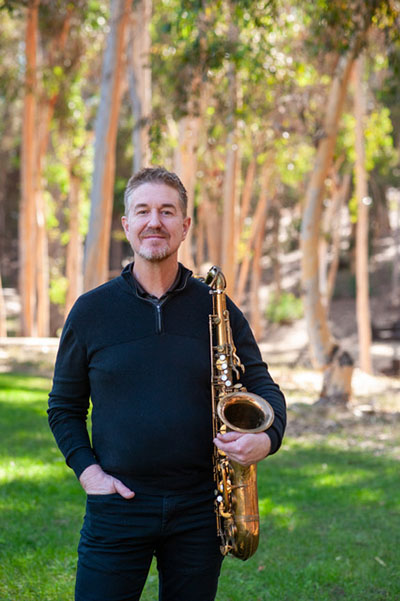
David Borgo
· Professor & Director of Graduate StudiesUniversity of California, San Diego · Music
Active 1997–2022
About
David Borgo is a Professor of Music at UC San Diego, where he teaches in the Integrative Studies and Jazz and Music of the African Diaspora Programs. He holds a B.M. degree in Jazz Studies from Indiana University and M.A. and Ph.D. degrees in Ethnomusicology from UCLA. Since joining the UCSD faculty in 2002, he has served as the Department Chair from 2017 to 2020 and is also affiliated faculty in Ethnic Studies and Cognitive Science. Borgo has received recognition for his teaching, including a 2013 Distinguished Teaching Award from the African and African American Studies Research Project and a 2020 Diversity Equity and Inclusion Teaching Award. As a jazz musician, he has won the International John Coltrane Competition at age 24 and has toured extensively across Europe, Asia, Africa, and the Americas. He has released 17 albums of original music on various record labels and has studied with and performed alongside many renowned jazz musicians such as Herbie Hancock, David Liebman, Billy Higgins, and others. His musical work spans jazz, improvised music, electro-acoustic improvisation with KaiBorg, and intricate polyrhythmic music with Kronomorfic. Critics have praised his adventurous modern jazz sound, versatility, and ability to blend different aesthetics, with descriptions highlighting his warm tone, delicate patterns, and the broad spectrum of his musical expression.
Research topics
- Psychology
- Artificial Intelligence
- Political Science
- Sociology
- Computer Science
- Communication
- Social psychology
- Business
- Cognitive science
- Art
- Visual arts
- Law
- Telecommunications
Selected publications
Sync or Swarm, Revised Edition
2022 · 7 citations
1st authorCorresponding- Computer Science
- Sociology
- Artificial Intelligence
<JATS1:p>The revised edition of Sync or Swarm promotes an ecological view of musicking, moving us from a subject-centered to a system-centered view of improvisation. It explores cycles of organismic self-regulation, cycles of sensorimotor coupling between organism and environment, and cycles of intersubjective interaction mediated via socio-technological networks. Chapters funnel outward, from the solo improviser (Evan Parker), to nonlinear group dynamics (Sam Rivers trio), to networks that comprise improvisational communities, to pedagogical dynamics that affect how individuals learn, completing the hermeneutic circle. Winner of the Society for Ethnomusicology's Alan Merriam prize in its first edition, the revised edition features new sections that highlight electro-acoustic and transcultural improvisation, and concomitant issues of human-machine interaction and postcolonial studies.</JATS1:p>
Duke University Press eBooks · 2020
1st authorCorresponding- Political Science
- Business
- Psychology
Strange loops of attention, awareness, action, and affect in musical improvisation
2019-04-11 · 3 citations
book-chapter1st authorCorrespondingAbstract This chapter champions the notion of ‘strange’, paradoxical, level-crossing feedback loops as a means to address the shortcomings of information-processing approaches to cognition, especially as applied to musical improvisation. It highlights the inherent challenges of studying improvisation and consciousness, and suggests ways that embodied and enactive theories of cognition, and emerging ideas in predictive processing and social psychology, may offer productive ways to understand mind and consciousness, and the dynamics of collective musical improvisation. Improvising music together, the chapter argues, involves joint action, embodied coordination, collective attention, and shared intention in ways that challenge conventional understandings of cognition and consciousness.
The Art of Improvisation in the Age of Computational Participation
2018-12-07 · 1 citations
book-chapter1st authorCorrespondingThis chapter explores the post-millennial musical moment by tracing a variety of approaches to, and attitudes about, human-computer interaction in jazz and improvised music. In particular, it focuses on several examples of computerized systems that have been designed and presented as semi-autonomous agents, having the capacity to invent, provoke, and respond to human musicians in improvised performance. The chapter interrogates how computational modeling of improvisation simultaneously elucidates, challenges, and perpetuates normative conceptions of improvisation, and it argues that the details surrounding the implementation of these systems, including how performers choose to interact with them, shed considerable light on how computer-mediated improvisation necessarily reflects specific culturally and historically situated understandings of creativity, collaboration, and computation.
The Complex Dynamics of Improvisation
Springer handbooks · 2018-01-01 · 6 citations
book-chapter1st authorCorrespondingJazz Research Journal · 2017-08-02 · 1 citations
article1st authorCorrespondingEdward W. Sarath, Improvisation, Creativity, and Consciousness: Jazz as Integral Template for Music, Education, and Society. Albany, NY: State University of New York Press, 2013. xi + 488 pp. ISBN 978-1-4384-4721-6 (hbk). $95.00/£73.70.
2016-03-25 · 2 citations
book-chapter1st authorCorresponding2016-03-03 · 5 citations
book-chapter1st authorCorrespondingImprovisation as Art: Conceptual Challenges, Historical Perspectives, Edgar Landgraf
Critical Studies in Improvisation / Études critiques en improvisation · 2014-01-09
articleOpen access1st authorCorrespondingFrom sparse "lowercase" excursions to "fire music" assaults and everything in between, improvised music performances play with our expectations.They explore the boundaries of complexity on micro and macro scales, often pushing at the very limits of comprehensibility.Conceptualizing the diverse music, methods, and mindsets associated with improvisation poses a daunting challenge.When asked about their aesthetic or musical approach, improvisers frequently champion innovation and newness.Yet these qualities arguably can only be heard and understood in relation to a tradition, to lived experience, to the tried and true.Similarly, scholars researching improvisation tend to emphasize the music's distinctive qualities by separating the fleeting from the fixed, the actual from the ideal, the sensual from the intellectual, the lived from the learned.In other words, the field of improvisation studies appears stuck in a binary rut.Authors and artists celebrate the process over the product, the body instead of the mind, originality and singularity above and beyond repetition and variation.Some adopt the position from the outset that improvisation is indescribable, that it can't be taught, that it shouldn't be theorized.They usually do this, however, as a preamble to describing, teaching, and theorizing the subject, often quite eloquently.Edgar Landgraf's book, Improvisation as Art: Conceptual Challenges, Historical Perspectives, confronts this binary rut, and the circle of self-contradiction that often accompanies it, by following a rather unusual but ultimately compelling route.Drawing in somewhat equal measure on contemporary thought in systems theory and neocybernetics and on the work of late eighteenth and nineteenth century German scholars, Landgraf connects the contemporary debates surrounding improvisation to the beginnings of modern aesthetics while also arguing that neocybernetic thought fundamentally changes how we should envision the topic.For some readers not well-versed in these fields, Landgraf's approach may be a bit intimidating, but his goals are lofty.Ultimately, he asks us to move from a subject-centered to a systems-centered view of improvisation, and he seeks to push the field of improvisation studies past its own humanist assumptions.Landgraf's book is not alone in this regard.The Philosophy of Improvisation by Gary Peters, a book with which Landgraf's work often seems in direct conversation, has similar intentions.Both authors emphasize how inherited notions of aesthetic autonomy, subjectivity, and genius have informed contemporary understandings of improvisation.They also see their work as a countermeasure to contemporary accounts that, in their view, overemphasize the potential for improvisation to foster intersubjective communication and community.Peters goes so far as to describe his project as "mounting a resistance to all dialogics that would reduce improvisation to a glorified love-in dressed up as art" (3).More diplomatically, Landgraf cautions against employing ill-defined notions of "community" and encourages researchers to interrogate the actual dynamics of communication at work.According to Landgraf, improvisation does not overcome contradiction and differences to arrive at consensus; rather, it explores "the productivity and inventiveness of contentious social processes that supersede the purview of the individual" (12).
The Ghost in the Music, or the Perspective of an Improvising Ant
Oxford University Press eBooks · 2014-05-01 · 6 citations
book1st authorCorrespondingOne of the particular joys of improvising music together is not knowing precisely the relationship between one’s own actions and thoughts (one has to surprise oneself, after all) or between one’s actions and those of other improvisers (did you do that because I did that? Or did I do that because you did that?). Drawing on research in social psychology, actor-network theory, and the extended mind thesis in cognitive science, this chapter argues that one’s experience of musical “authorship” can be enhanced or undermined rather easily by social, material, and technological forms of agency in the environment. It concludes that musical improvisation offers simultaneously a situated practice for exploring interagency—and thereby exorcising the humanistic ghost of a “self-luminous” will—and the possibility of creating some provisional closure, some fleeting reduction of complexity, in a world increasingly characterized by relentless machinic heterogenesis.
Frequent coauthors
- 2 shared
Kenneth J. Bindas
- 1 shared
B. Lee Cooper
- 1 shared
David Sanjek
Awards & honors
- 2020 Diversity Equity and Inclusion Teaching Award
- Alan P. Merriam Prize from the Society for Ethnomusicology (…
- Resume-aware match score
- Save to shortlist
- AI-drafted outreach
See your match with David Borgo
PhdFit ranks faculty by your research interests, methods, and publications — grounded in their actual work, not templates.
- Free to start
- No credit card
- 30-second signup