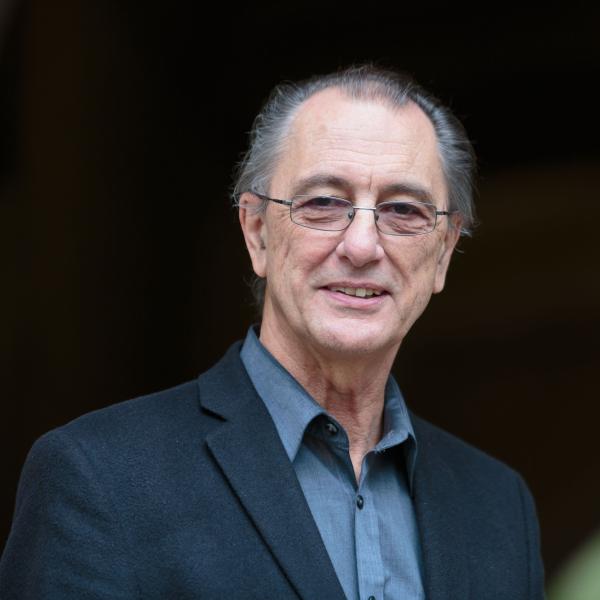
David E. Wellbery
· LeRoy T. and Margaret Deffenbaugh Carlson University Professor in the Department of Germanic StudiesVerifiedUniversity of Chicago · Germanic Studies
Active 1977–2025
About
David E. Wellbery is the LeRoy T. and Margaret Deffenbaugh Carlson University Professor in the Department of Germanic Studies at the University of Chicago. He earned his Ph.D. from Yale University in 1977 and has held academic positions at Stanford, Johns Hopkins, and Chicago. His research interests converge on the late eighteenth and early nineteenth centuries, focusing on the Age of Goethe or the Age of Idealism, and the impact of the epistemological revolution of that period on contemporary thought. His ongoing projects include developing a morphological hermeneutics, exploring Goethe and philosophy, and examining the thought of tragedy. Wellbery's scholarly work engages deeply with debates on the conceptual foundations of his field, including hermeneutics, semiotics, structural analysis, systems theory, media theory, and poststructuralism. Since joining Chicago in 2001, he has collaborated with colleagues in philosophy on a project titled Self-Determining Form and has been active as co-editor of the Deutsche Vierteljahrsschrift für Literaturwissenschaft und Geistesgeschichte. His research emphasizes the great literary figures of the Idealist period—particularly Goethe, Schiller, Hölderlin, and the Romantics—and their intersection with philosophical projects of their time. He also investigates the pessimistic tradition stemming from Schopenhauer and its influence on modernist literature, including figures like Nietzsche, Kafka, and Borges. Wellbery is committed to preparing doctoral students for active participation in international discussions within Germanistik and related disciplines. He has received numerous awards, including the Research Prize of the Alexander von Humboldt Foundation, the Jacob and Wilhelm Grimm Prize of the DAAD, and the Gold Medal from the Goethe Gesellschaft in Weimar. He is an elected member of several prestigious academies, including the American Academy of Arts and Sciences, the American Philosophical Society, and the Deutsche Akademie für Sprache und Dichtung. His teaching includes courses on Goethe’s Faust, narratology, aesthetics, and modern art, among others, and he has authored several influential publications on German literature and philosophy.
Research topics
- Sociology
- Computer Science
- Aesthetics
- Philosophy
- Materials science
- Epistemology
Selected publications
2025-03-12
bookGoethe fungierte bis weit ins 20. Jahrhundert hinein als ein Nationalschriftsteller der USA. Die Rezeption beginnt bei den Transzendentalisten um Ralph Waldo Emerson und Margaret Fuller, wird ausgeformt in der US-amerikanischen Literatur der Jahrhundertwende und neu akzentuiert durch die Autorinnen und Autoren, die nach 1933 aus Deutschland in die USA emigrierten. Die Aufsätze in diesem Band fragen nach den literarischen wie ideengeschichtlichen Wechselverhältnissen und rekonstruieren im Zusammenspiel eine transatlantische Faszinationsgeschichte.
“Dies Bildnis ist bezaubernd schön”: On the Morphology of Eighteenth-Century Drama
The Germanic Review Literature Culture Theory · 2024-07-02
article1st authorCorresponding2024-04-04
book-chapter1st authorCorrespondingThe Literary Grammar of Entrances: On the Work of Juliane Vogel
The Germanic Review Literature Culture Theory · 2024-07-02
articleSenior author2023-03-20
book-chapterOpen accessJohann Wolfgang von Goethe by Jeremy Adler
Goethe yearbook · 2023-01-01
article1st authorCorrespondingReviewed by: Johann Wolfgang von Goethe by Jeremy Adler David E. Wellbery Jeremy Adler. Johann Wolfgang von Goethe. London: Reaktion, 2020. 256 pp. This presentation of Goethe's life and work in the Critical Lives series is just the book every scholar of Goethe has been looking for, and this not merely because it is deeply informed, original in its judgments, and keenly insightful, but also because it is the book to recommend to students and nonspecialists who, after having read, say, Werther or Faust, seek a picture of the overall achievement. The book's virtues are legion. Perhaps foremost among them is that it calls attention to Goethe's contemporary significance while firmly situating his work within the context of European literary and cultural history. Goethe's work comes into view here as both remarkably relevant to the concerns of our moment and as a nodal point in a webwork of cultural traditions extending as far back as the biblical and Greco-Roman interventions. Thankfully, Adler's interrogation of Goethe's life and work sloughs off the carapace of disciplinary obsession and gives us a Goethe who deserves to be a topic of urbane and literate conversation. Indeed, the book is a demonstration of the indispensability of appreciation and discernment—the aims of "criticism" as it emerged in the Enlightenment—to a free and flourishing cultural life. Every knowledgeable reader will find in Adler's book moments that illuminate their own particular zones of interest. Among the segments I found especially salient was the account of Goethe's Italian sojourn and, in particular, the account of his deep engagement with Palladio. Brief but nonetheless sharply focused observations on Palladio's masterful treatise The Four Books of Architecture (1570), a copy of which Goethe, inspired by his autoptic inspection of several buildings, intensely studied, lead into an explanation of neoclassical form as remarkably supple and multivalent. The significance of Palladio's art for Goethe can, in fact, be studied in the latter's own drawings and commentaries on particular polyfunctional moments of architectural composition. Adler employs the insights gained from his consideration of the Palladio material in an account of the controlled fluidity that characterizes the verse version of Iphigenie auf Tauris, an account that, despite its brevity, is fresh and richly suggestive. I add to this Adler's important thought—one I share—that Iphigenie is best viewed together with the major dramatic works that chronologically frame it: Lessing's Nathan der Weise and Mozart and Schikaneder's Die Zauberflöte. The same (slightly dilated) decade that produced Kant's three critiques is likewise the epochal home of the three masterpieces of German-language Enlightenment drama. Add to this the link that Adler draws between Goethe's play and Mary [End Page 179] Wollstonecraft's Vindication of the Rights of Woman and you have material for a rewarding exploration of Goethe's play. The same chapter that contains the discussion of Iphigenie concludes with a demonstration of abundance in brevity: a survey of Goethe's studies in plant morphology, his hypothesis of the Urpflanze, the famous debate with Schiller, the elegiac couplets of "Die Metamorphose der Pflanzen," and the afterlife of Goethe's theory in the work of Charles Darwin, Gregor Mendel, and D'Arcy Thompson. I also want to call attention to the six rich pages Adler devotes to Die Wahlverwandtschaften. Of course, there is no more knowledgeable expert than Adler on the "chemical simile" that gives the novel its title and, to a degree, models the movements of its characters. Accordingly, the reader learns that the term comes from the Swedish chemist Bergman, that it charts the "chiastic" process of double exchange of bonded substances (not elements!), and that chemists today call the process "double decomposition." Adler does not dwell on the ambiguities of the figure but moves quickly and helpfully to its significance as a model of social and psychological cohesion and dissolution. It adds to our appreciation of the novel to learn that Max Weber, who often employed literary references to lend intellectual zest to his analyses, employed the concept of elective affinities in two of his most famous works. In criticism, choice of the...
Jeremy Adler. Johann Wolfgang von Goethe. London: Reaktion, 2020. 256 pp.
2023-04-08
book-chapter1st authorCorresponding2023-06-05
book-chapterOpen accessJeremy Adler. Johann Wolfgang von Goethe. London: Reaktion, 2020. 256 pp.
Boydell and Brewer eBooks · 2023-12-31
book-chapter1st authorCorresponding2023-08-07
book-chapterOpen accessSenior author
Frequent coauthors
- 178 shared
Jutta Müller‐Tamm
- 178 shared
Michael Gamper
Institut für Zeitgeschichte München–Berlin
- 173 shared
Herausgegeben Von
University of Bern
- 173 shared
Hans Ulrich Gumbrecht
- 169 shared
Anita Traninger
- 169 shared
Jürgen Brinckmann
Software (Spain)
- 169 shared
Friedrich Schlegel Graduiertenschule
The University of Tokyo
- 169 shared
Janet Walker
Portland State University
Awards & honors
- Research Prize of the Alexander von Humboldt Foundation
- Jacob and Wilhelm Grimm Prize of the DAAD
- Gold Medal awarded by the Goethe Gesellschaft in Weimar
- Honorary doctorate from the University of Konstanz
- Elected member of the American Academy of Arts and Sciences
- Resume-aware match score
- Save to shortlist
- AI-drafted outreach
See your match with David E. Wellbery
PhdFit ranks faculty by your research interests, methods, and publications — grounded in their actual work, not templates.
- Free to start
- No credit card
- 30-second signup