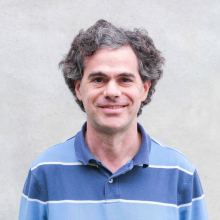
David Gottesman
· ProfessorVerifiedUniversity of Maryland, College Park · Computer Science
Active 1968–2026
About
Daniel Gottesman is the Brin Family Endowed Professor in Theoretical Computer Science at the University of Maryland, where he is a faculty member in the Computer Science department and a member of UMIACS. He is also a QuICS Fellow and Co-director of the Joint Center for Quantum Information and Computer Science (QuICS). Gottesman earned his Ph.D. at Caltech in 1997 and completed postdoctoral research at Los Alamos National Laboratory and Microsoft Research. He subsequently served as a Long-Term CMI Prize Fellow with the Clay Mathematics Institute in the UC Berkeley Computer Science department. Before joining the University of Maryland, he spent 19 years as a faculty member at the Perimeter Institute in Waterloo, Ontario. His research primarily focuses on quantum computation and quantum information, with significant contributions in quantum error correction, fault-tolerant quantum computation, quantum complexity, and quantum cryptography. He is best known for developing the stabilizer code formalism, which provides a framework for creating and describing a large class of quantum codes, and for pioneering work on performing quantum gates using quantum teleportation. Gottesman has been recognized as one of MIT Technology Review's TR100 Top Young Innovators in 2003 and is a Fellow of the American Physical Society. In addition to his research, Gottesman has authored a draft textbook on quantum error correction and fault tolerance titled "Surviving as a Quantum Computer in a Classical World." He teaches graduate and undergraduate courses at the University of Maryland on topics including quantum information processing, cryptography, quantum complexity, and quantum error correction and fault tolerance.
Research topics
- Computer Science
- Combinatorics
- Mathematics
- Quantum mechanics
- Algorithm
- Distributed computing
- Theoretical computer science
- Geometry
- Physics
Selected publications
No-Go Theorem on Fault Tolerant Gadgets for Multiple Logical Qubits
ArXiv.org · 2026-02-13
articleOpen accessSenior authorIdentifying stabilizer codes that admit fault-tolerant implementations of the full logical Clifford group would significantly advance fault-tolerant quantum computation. Motivated by this goal, we study several classes of fault-tolerant gadget constructions consisting of Clifford gates acting on the physical qubits, including transversal gadgets, code automorphisms, and fold-transversal gadgets. While stabilizer codes encoding a single logical qubit, most notably the [[7,1,3]] Steane code, are known to admit transversal implementations of the full logical Clifford group, no analogous examples are known for codes encoding multiple logical qubits. In this work, we prove a no-go theorem establishing that no stabilizer code admits a fully transversal implementation of the Clifford group on more than one logical qubit. We further strengthen this result by showing that fold-transversal implementations of the full logical Clifford group are impossible for stabilizer codes encoding more than two logical qubits. More generally, we introduce the notion of k-fold transversal gadgets and prove that implementing the full Clifford group on k logical qubits requires at least k-fold transversal gadgets at the physical level. In addition, we analyze code-automorphism based constructions and demonstrate that they also fail to realize the full Clifford group on multiple logical qubits for any stabilizer code. Together, these results place fundamental constraints on fault-tolerant Clifford gadget design and show that stabilizer codes supporting the full logical Clifford group on multiple logical qubits via these architectures do not exist. Since the Clifford group is a core component of universal gate sets, our findings imply that quantum computing with codes encoding multiple logical qubits within a single code block necessarily entails more complex constructions for fault tolerance.
No-Go Theorem on Fault Tolerant Gadgets for Multiple Logical Qubits
Open MIND · 2026-02-13
preprintSenior authorIdentifying stabilizer codes that admit fault-tolerant implementations of the full logical Clifford group would significantly advance fault-tolerant quantum computation. Motivated by this goal, we study several classes of fault-tolerant gadget constructions consisting of Clifford gates acting on the physical qubits, including transversal gadgets, code automorphisms, and fold-transversal gadgets. While stabilizer codes encoding a single logical qubit, most notably the [[7,1,3]] Steane code, are known to admit transversal implementations of the full logical Clifford group, no analogous examples are known for codes encoding multiple logical qubits. In this work, we prove a no-go theorem establishing that no stabilizer code admits a fully transversal implementation of the Clifford group on more than one logical qubit. We further strengthen this result by showing that fold-transversal implementations of the full logical Clifford group are impossible for stabilizer codes encoding more than two logical qubits. More generally, we introduce the notion of k-fold transversal gadgets and prove that implementing the full Clifford group on k logical qubits requires at least k-fold transversal gadgets at the physical level. In addition, we analyze code-automorphism based constructions and demonstrate that they also fail to realize the full Clifford group on multiple logical qubits for any stabilizer code. Together, these results place fundamental constraints on fault-tolerant Clifford gadget design and show that stabilizer codes supporting the full logical Clifford group on multiple logical qubits via these architectures do not exist. Since the Clifford group is a core component of universal gate sets, our findings imply that quantum computing with codes encoding multiple logical qubits within a single code block necessarily entails more complex constructions for fault tolerance.
The rotation-invariant Hamiltonian problem is QMA$_{\rm EXP}$-complete
ArXiv.org · 2025-08-29
preprintOpen accessSenior authorIn this work, we study a variant of the local Hamiltonian problem where we restrict to Hamiltonians that live on a lattice and are invariant under translations and rotations of the lattice. In the one-dimensional case this problem is known to be QMA$_{\rm EXP}$-complete. On the other hand, if we fix the lattice length then in the high-dimensional limit the ground state becomes unentangled due to arguments from mean-field theory. We take steps towards understanding this complexity spectrum by studying a problem that is intermediate between these two extremes. Namely, we consider the regime where the lattice dimension is arbitrary but fixed and the lattice length is scaled. We prove that this rotation-invariant Hamiltonian problem is QMA$_{\rm EXP}$-complete answering an open question of [Gottesman, Irani 2013]. This characterizes a broad parameter range in which these rotation-invariant Hamiltonians have high computational complexity.
Error Correction in Dynamical Codes
Quantum · 2025-10-20 · 4 citations
articleOpen accessSenior authorWe ask what is the general framework for a quantum error correcting code that is defined by a sequence of measurements. Recently, there has been much interest in Floquet codes and space-time codes. In this work, we define and study the distance of a dynamical code. This is a subtle concept and difficult to determine: At any given time, the system will be in a subspace which forms a quantum error-correcting code with a given distance, but the full error correction capability of that code may not be available due to the schedule of measurements associated with the code. We address this challenge by developing an algorithm that tracks information we have learned about the error syndromes through the protocol and put that together to determine the distance of a dynamical code, in a non-fault-tolerant context. We use the tools developed for the algorithm to analyze the initialization and masking properties of a generic Floquet code. Further, we look at properties of dynamical codes under the constraint of geometric locality with a view to understand whether the fundamental limitations on logical gates and code parameters imposed by geometric locality for traditional codes can be surpassed in the dynamical paradigm. We find that codes with a limited number of long range connectivity will not allow non-Clifford gates to be implemented with finite depth circuits in the 2D setting.
Toward a 2D Local Implementation of Quantum Low-Density Parity-Check Codes
PRX Quantum · 2025-01-09 · 25 citations
articleOpen accessSenior authorGeometric locality is an important theoretical and practical factor for quantum low-density parity-check (qLDPC) codes that affects code performance and ease of physical realization. For device architectures restricted to two-dimensional (2D) local gates, naively implementing the high-rate codes suitable for low-overhead fault-tolerant quantum computing incurs prohibitive overhead. In this work, we present an error-correction protocol built on a bilayer architecture that aims to reduce operational overheads when restricted to 2D local gates by measuring some generators less frequently than others. We investigate the family of bivariate-bicycle qLDPC codes and show that they are well suited for a parallel syndrome-measurement scheme using fast routing with local operations and classical communication (LOCC). Through circuit-level simulations, we find that in some parameter regimes, bivariate-bicycle codes implemented with this protocol have logical error rates comparable to the surface code while using fewer physical qubits.
From quantum cheating to quantum security
Physics Today · 2025-01-01 · 1 citations
article1st authorCorrespondingFor thousands of years, code-makers and code-breakers have been competing for supremacy. Their arsenals may soon include a powerful new weapon: quantum mechanics.
PRX Quantum · 2025-05-28 · 3 citations
preprintOpen accessSenior authorDevice error rates on current quantum computers have improved enough to where demonstrations of error correction below break even are now possible. Still, the circuits required for quantum error correction introduce significant overhead and sometimes inject more errors than they correct. In this work, we introduce adaptive syndrome extraction as a scheme to improve code performance and reduce the quantum error-correction cycle time by measuring only the stabilizer generators that are likely to provide useful syndrome information. We provide a concrete example of the scheme through the [[4,2,2]] code concatenated with a hypergraph product code and a syndrome-extraction cycle that uses quantum error detection to modify the syndrome-extraction circuits in real time. Compared to nonconcatenated codes and nonadaptive syndrome extraction, we find that the adaptive scheme achieves over an order of magnitude lower logical error rates while requiring fewer gates and physical qubits. Furthermore, we show how to achieve fault-tolerant universal logical computation with [[4,2,2]]-concatenated hypergraph product codes.
Low-depth quantum symmetrization
arXiv (Cornell University) · 2024-11-06 · 2 citations
preprintOpen accessSenior authorQuantum symmetrization is the task of transforming a non-strictly increasing list of $n$ integers into an equal superposition of all permutations of the list (or more generally, performing this operation coherently on a superposition of such lists). This task plays a key role in initial state preparation for first-quantized simulations. Motivated by an application to fermionic systems, various algorithms have been proposed to solve a weaker version of symmetrization in which the input list is strictly increasing, but the general symmetrization problem with repetitions in the input list has not been well studied. We present the first efficient quantum algorithms for the general symmetrization problem. If $m$ is the greatest possible value of the input list, our first algorithm symmetrizes any single classical input list using $\tilde{O}(\log n)$ depth and $O(n\log n + \log m)$ ancilla qubits, and our second algorithm symmetrizes an arbitrary superposition of input lists using $\tilde{O}(\log^3 n)$ depth and $O(n\log n)$ ancilla qubits. Our algorithms enable efficient simulation of bosonic quantum systems in first quantization and can prepare (superpositions of) Dicke states of any Hamming weight in $\tilde{O}(\log n)$ depth (respectively, $\tilde{O}(\log^3 n)$ depth) using $O(n\log n)$ ancilla qubits. We also propose an $\tilde{O}(\log^3 n)$-depth quantum algorithm to transform second-quantized states to first-quantized states. Using this algorithm, QFT-based quantum telescope arrays can image brighter photon sources, extending quantum interferometric imaging systems to a new regime.
Partial Syndrome Measurement for Hypergraph Product Codes
Quantum · 2024 · 9 citations
Senior authorCorresponding- Computer Science
- Mathematics
- Computer Science
Hypergraph product codes are a promising avenue to achieving fault-tolerant quantum computation with constant overhead. When embedding these and other constant-rate qLDPC codes into 2D, a significant number of nonlocal connections are required, posing difficulties for some quantum computing architectures. In this work, we introduce a fault-tolerance scheme that aims to alleviate the effects of implementing this nonlocality by measuring generators acting on spatially distant qubits less frequently than those which do not. We investigate the performance of a simplified version of this scheme, where the measured generators are randomly selected. When applied to hypergraph product codes and a modified small-set-flip decoding algorithm, we prove that for a sufficiently high percentage of generators being measured, a threshold still exists. We also find numerical evidence that the logical error rate is exponentially suppressed even when a large constant fraction of generators are not measured.
arXiv (Cornell University) · 2024-02-12 · 1 citations
preprintOpen accessSenior authorTo implement a quantum error correction protocol, we first need a scheme to prepare our state in the correct subspace of the code, and this can be done using a unitary encoding circuit. Majorana codes are special since any gates that transform such codes must preserve fermionic parity. In this paper, we present an algorithm that uses the stabilizer matrix to compute unitary encoding circuits for Majorana codes. We present two approaches, both of which use a version of Gaussian elimination with row operations replaced with elementary fermionic Clifford operations. One approach uses an additional ancilla mode and works for all Majorana stabilizer codes, while the second approach does not use ancilla but does not work if the total parity is inside the stabilizer group.
Frequent coauthors
- 15 shared
John Preskill
- 13 shared
Adam Smith
- 12 shared
Hoi‐Kwong Lo
- 9 shared
Noah Berthusen
Joint Center for Quantum Information and Computer Science
- 9 shared
Claude Crépeau
- 9 shared
Maryam Mudassar
- 8 shared
Samuel L. Braunstein
University of York
- 7 shared
Sandy Irani
Labs
CLIP LabPI
Education
- 1997
Ph.D., Physics
California Institute of Technology
- Resume-aware match score
- Save to shortlist
- AI-drafted outreach
See your match with David Gottesman
PhdFit ranks faculty by your research interests, methods, and publications — grounded in their actual work, not templates.
- Free to start
- No credit card
- 30-second signup