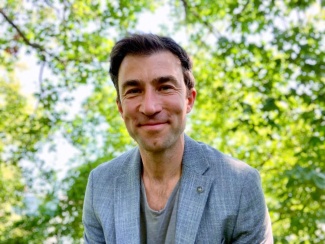
David Pietraszewski
· Assistant ProfessorVerifiedUniversity of California, Santa Barbara · Psychology
Active 2011–2026
About
David Pietraszewski received his B.A. from Ithaca College and his Ph.D. in Psychological and Brain Sciences from UCSB in 2009. Following his doctoral studies, he completed a postdoctoral fellowship at Yale University until 2014. He then served as a Research Scientist, equivalent to an assistant professor, at the Max Planck Institute for Human Development (Bildungsforschung) in Berlin, Germany. In March 2024, he became a faculty member at UCSB. His professional trajectory highlights a strong foundation in psychological and brain sciences, with experience spanning prestigious institutions in the United States and Germany.
Research topics
- Computer Science
- Artificial Intelligence
- Machine Learning
- Sociology
- Political Science
- Psychology
- Social psychology
- Cognitive psychology
- Gender studies
- Biology
- Cognitive science
- Epistemology
Selected publications
Neural Signatures of the Triadic Primitives: an ERP Study
Open MIND · 2026-01-01
otherOpen accessThe present project investigates the neural signatures of representing social groups. Using electroencephalography (EEG), we will measure the neural responses of participants engaging in a triadic social interaction task with expected and deviant outcomes. The Triadic Primitives Model (Pietraszewski, 2022) posits that certain cognitive priors for representing adversarial coalitions are in place. Depending on how a third agent becomes involved in a dyadic conflict, the four priors are: generalization, alliance, displacement, and defense. The model predicts that violating the expected outcomes of triadic interactions will elicit brain activity associated with surprise, namely the event related potentials (ERPs) N2 and P300. By examining the Triadic Primitives Model in light of EEG evidence, the project aims to refine the current scientific discourse on social cognition.
oLT7: How to ensure that the theory crisis continues
OSF Preprints (OSF Preprints) · 2026-05-05
other1st authorCorrespondingEvolution and Human Behavior · 2026-04-04
article1st authorCorrespondingA psychological explanation of the problem of free will
2025-08-31
articleOpen access1st authorCorrespondingThe problem of free will involves reconciling a scientific view of the mind as composed ofmechanisms with the notion of agents who enjoy freedom. Difficulty in reconciling these views hasled to perennial waves of debate over whether free will really exists, and what evidence mightadjudicate this question. Here, we adopt a novel approach to the problem by treating the perceptionof the problem of free will itself as a psychological phenomenon. Evolved systems for reasoningabout the self and the social world treat predictable, mechanistic relationships as antithetical toagency and free will. As a consequence, one has the experience of making up one’s mind with thepossibility of doing otherwise, and of influencing others by intervening upon what they think andbelieve. In contrast, evolved systems for reasoning about artifacts and physical relationships treatmental phenomena as emerging out of predictable mechanisms that lack the capacity to dootherwise, and need not be intervened upon via thoughts and beliefs. Different cognitive systemsare thereby producing conflicting intuitions about how to conceptualize the mind, and theseconflicting outputs give rise to the free will problem. The arguments for and against free will areunderstandable in light of this analysis: they emphasize different evidentiary standards whichthemselves stem from different psychological adaptations for understanding reality. Understandingthe psychological basis of the problem, we suggest, goes a long way towards solving the problem offree will.
An empirical test of the Triadic Primitives Model
Open Science Framework · 2025-01-01
otherOpen access1st authorCorrespondingExisting theoretical work (e.g. Pietraszewski, 2016, 2022) offers a set of computational primitives that constitute group membership. These are a set of roles within four different triadic interaction types, all of which have the following structure: A attacks B, and then because of this event, a third agent, C, becomes involved. C can either attack A, or B, or A can then attack C, or B can then attack C. An architecture that can represent these four interaction types and string them together, the theory runs, is sufficient to represent and reason about polyadic conflict (so long as specific agents can be assigned to any of the roles A, B, and C; see Pietraszewski, 2016, for details and examples). In this study, we explore the hypothesis presented in Pietraszewski (2022, also 2013, 2016), which is that what group membership constitutes to the human mind (in the context of conflict) is the occupation of particular roles within these four triadic primitives. These are roles B and C when A attacks C and when C attacks A, roles A and C when C attacks B, and when B attacks C (see Figure 1). This account makes two broad predictions, both of which will be tested in the current studies. The first prediction is that it should be intuitive for participants to infer group membership based on observing agents occupying these roles. We refer to this as going from “behaviors to groups”. That is, upon seeing a set of three individual agents interacting, participants judgements of who is in a group with whom should comport with the theory (see Figure 1 for which roles within each of the triadic interactions constitutes group membership, according to the theory). Crucially, participants will only see the cost-imposition behaviors; the roles that constitute group membership will not be highlighted. The second prediction is that participants should generate expectations of the group constitutive roles when they are given information about abstract group membership. We refer to this as going from “groups to behaviors”. Participants will be shown two different groups (in this case, little cartoon characters with spatial and physical differences, where the two clusters of little characters are verbally labelled as belonging to different groups), and will then be shown three cartoon characters, and asked to predict how a third character will behave, given an interaction between two. In essence, this amounts to asking participants if they intuitively expect the group-constitute triadic interaction types, given prior information about who is already in a group with whom.
A psychological explanation of the problem of free will
2025-01-25
preprintOpen access1st authorCorrespondingThe problem of free will involves reconciling a scientific view of the mind as composed ofmechanisms with the notion of agents who enjoy freedom. Difficulty in reconciling these views hasled to perennial waves of debate over whether free will really exists, and what evidence mightadjudicate this question. Here, we adopt a novel approach to the problem by treating the perceptionof the problem of free will itself as a psychological phenomenon. Evolved systems for reasoningabout the self and the social world treat predictable, mechanistic relationships as antithetical toagency and free will. As a consequence, one has the experience of making up one’s mind with thepossibility of doing otherwise, and of influencing others by intervening upon what they think andbelieve. In contrast, evolved systems for reasoning about artifacts and physical relationships treatmental phenomena as emerging out of predictable mechanisms that lack the capacity to dootherwise, and need not be intervened upon via thoughts and beliefs. Different cognitive systemsare thereby producing conflicting intuitions about how to conceptualize the mind, and theseconflicting outputs give rise to the free will problem. The arguments for and against free will areunderstandable in light of this analysis: they emphasize different evidentiary standards whichthemselves stem from different psychological adaptations for understanding reality. Understandingthe psychological basis of the problem, we suggest, goes a long way towards solving the problem offree will.
The Evolved Cognitive Architecture for Groups
2025-03-14
preprintOpen access1st authorCorrespondingGroups are fundamental to human life, and to understand why, one needn’t look any further than the above quote. But it is one thing to understand why a phenomenon exists, and another to understand how it works. Understanding how the psychology of groups works will be our concern in this chapter.
On the evolved psychological mechanisms that make peace and reconciliation between groups possible
Behavioral and Brain Sciences · 2024-01-01
articleSenior authorIf group norms and decisions foster peace, then understanding how norms and decisions arise becomes important. Here, we suggest that neither norms nor other forms of group-based decision making (such as offering restitution) can be adequately understood without simultaneously considering (i) what individual psychologies are doing and (ii) the dynamics these psychologies produce when interacting with each other.
Homo historicus: History as psychological science
Behavioral and Brain Sciences · 2024-01-01
articleOpen access1st authorCorrespondingHistorical myths are indeed a mystery in need of explanation, and we elaborate on the present adaptationist account. However, the same analysis can also be applied to motivations to produce and consume history in general: That humans produce and consume history is also a mystery in need of psychological explanation. An adaptationist psychological science of history is needed.
On the Problems Solved by Cognitive Processes
Cognitive Science · 2023-06-01 · 4 citations
letterOpen accessCognitive scientists have focused too narrowly on the acquisition of data and on the methods to extract patterns from those data. We argue that a successful science of the mind requires widening our focus to include the problems being solved by cognitive processes. Frameworks that characterize cognitive processes in terms of instrumental problem-solving, such as those within the evolutionary social sciences, become necessary if we wish to discover more accurate descriptions of those processes.
Frequent coauthors
- 12 shared
Annie E. Wertz
University of California, Santa Barbara
- 5 shared
Karen Wynn
Clinical Trial Investigators
- 5 shared
Michael E. McCullough
- 5 shared
Gregory A. Bryant
University of California, Los Angeles
- 4 shared
Timothy J. Pleskac
- 3 shared
Leda Cosmides
University of California, Santa Barbara
- 3 shared
John Tooby
University of California, Santa Barbara
- 2 shared
Arend Hintze
Dalarna University
Labs
Awards & honors
- Laura Lewis Awarded APA Fantz Memorial Award
- Karen Szumlinski Receives 2026 Distinguished Teaching Award
- Professor Shelly Gable elected to the American Association f…
- Resume-aware match score
- Save to shortlist
- AI-drafted outreach
See your match with David Pietraszewski
PhdFit ranks faculty by your research interests, methods, and publications — grounded in their actual work, not templates.
- Free to start
- No credit card
- 30-second signup