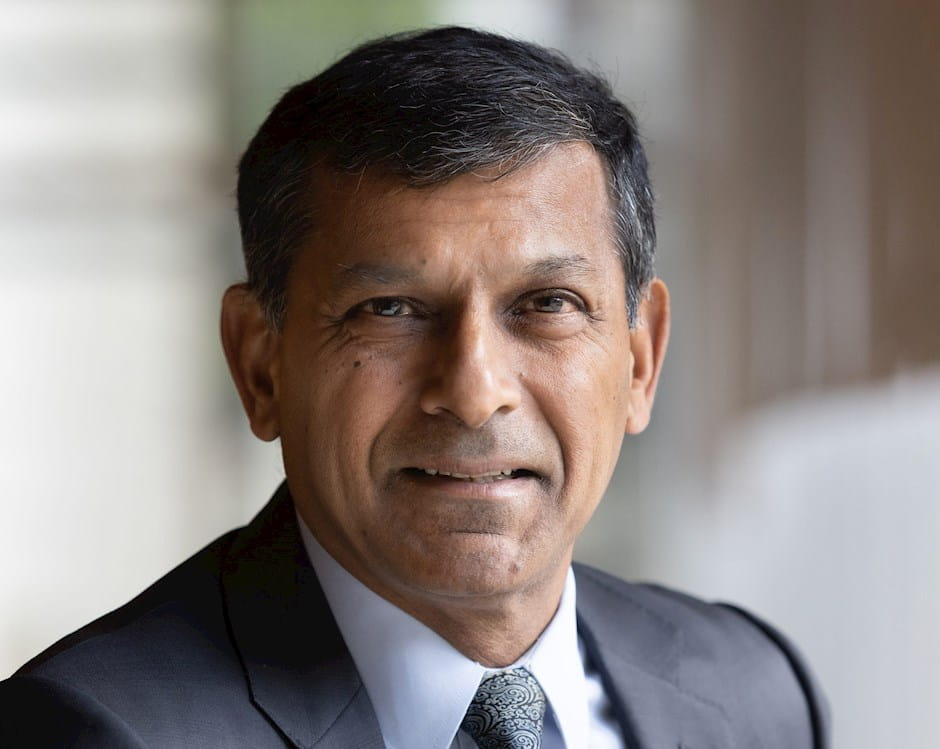
Raghu Rajan
· Clinical Professor of FinanceVerifiedUniversity of Chicago · Booth School of Business
Active 1988–2026
Research topics
- Economics
- Business
- Financial system
- Finance
- Monetary economics
Selected publications
4 Where Should India Place Its Hopes?
Princeton University Press eBooks · 2026-01-19
book-chapter1st authorCorrespondingPrelude: Governance and Structures
Princeton University Press eBooks · 2026-01-19
book-chapter1st authorCorrespondingPrinceton University Press eBooks · 2026-01-19
book1st authorCorrespondingThe new path for economic development that India must create The whole world has a stake in India’s future, and that future hinges on whether India can develop its economy and deliver for its population—now the world’s largest—while staying democratic. India’s economy has overtaken the United Kingdom’s to become the fifth-largest in the world, but it is still only one-fifth the size of China’s, and India’s economic growth is too slow to provide jobs for millions of its ambitious youth. Blocking India’s current path are intense global competition in low-skilled manufacturing, increasing protectionism and automation, and the country’s majoritarian streak in politics. In Breaking the Mold , Raghuram Rajan and Rohit Lamba show why and how India needs to blaze a new path if it’s to succeed. India diverged long ago from the standard development model, the one followed by China—from agriculture to low-skilled manufacturing, then high-skilled manufacturing and, finally, services—by leapfrogging intermediate steps. India must not turn back now. Rajan and Lamba explain how India can accelerate growth by prioritizing human capital, expanding opportunities in high-skilled services, encouraging entrepreneurship, and strengthening rather than weakening its democratic traditions. It can chart a path based on ideas and creativity even at its early stage of development. Filled with vivid examples and written with incisive candor, Breaking the Mold shows how India can break free of the stumbling blocks of the past and embrace the enormous possibilities of the future.
Princeton University Press eBooks · 2026-01-19
book-chapter1st authorCorrespondingWhen is Less More? Bank Arrangements for Liquidity vs Central Bank Support
SSRN Electronic Journal · 2025-01-01
preprintOpen accessWhen is Less More? Bank Arrangements for Liquidity vs Central Bank Support
SSRN Electronic Journal · 2025-01-01
preprintOpen accessThe Long and Short of Financial Development
SSRN Electronic Journal · 2025-01-01
preprintOpen accessSenior authorWhen is Less More? Bank Arrangements for Liquidity vs Central Bank Support
National Bureau of Economic Research · 2025-08-01
reportOpen accessTheory suggests that in the face of fire-sale externalities, banks have incentives to overinvest in order to issue cheap money-like deposit liabilities.The existence of a private market for insurance such as contingent capital can eliminate the overinvestment incentives, leading to efficient outcomes.However, it does not eliminate fire sales.A central bank that can infuse liquidity cheaply may be motivated to intervene in the face of fire sales.If so, it can crowd out the private market and, if liquidity intervention is not priced at higher-than-breakeven rates, induce overinvestment once again.We examine various forms of public intervention to identify the least distortionary ones.Our analysis suggests why private contingent capital dominated in the era preceding central banks and deposit insurance, why it waned subsequently, as well as why banking crises and speculative excesses continue to recur periodically.
Taking Stock of Some Core Assumptions in Finance
2025-04-08
book-chapter1st authorCorrespondingAbstract This chapter critically examines foundational assumptions in finance, acknowledging their role as frameworks for rigorous thinking rather than immutable truths. It delves into three key assumptions: market efficiency, shareholder value maximization, and the Modigliani–Miller theorem, elucidating their implications and evolving interpretations. Additionally, it explores the role of finance in societal issues like climate change and discrimination, emphasizing the need for responsible corporate behavior. The chapter also reflects on the teaching of finance and the evolving nature of shareholder preferences, advocating for a balanced approach that considers the interests of all stakeholders. Overall, it encourages a nuanced understanding of finance’s role in shaping economic and social landscapes.
SSRN Electronic Journal · 2025-01-01
articleOpen accessSenior author
Recent grants
NSF · $393k · 2002–2008
Frequent coauthors
- 229 shared
Luigi Zingales
University of Chicago
- 167 shared
Viral V. Acharya
National Bureau of Economic Research
- 96 shared
Rodney Ramcharan
University of Southern California
- 94 shared
Douglas W. Diamond
National Bureau of Economic Research
- 70 shared
Eswar Prasad
- 62 shared
Christian Leuz
- 47 shared
Arvind Subramanian
Post Graduate Institute of Medical Education and Research
- 44 shared
Mitchell A. Petersen
National Bureau of Economic Research
- Resume-aware match score
- Save to shortlist
- AI-drafted outreach
See your match with Raghu Rajan
PhdFit ranks faculty by your research interests, methods, and publications — grounded in their actual work, not templates.
- Free to start
- No credit card
- 30-second signup