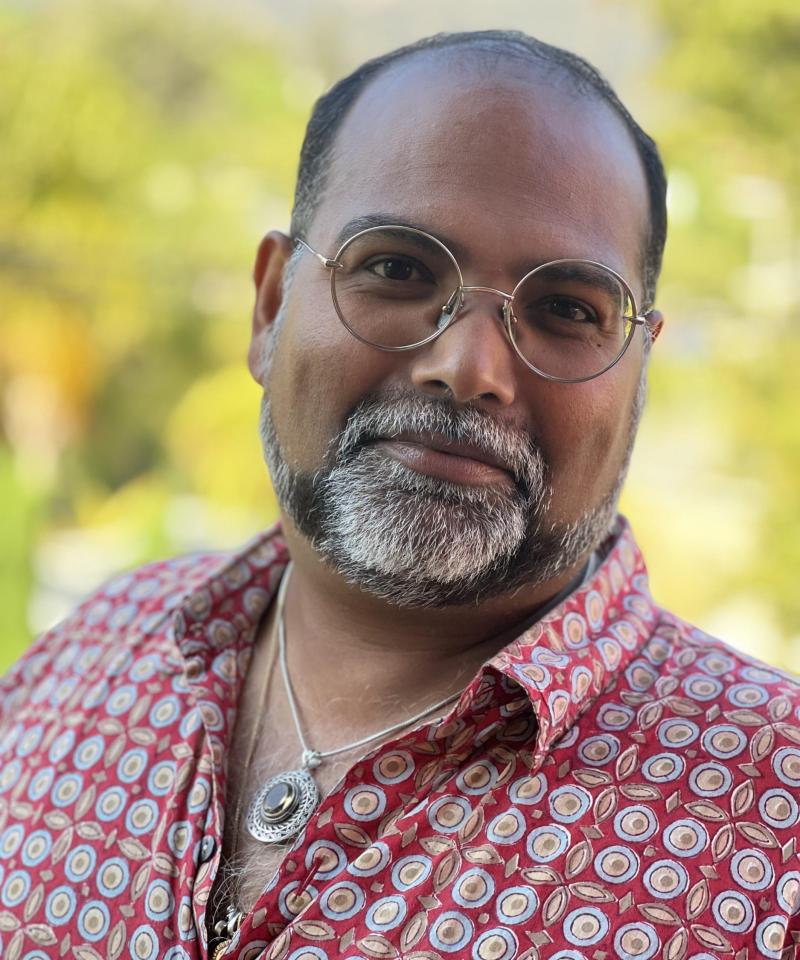
Debanuj DasGupta
· Associate ProfessorVerifiedUniversity of California, Santa Barbara · Women's and Gender Studies
Active 2014–2025
About
Debanuj DasGupta is an Associate Professor of Feminist Studies at the University of California, Santa Barbara, with a focus on transgender studies, queer theory, transnational feminism and sexuality studies, queer migration studies, South Asia studies, international development, and human rights. His research and teaching concentrate on the global governance of migration, sexuality, and HIV, utilizing collaborative scholar and activist research methods to explore the political potentials of trauma experienced by LGBTQ immigrants, refugees, and asylum seekers. Prior to UCSB, he served as an Assistant Professor of Geography and Women’s, Gender, and Sexuality Studies at the University of Connecticut from 2016 to 2020. He has held leadership roles such as Board Co-Chair of the Center for LGBTQ Studies at CUNY and is on the editorial board of Geography Compass. His scholarly work has been published in numerous academic journals, and he is involved in editing volumes related to queer activism and digital activism in India. Debanuj has received several prestigious awards, including the Engaging the Humanities Research Award from UCHRI and the SSRC Junior Scholar Award in Trans-Regional Studies. He is a survivor of the detention/prison industrial complex and has lived as an undocumented immigrant in the US for over a decade. Before entering academia, he worked for over twenty years in movements for sexual liberation and migrant justice in the US and India.
Research topics
- Sociology
- Gender studies
- Political science
- Law
- Criminology
Selected publications
The Professional Geographer · 2025-11-02
article1st authorCorrespondingThe Professional Geographer · 2025-11-02
articleOpen accessSenior author10.1080/00330124.2025.2582176
Roundtable: Queer/Trans of Color Transits and the Imaginaries of Racial Capitalism
South Atlantic Quarterly · 2024-01-01 · 4 citations
articleIn this roundtable, scholars respond to the following guiding questions of the special issue: Racial capitalism in US scholarship is necessarily and rightfully narrated through the Transatlantic slave trade. While this is a globally relevant history for understanding the past and the present of transnational racial orders, what other histories and present modes of capitalist accumulation are relevant to telling a global history of racial capitalism? How do queer hermeneutics reckon with global and transnational histories of social differentiation that ground in other or additional intellectual traditions of what we might expansively call “race”? How would queer of color critique as an analytic be useful to question the very making of abject and abnormal bodies, the structures of knowledge and regimes of truth that produce them, and the political economies that necessitate them? To what extent does positioning queer and trans of color critique as methods objects and subjects, “beyond identity politics,” or even “the Human,” alleviate or otherwise reconfigure these issues?
Transgender Rights and Religiosities in India
GLQ A Journal of Lesbian and Gay Studies · 2023-06-01 · 11 citations
articleSenior authorThis article argues that religious mythologies and cultural narratives about the timelessness of gender diversity in South Asia frame the formation of the transgender subject of rights in India. The authors interrogate a verdict issued by the Supreme Court of India in 2014 and the Transgender Person Bill of Rights (2018) to ascertain the frames of recognition accorded diverse transgender communities in India. This is followed by an analysis of the category of eunuch created and criminalized by British colonizers and the present-day category of transgender based on self-affirmation of gender. The conflating of religious mythologies into deliberations about transgender constitutional rights reveals how the supposedly secular rights – based claims of and for transgender communities are mediated through a predominantly Hindu Brahmanical imagination of the rights-bearing transgender subject. The authors examine autobiographical narratives by three prominent transgender rights activists in India: Laxmi Narayan Tripathi, Living Smile Vidya, and A. Revathi, who provide conflicting visions about the role of religion and state recognition of transgender identities. The authors argue the need for theorizing transgender subjectivities from non-Brahman, Dalit, transmasculine, and non – North Indian perspectives. Such theorizations reveal the potential of coalitional transgender activisms that seek to disrupt Hindu-nationalist hailing of the transgender subject of rights in contemporary India. The authors offer new directions in transgender studies by showing how religious narratives, ritual and performance lie at the heart of transgender subject formation while gesturing toward how such formation risks subsuming transgender identities within (Hindu) nationalist projects.
Affective Heritage and the Politics of Memory After 9/11: Curating Trauma at the Memorial Museum
The AAG Review of Books · 2023-01-02 · 1 citations
articleOpen accessSouth Asian Popular Culture · 2023-05-04 · 2 citations
articleSenior authorThe 2020 crime thriller web series Paatal Lok featured a Nepali trans woman by the name of Mary Lyngdoh who is referred to as ‘Cheeni’ (a racial epithet for persons from India’s Northeast region and East Asia). The series has been lauded for its inclusive representation of a transgender actor, Henthoi Mairembam from Manipur, yet the choice of a Khasi name, ‘Mary Lyngdoh’, for a Nepali character as well as the use of ‘Cheeni’ as an alias raise multiple questions about racialization and queer politics in India. This arbitrary racialized characterization in Paatal Lok and its queer Northeast representation can serve as critical points of departure to examine the emerging LGBTQ politics in Northeast India. This paper attempts to highlight the convergences and incommensurability of LGBTQ politics in the region, particularly in Manipur, with that of mainland India. Against the backdrop of the history of militarization and conflict in Northeast India, LGBTQ individuals migrants from the region are further racialized in India’s metropolitan centers. This geopolitical alienation is felt by LGBTQ persons from the Northeast at the scale of the body. LGBTQ politics in Manipur represents a new form of resistance that introduces ‘Indigeneity’ as an identity and an epistemic category to counter the assimilationist projects of Hindutva’s authoritarian nationalism.
2023-12-11
book-chapterSenior authorThe 2020 crime thriller web series Paatal Lok featured a Nepali trans woman by the name of Mary Lyngdoh who is referred to as ‘Cheeni’ (a racial epithet for persons from India’s Northeast region and East Asia). The series has been lauded for its inclusive representation of a transgender actor, Henthoi Mairembam from Manipur, yet the choice of a Khasi name, ‘Mary Lyngdoh’, for a Nepali character as well as the use of ‘Cheeni’ as an alias raise multiple questions about racialization and queer politics in India. This arbitrary racialized characterization in Paatal Lok and its queer Northeast representation can serve as critical points of departure to examine the emerging LGBTQ politics in Northeast India. This paper attempts to highlight the convergences and incommensurability of LGBTQ politics in the region, particularly in Manipur, with that of mainland India. Against the backdrop of the history of militarization and conflict in Northeast India, LGBTQ individuals migrants from the region are further racialized in India’s metropolitan centers. This geopolitical alienation is felt by LGBTQ persons from the Northeast at the scale of the body. LGBTQ politics in Manipur represents a new form of resistance that introduces ‘Indigeneity’ as an identity and an epistemic category to counter the assimilationist projects of Hindutva’s authoritarian nationalism.
Law, gender identity, and the uses of human rights: The paradox of recognition in South Asia
Journal of Human Rights · 2021-01-01 · 50 citations
articleSenior authorSouth Asia abounds with diverse gender identities that vary regionally based on religion, language, and cultural practices. Transgender rights activists have successfully deployed human rights rhetoric in order to obtain legal recognition of diverse gender identities from courts. However, the collapsing of these diverse identities and practices into a single category, under the transgender umbrella, by governments and judiciaries has created complex mechanisms for legal recognition of transgender persons. Simultaneously, international human rights principles are being invoked to win victories at the national level, which in turn offers insights into the dynamic interplay between law, activism, and human rights. In this article, we outline the constraints and opportunities presented by the changes in legal recognition of diverse gender identities across South Asia. We argue that the uses of international human rights statutes in national-level legal and judicial deliberations about recognizing transgender persons across South Asia offer limited opportunities, and mostly delimit access to formal citizenship, the very objective these laws seek to achieve. Simultaneously, this moment of wrestling with the limits of law, while continuing to demand full recognition from individual states, has given rise to cross-border mobilizations of a vibrant transgender rights movement. Such mobilizations reveal how diverse transgender activists are reinterpreting human rights principles in order to create coalitional multi-issue trans/justice movements throughout South Asia.
Aparajita and Nishith Chetana: the city’s contested fabric
Contemporary South Asia · 2020-10-01
articleSenior authorCorrespondingThis article examines self-making projects and the desire for respectability within queer lives in Kolkata, across distinct class-caste affiliations. We argue the desire for queer respectability take virtual forms, sartorial fashioning, and yet remains a convoluted project mirroring Kolkata’s relationship with neoliberal capitalism. The authors engage with a young lesbian identified activist and a young male fashion designer whose sexual identity remains tacit. Their virtual and real interactions reveal how both the characters conceal their caste and class status through projects of sartorial fashion in order to be read as appropriately queer. The article argues for understanding sexual and gender identities in relation with class, and caste status, as well as ethnic and religious identities, thereby revealing how the liberatory potentials of queer activism is a form of emergent neoliberal governmentality within contemporary India.
The Politics of Transgender Asylum and Detention
Human Geography · 2019-11-01 · 15 citations
article1st authorCorrespondingImmigration procedures related to asylum and detention are based on sex/gender binaries. Such binaries frame the bodies of undocumented transgender asylum seekers as unintelligible to immigration law and subject them to intense trauma. The experiences of trauma and death of transgender detainees within detention centers is a spatialized experience. The assignment of detention cells based on birth gender, denial of hormones and live saving treatments constitute a racialized and gendered torture upon the body of the transgender detainee. The article attends to the narratives of transgender detainees within detention cell by analyzing the script of “ Tara's Crossing,” a play based on the narratives of transgender detainees and asylum seekers. The play was produced by LGBTQ immigrant right activists soon after the attacks on 9/11 and the intensification of detention and deportation as a part of national security procedures. Drawing upon the script of Tara's Crossing, along with activist archives such as flyers, newsletter articles, and radio interviews of Balmitra Vimal Prasad, the protagonist of the play, the article analyzes the ways in which the sex/gender binary is reiterated within the detention cell, as well as asylum procedures. I turn to the activism around Tara's Crossing and the present-day activism of transgender immigrants in order to show how trauma experienced by transgender detainees holds potential for creating coalitional oppositional politics.
Frequent coauthors
- 10 shared
Rohit K. Dasgupta
- 2 shared
Maisnam Arnapal
- 2 shared
Ila Nagar
- 2 shared
Dipika Jain
Delhi Technological University
- 2 shared
Cesare Di Feliciantonio
Sapienza University of Rome
- 2 shared
Amy Sodaro
- 1 shared
Srila Roy
University of the Witwatersrand
- 1 shared
Durba Mitra
Education
- 2016
PhD, Women's, Gender, and Sexuality Studies
Ohio State University
- 2008
M.A. Geography & Urban Planning, Geography & Urban Planning
University of Akron
- 1995
B.A. (HONS), Sociology
Presidency University
Awards & honors
- Engaging the Humanities Research Award from the University o…
- Social Science Research Council (SSRC) Junior Scholar Award…
- The Global Challenges Research Fund (UK) from the British De…
- Fellowship from the Salzburg Global Forum
- Fellowship from the United Nations Development Program
- Resume-aware match score
- Save to shortlist
- AI-drafted outreach
See your match with Debanuj DasGupta
PhdFit ranks faculty by your research interests, methods, and publications — grounded in their actual work, not templates.
- Free to start
- No credit card
- 30-second signup