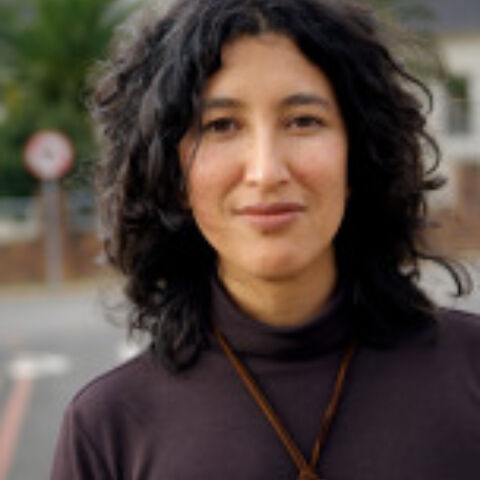
Gabeba Baderoon
· Associate Professor of Women’s, Gender and Sexuality Studies, African Studies and Comparative LiteratureVerifiedPennsylvania State University · Political Science and International Affairs
Active 1999–2025
About
Gabeba Baderoon is an Associate Professor of Women’s, Gender and Sexuality Studies, African Studies, and Comparative Literature at Penn State. She holds courtesy appointments in the Social Thought Program and the School of International Affairs. Baderoon received her PhD in English from the University of Cape Town and has held Post-doctoral fellowships in the Africana Research Center and the 'Islam, African Publics and Religious Values' Project. She co-directs the African Feminist Initiative at Penn State with Alicia Decker and Maha Marouan. Her scholarly work includes the authoring of the book 'Regarding Muslims: from Slavery to Post-Apartheid,' which received the National Institute for the Humanities and Social Sciences Best Non-fiction Monograph Award. She has also published poetry collections such as 'The Dream in the Next Body,' 'A Hundred Silences,' and 'The History of Intimacy,' which have been recognized with awards including the Daimler award, the Elisabeth Eybers Poetry Prize, the University of Johannesburg Prize for South African Writing, and a Best Poetry Book Award from the National Institute for the Humanities and Social Sciences. Additionally, Baderoon co-edited the award-winning essay collection 'Surfacing: on Being Black and Feminist.' Her research and creative contributions focus on issues related to gender, sexuality, African studies, and the intersections of literature and social thought.
Research topics
- Sociology
- Political Science
- Computer Science
- Dermatology
- Medicine
- Media studies
- Gender studies
- Geography
Selected publications
3 Elaine Salo’s ‘ABC on African feminisms’: Epistemic community as a practice of reading together
Lynne Rienner Publishers eBooks · 2025-12-31
book-chapterSenior author‘I Forget to Look’ and ‘The History of Intimacy’
Feminist Encounters A Journal of Critical Studies in Culture and Politics · 2024-03-01
articleOpen access1st authorCorrespondingThe poems ‘I Forget to Look’ and ‘The History of Intimacy’ from Gabeba Baderoon.
What are the challenges facing Africanist and African women's and gender studies scholars?
Women's studies quarterly · 2024
1st authorCorresponding- Sociology
- Political Science
- Gender studies
What are the challenges facing Africanist and African women's and gender studies scholars? Gabeba Baderoon (bio), Maha Marouan (bio), and Alicia Decker (bio) [End Page 107] Editors of Pandemonium spoke with Gabeba Baderoon, Maha Marouan, and Alicia Decker on August 4 and 28, 2023. Alicia Decker: Out of our shared challenges came the idea to create an alternative space to engage in critical conversations and scholarly work on feminist issues in Africa and the African diaspora—dynamics that are not equitable all the time. The African Feminist Initiative (AFI) is a transnational virtual community that my colleague Gabeba Baderoon and I started at Penn State in 2015. Gabeba and I came together to create a space to think critically about African feminisms, a truly global transnational collective that is actively engaged in all levels of feminist activism, dialogue, and research both within and outside the academy. In 2018, Maha joined us as our third codirector, so the three of us function as equals … as a triumvirate. As of 2023, AFI has over five hundred members, many from Africa, but also from Europe, South America, Asia, and North America. We have held six international conferences and workshops and have become a hub for virtual transnational feminist movement across different kinds of borders. AFI serves as an example of a feminist community that's growing in the midst of backlash. Transnational feminisms are obviously not new, but it does seem like it is a space that is continuing to grow and thrive, consisting of actively politicized communities addressing some of the challenges the discipline is facing and ensuring there is space for conversations that are more challenging in certain institutional and national settings. Gabeba Baderoon: I'm a South African, so a lot of my work tends to be on South Africa. I have strong connections with the universities there. Austerity has been the reality there, and in the U.S., of course, too. I'm so grateful to have this as my job. So how does something like women's and gender studies in Africa flourish? The story is sometimes a little surprising: sometimes outside of the classroom. But there are also positive developments to report on what is happening inside the classroom and inside the university. For instance, the development of the Department of Feminist Studies at the [End Page 108] University of Cape Town is just a magnificent arrival of something that has been in discussion among many of us for a long time, since the late 1990s. Maha Marouan: I grew up in Morocco, that's my home, but I work at a U.S. institution, so when I do work in the continent, I am challenged differently. Some of the challenges for me are: How do you form feminist solidarities transnationally? How do you challenge global hierarchies? How do you forge feminist linkages without undermining feminist politics of resistance as forged in the specificity of one's history and locale? I get a sense at times that I am caught between two worlds, but most of the time, I feel deeply enriched by my positionality. The work that we do through AFI is to continue to find linkages and learn from one another. We do that through our monthly feminist dialogues, we do it through transnational collaborative projects that reflect the complexity of our commitment and positionality but without privileging one particular mode of knowledge. This does not mean this is a smooth-sailing process. In fact, I am constantly faced with challenges. Identity politics play a part. For instance, Alicia's idea to work collaboratively with scholars from different parts of the continent to examine the state of women and gender studies in academia was an important initiative. But there was a lot of tension when all of us from different backgrounds and locales met. Because Alicia and I are academically situated in the Global North, we were perceived by many of our colleagues in the continent as reinforcing these global hierarchies by undertaking this project. My African belonging was also challenged. As a North African, I was perceived as "less authentically" African—despite the fact that I do not subscribe to the colonial division...
Sand is History; and Beach/Law
Feminist formations · 2024-12-01
article1st authorCorrespondingMaking History and Writing the Present: The WCCR and Black Feminism at the University of Cape Town
Feminist formations · 2024-12-01
article1st authorCorrespondingAbstract: In this article, Gabeba Baderoon narrates her experience as a member of a transformative feminist collective at the University of Cape Town in the 1990s, the Women of Colour Consciousness Raising group. The article locates the group within the radical work of South African feminists in reshaping both the private and broader culture of that decade and, centrally, their role in reinventing the post-apartheid academy. The 1990s was an interstitial time marked both by dreams of freedom and the lingering pall of apartheid. Baderoon draws on the voices of WCCR members to outline the relations of care, critique, creativity, and a bodily assertion of intellectual belonging crafted within the group, arguing that these constituted a way of living freedom into being during that crucial period. The article traces formative moments in the WCCR's history, its complex ties with the university, and the relationships of mutuality and support forged within the collective. The article incorporates an archive of documents, memories, and ongoing conversations among WCCR members to offer an insight into the shaping of a generation of post-apartheid feminists, who have gone on to become some of the most eminent scholars, teachers, activists, and artists of the contemporary period.
Wits University Press eBooks · 2023
1st authorCorresponding- Geography
Transition · 2022-03-01
article1st authorCorrespondingTransition · 2022
1st authorCorresponding- Dermatology
- Medicine
Black feminist writers in South Africa raise their voices in a new book
2021-05-30
preprintSenior authorWits University Press eBooks · 2021 · 28 citations
Senior authorCorresponding- Computer Science
- Computer Science
Frequent coauthors
- 2 shared
Alicia C. Decker
- 1 shared
Charles Green
The University of Texas Health Science Center at Houston
- 1 shared
Adam Sitze
Amherst College
- 1 shared
Maha Marouan
- 1 shared
Desirée Lewis
- 1 shared
Jane Bryce
University of the West
- 1 shared
Stephanie Newell
Advisory Board Company (United States)
- 1 shared
Nina Hoel
University of Oslo
Education
- 2004
PhD, English
University of Cape Town
Awards & honors
- Sarah Baartman Senior Fellowship at the University of Cape T…
- Extraordinary Professorship of English at Stellenbosch Unive…
- Fellowship at the African Gender Institute
- Fellowship at the Nordic Africa Institute
- Fellowship at Bellagio
- Resume-aware match score
- Save to shortlist
- AI-drafted outreach
See your match with Gabeba Baderoon
PhdFit ranks faculty by your research interests, methods, and publications — grounded in their actual work, not templates.
- Free to start
- No credit card
- 30-second signup