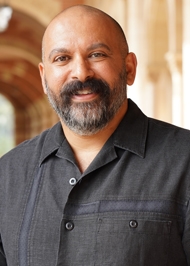
H. Samy Alim
· Professor and David O. Sears Presidential Endowed Chair in the Division of Social SciencesVerifiedUniversity of California, Los Angeles · Anatomy and Cell Biology
Active 1999–2025
About
H. Samy Alim is the David O. Sears Presidential Endowed Chair in the Social Sciences and a Professor of Anthropology at UCLA. He also serves as the Associate Director of the Ralph J. Bunche Center for African American Studies, where he is Faculty Director of the UCLA Hip Hop Initiative. Alim has been researching and writing about Hip Hop Culture for over 25 years, focusing on its transformative power as a significant cultural movement. His work explores Black Language, Hip Hop Culture globally, and the intersections of language, race, and identity. He is the author or editor of twelve books, including 'Freedom Moves: Hip Hop Knowledges, Pedagogies, and Futures' (2023), which examines hip hop’s influence across generations and borders. His research includes extensive ethnographic studies of Hip Hop Culture in Cape Town, South Africa, and he is engaged in community projects through the UCLA Hip Hop Initiative. Alim's scholarship also addresses language and racial politics, exemplified by his books 'You Know My Steez' and 'Articulate While Black,' and he has organized influential symposiums and edited key volumes such as the 'Raciolinguistics' and 'Oxford Handbook of Language and Race.' His work combines ethnographic analysis, discourse analysis, and community engagement, making significant contributions to understanding the cultural, linguistic, and political dimensions of Hip Hop and race.
Research topics
- Sociology
- Political Science
- Psychology
- Pedagogy
- Law
- Gender studies
- Anthropology
- Literature
- Archaeology
- History
- Communication
- Art
- Criminology
Selected publications
University of Pennsylvania Press eBooks · 2025-03-06
book-chapterSenior authorHarvard Educational Review · 2024-01-01 · 19 citations
articleIn this Voices: Reflective Accounts of Education essay, Gloria Ladson-Billings, Django Paris, H. Samy Alim, and Na’ilah Suad Nasir speak to the past, present, and future of culturally sustaining pedagogies. This dialogue marks the tenth anniversary of the Culturally Sustaining Pedagogies Symposium, published in the Harvard Educational Review in 2014, where the authors illustrated how culturally relevant, sustaining, and revitalizing pedagogies are part of a long tradition seeking to center culture and justice in teaching and learning. This conversation also builds on dialogues initiated by HER in 2017 on cross-pollinating culturally sustaining pedagogy with disability studies. In this current dialogue, which has been edited for publication, the authors reflect on key developments in the field over the past ten years and engage with culturally sustaining pedagogy in light of ongoing global movements and issues of the current moment. They offer directions forward for research and practice, including rethinking culture and theorizing alongside communities.
The Transformational Power of Community and Culturally Sustaining Education:
University of Pennsylvania Press, Inc. eBooks · 2024-12-17
book-chapterSenior authorFreedom Moves: Theorizing Hip Hop as Black Liberatory Practice
Equity & Excellence in Education · 2023-10-02 · 1 citations
article1st authorCorrespondingThis article theorizes Hip Hop as Black liberatory practice by explicating the links between Hip Hop knowledges, pedagogies, and futures. I draw on multiple research and classroom experiences, including co-teaching a course with pioneering Hip Hop artist Chuck D of Public Enemy. The course examined Hip Hop culture as an extension of Black freedom culture and delved into the politics and the poetics, as well as the activism and the aesthetics, of the Hip Hop arts movement. Presented in interview format, this article highlights Hip Hop as an organic form of culturally sustaining pedagogy that aims to advance the Black liberatory practices that we refer to as "freedom moves" (Alim et al., 2023).
2023-03-21 · 1 citations
other1st authorCorresponding2023-07-12
book-chapterSenior authorThis chapter offers an in-depth exploration of methodological and theoretical aspects of the study of language and race. We outline the field of language and race by consolidating various perspectives within language studies, providing an interdisciplinary space for interaction between sociolinguists, linguistic anthropologists, and applied linguists. The field has focused on the linguistic construction of ethnoracial identities, the role of language in processes of racialization and ethnicization, and the language ideological processes that drive the marginalization of racially minoritized populations in the context of historically rooted political and economic systems. In recent years, the study of language and race has been amplified by a set of approaches that seek to unite the study of language with critical inquiry into racialization processes. Raciolinguistics scholars view race through the lens of language and view language through the lens of race to better understand them as co-constitutive processes. The process of linguistic racialization - where race is an enduring yet evolving social process steeped in centuries of colonialism and capitalism - is central to these approaches. A growing number of language and race researchers are offering translanguaging, intersectional, and queer perspectives in line with the field’s critical, antiracist, anticolonial approach.
Public Enemy, Public Scholarship: Hiphopography and the Co-production of Knowledge with Chuck D
2023-01-01 · 1 citations
book-chapter1st authorCorrespondingDaedalus · 2023-01-01 · 10 citations
articleOpen access1st authorCorrespondingAbstract In this essay, I explore how paradigms like raciolinguistics and culturally sustaining pedagogies can offer substantive breaks from mainstream thought and provide us with new, just, and equitable ways of living together in the world. I begin with a deep engagement with Boots Riley and his critically acclaimed, anticapitalist, absurdist comedy Sorry to Bother You, in hopes of demonstrating how artists, activists, creatives, and scholars might: 1) cotheorize the complex relationships between language and racial capitalism and 2) think through the political, economic, and pedagogical implications of this new theorizing for Communities of Color. In our current sociopolitical situation, we need to continue making pedagogical moves toward freedom that center and sustain Communities of Color in the face of the myriad ways that white settler capitalist terror manifests. As we continue to theorize the relationships between language and racial capitalism, frameworks like raciolinguistics and culturally sustaining pedagogies provide fundamentally critical, antiracist, anticolonial approaches that reject the capitalist white settler gaze and its kindred cisheteropatriarchal, English-monolingual, ableist, classist, xenophobic, and other hegemonic gazes. What they offer us, instead, is a break from the assimilationist politics of the past and a move toward abolitionist frameworks of the future.
2022-10-28
book-chapterOpen access1st authorCorrespondingJournal of Linguistic Anthropology · 2021 · 37 citations
1st authorCorresponding- Sociology
- Political Science
- Gender studies
This article offers a broad and deep discussion of critical issues in the study of language, race, and political economy through an analysis of the verbal art, aesthetics, and performances of South African hip hop artists. In particular, we present an in‐depth analysis of the Afrikaaps language movement in Cape Town, South Africa and theorize the language‐race‐land complex , the range of issues with respect to the co‐constitution and refusal of the colonial logics of language, race, and land. Specifically, we address the Afrikaaps language movement in Cape Town, South Africa. Afrikaaps is a South African hiphopera that disrupts white settler colonial logics of language, race, and land through an interrogation and revision of white supremacist constructions of Afrikaans. This reinvention of language, race, and land frees the Afrikaans‐speaking, so‐called Coloured community from oppressive, colonial logics and offers them new ways of envisioning their linguistic, racial, spatial, and political‐economic futures. We argue that, for the artists–activists involved in this decolonial, raciolinguistic movement, Hip Hop becomes a critical vehicle for raising consciousness through language, foregrounding Indigenous knowledge systems, and upending the white supremacist legacies of apartheid through a radical re‐education. Methodologically, we center Black and Indigenous artists’ voices, understanding them to be more than cultural producers but also cultural theorists. We draw upon our longitudinal, ethnographic cultural engagement with the Hip Hop artists involved in the theatre production and related forms of language activism (Alim & Haupt 2015, 2017; Haupt 2012; Haupt et al. 2019; Jansen 2019; Jansen et al. 2019; Stroud & Williams 2017; Williams 2018), as well as language and media analyses of the Afrikaaps production, soundtrack, and documentary film (Valley 2010).
Frequent coauthors
- 12 shared
Joo-Young Lee
- 9 shared
Lauren Mason Carris
Western Governors University
- 7 shared
Django Paris
University of Washington
- 5 shared
Quentin Williams
- 4 shared
Geneva Smitherman
- 3 shared
Ángela Reyes
University of California, Riverside
- 3 shared
Adam Haupt
University of Cape Town
- 3 shared
Casey Philip Wong
Awards & honors
- David O. Sears Presidential Endowed Chair in the Social Scie…
- Founding Director of the Center for Race, Ethnicity, and Lan…
- Editor of the Oxford Studies in Language and Race
- Resume-aware match score
- Save to shortlist
- AI-drafted outreach
See your match with H. Samy Alim
PhdFit ranks faculty by your research interests, methods, and publications — grounded in their actual work, not templates.
- Free to start
- No credit card
- 30-second signup