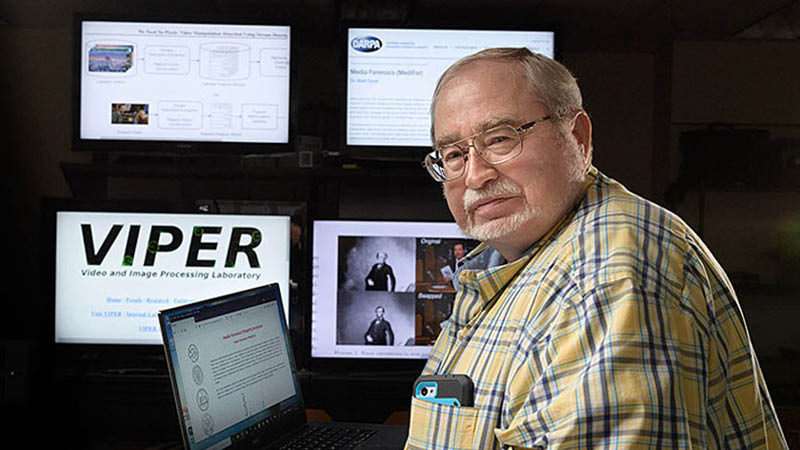
Edward J. Delp
VerifiedPurdue University · Computer Science
Active 1977–2026
Research topics
- Endocrinology
- Physical medicine and rehabilitation
- Gerontology
- Internal medicine
- Medicine
Selected publications
Detecting and Attributing Synthetic Spanish Speech: The HISPASpoof Dataset
2026-04-21
articleSenior authorZero-shot Voice Cloning (VC) and Text-to-Speech (TTS) methods enable the generation of highly realistic synthetic speech, raising serious concerns about their misuse. While numerous detectors exist for English and Chinese, Spanish—spoken by 600 million people, remains underrepresented in speech forensics. We introduce HISPASpoof, the first large-scale Spanish dataset for synthetic speech detection and attribution, containing real speech from public corpora across six accents and synthetic speech from six zero-shot TTS systems. Evaluating five methods shows that English-trained detectors fail on Spanish, while HISPASpoof training substantially improves detection. We also evaluate attribution performance for identifying synthesis methods. HISPASpoof provides a critical benchmark for inclusive Spanish speech forensics.
IEEE Transactions on Biomedical Engineering · 2026-01-01
articleOBJECTIVE: To enhance the diagnostic utility of 4D flow MRI in assessing cerebrospinal fluid (CSF) dynamics by super-resolving and denoising measured velocities using temporally coherent, physics-guided neural networks (PGNN). METHODS: Synthetic 4D flow MRI was generated from 40 computational fluid dynamics (CFD) simulations across 10 ventricular geometries. These simulations were used to generate paired synthetic 4D flow MRI and high-resolution velocity fields used for supervised training. Here, we compare a previously developed temporally independent network (div-mDCSRN-Flow) using divergence-based regularization with two novel temporal PGNNs (tempo-mDCSRN-Flow using divergence-regularization and TransVort additionally constrained by the vorticity transport equation). RESULTS: In application to synthetic 4D flow MRI of a double gyre flow showed the temporal PGNNs improve vorticity estimation. Similarly, both temporal methods improved estimation of vorticity and time-averaged wall shear stress (TAWSS) of synthetic 4D flow MRI in the 3rd and 4th ventricle. While using temporal PGNNs improves velocity and vorticity quantification across temporal resolutions, TransVort demonstrated additional improvement at fine temporal resolutions. Application of TransVort to in vivo 4D flow MRI of CSF flow captured vortex formation and dissipation in the 4th ventricle over the cardiac cycle. CONCLUSION: Leveraging the temporal information of 4D flow MRI improves reconstruction of high-resolution velocity fields. This leads to better estimation of gradient-based flow metrics such as vorticity and TAWSS, which are associated with neurodegenerative and neurovascular diseases. SIGNIFICANCE: Augmenting the accuracy of 4D flow MRI increases its potential for adoption as a clinical tool for diagnosing and monitoring disorders of neurofluid dynamics.
How Do We Teach Signal Processing Courses in the Era of AI?
IEEE RESOURCE CENTERS · 2025-12-22
otherOpen accessJournal of Medical Imaging · 2025-03-11 · 1 citations
articleOpen accessSenior authorCorrespondingPurpose: The advancement of high-content optical microscopy has enabled the acquisition of very large three-dimensional (3D) image datasets. The analysis of these image volumes requires more computational resources than a biologist may have access to in typical desktop or laptop computers. This is especially true if machine learning tools are being used for image analysis. With the increased amount of data analysis and computational complexity, there is a need for a more accessible, easy-to-use, and efficient network-based 3D image processing system. The distributed and networked analysis of volumetric image data (DINAVID) system was developed to enable remote analysis of 3D microscopy images for biologists. Approach: We present an overview of the DINAVID system and compare it to other tools currently available for microscopy image analysis. DINAVID is designed using open-source tools and has two main sub-systems, a computational system for 3D microscopy image processing and analysis and a 3D visualization system. Results: DINAVID is a network-based system with a simple web interface that allows biologists to upload 3D volumes for analysis and visualization. DINAVID enables the image access model of a center hosting image volumes and remote users analyzing those volumes, without the need for remote users to manage any computational resources. Conclusions: The DINAVID system, designed and developed using open-source tools, enables biologists to analyze and visualize 3D microscopy volumes remotely without the need to manage computational resources. DINAVID also provides several image analysis tools, including pre-processing and several segmentation models.
A Graph Neural Network for Anomaly Detection in Multi-Channel Time Series Data
2025-10-06
articleTo validate our method, we performed experiments on two datasets - the Mars Reconnaissance Orbiter (MRO) telemetry dataset and the Multi-Scale Convolutional Recurrent Encoder-Decoder (MSCRED) dataset where dependencies between channels were introduced to simulate real-world spacecraft time series data. The proposed method demonstrates good anomaly detection capabilities, compared to other methods, as shown in the experimental results section. Our results highlight the effectiveness of graph-based prediction for anomaly detection in interdependent multi-channel spacecraft telemetry data.
Spacecraft Multivariate Time Series Anomaly Detection in the Presence of Non-Anomalous Spikes
2025-03-01
articleDetecting anomalies in spacecraft telemetry is important due to the extreme operational environment of these systems. Detecting anomalies can serve as early warnings for potential system failures. Typically, a spacecraft system contains hundreds (or thousands) of telemetry channels. There is a need for automated anomaly detection to enhance efficiency and accuracy. Deep learning reconstruction-based anomaly detection methods for multivariate time series have been extensively studied. In these methods, a network is used for time series reconstruction and anomalies are detected based on the error sequence between the reconstructed time series and the original time series. However, many approaches cannot accurately reconstruct abrupt changes, such as spikes, which may result in false or missed detections. In this paper, we examine reconstruction errors for anomaly detection. A Long Short- Term Memory (LSTM) autoencoder network is used for multivariate time series reconstruction. The error sequence between the reconstructed time series and the original time series is obtained. Then, the period of the error sequence is estimated to remove reconstruction errors caused by abrupt changes in the time series. A dynamic threshold is used to detect the anomalies in the error sequence. We examine the performance of the proposed method by using a synthetic dataset. The dataset is characterized by having non-anomalous spikes, large periods and correlation among channels.
How Do We Teach Signal Processing Courses in the Era of AI?
IEEE RESOURCE CENTERS · 2025-12-22
otherOpen accessDiffSSD: A Diffusion-Based Dataset For Speech Forensics
2025-03-12 · 4 citations
articleSenior authorDiffusion-based speech generators are ubiquitous. These methods can generate very high quality synthetic speech and several recent incidents report their malicious use. To counter such misuse, synthetic speech detectors have been developed. Many of these detectors are trained on datasets which do not include diffusion-based synthesizers. In this paper, we demonstrate that existing detectors trained on one such dataset, ASVspoof2019, do not perform well in detecting synthetic speech from recent diffusion-based synthesizers. We propose the Diffusion-Based Synthetic Speech Dataset (DiffSSD), a dataset consisting of about 200 hours of labeled speech, including synthetic speech generated by 8 diffusion-based open-source and 2 commercial generators. We also examine the performance of existing synthetic speech detectors on DiffSSD in both closed-set and open-set scenarios. The results highlight the importance of this dataset in detecting synthetic speech generated from recent open-source and commercial speech generators.
Diet Quality and Eating Frequency Were Associated with Insulin-Taking Status among Adults
Nutrients · 2024-10-11 · 1 citations
articleOpen accessObjective: This pilot cross-sectional study explored differences in dietary intake and eating behaviors between healthy adults and a group of adults taking insulin to manage diabetes. Methods: A characteristic questionnaire and up to four Automated Self-Administered 24-Hour dietary recalls were collected from 152 adults aged 18–65 years (96 healthy and 56 adults taking insulin) from Indiana and across the U.S. from 2022 to 2023. The macronutrient intake, diet quality via the Healthy Eating Index (HEI)-2015, eating frequency, and consistency of timing of eating were calculated and compared between the two groups using adjusted linear or logistic regression models. Results: The total mean HEI scores were very low, at 56 out of 100 and 49 out of 100 for the healthy and insulin-taking groups, respectively. Insulin-taking adults had significantly lower HEI total (p = 0.003) and component scores compared to the healthy group for greens and beans (2.0 vs. 3.0, p = 0.02), whole fruit (2.1 vs. 2.9, p = 0.05), seafood and plant proteins (2.1 vs. 3.3, p = 0.004), and saturated fats (3.7 vs. 5.4, p = 0.05). Eating frequency was significantly lower in the insulin-taking group than in the healthy group (3.0 vs. 3.4 eating occasions/day, p = 0.05). Conclusion: Evidence of the low diet quality and eating frequency of insulin takers may help inform and justify nutrition education to control and manage diabetes.
Improving Fairness in Synthetic Speech Detectors
2024-10-27
articleSenior authorMany methods have been proposed which can effectively detect synthetic speech. However, a recent study demonstrates that they exhibit bias and a higher false positive rate for bona fide speech from speakers with stuttering speech-impairment as compared to fluent speakers. This limits deploy-ment of these detectors, as this bias can have significant societal and political consequences and can erode the reputation of social platforms using such detectors. This bias may have arisen from the bias in training data used for these detectors. Creating synthetic and bona fide speech with stuttering, and adding it to the training set for mitigating bias, can be time-consuming. In this work, we propose StutterAug, a set of augmentations that simulate three major types of stuttering in speech, namely repetition, prolongation and blocks. We test StutterAug on 3 synthetic speech detectors and examine bias on stuttering speech using more than 28K bona fide stuttering speech. Our results show that detectors trained with StutterAug have on average 13% less bias relative to detector trained without StutterAug. StutterAug also leads to an average relative improvement of 27.96% in detection performance on ASVspoof2019 dataset and 11.27% in generalization performance on In-the-Wild dataset compared to baseline detectors trained without StutterAug.
Frequent coauthors
- 346 shared
Carol J. Boushey
University of Hawaiʻi at Mānoa
- 114 shared
S.B. Gelfand
Purdue University West Lafayette
- 112 shared
Nitin Khanna
Indian Institute of Technology Bhilai
- 102 shared
Paul Salama
University of Indianapolis
- 98 shared
Heather A. Eicher‐Miller
Purdue University West Lafayette
- 95 shared
Fengqing Zhu
Purdue University West Lafayette
- 59 shared
Kenneth W. Dunn
Indiana University – Purdue University Indianapolis
- 57 shared
Jan P. Allebach
Purdue University West Lafayette
Education
- 1979
Ph.D. Electricl Engineering, School of Electrical and Computer Engineering
Purdue University
- 1975
M.S., Department of Eecltrical Engineering
University of Cincinnati
- 1973
B.S., Electrical Engineering
University of Cincinnati
- Resume-aware match score
- Save to shortlist
- AI-drafted outreach
See your match with Edward J. Delp
PhdFit ranks faculty by your research interests, methods, and publications — grounded in their actual work, not templates.
- Free to start
- No credit card
- 30-second signup