Resume-aware faculty matching

Find professors who actually fit you

Upload your resume. Four AI agents analyze your background, rank the faculty who fit, inspect their recent research, and help you draft outreach — grounded in their actual work, not templates.

Free to startNo credit cardCancel anytime
Top matches Balanced preset
Dr. Sarah Chen
Stanford · Interpretability · NLP
91
Dr. Marcus Holloway
MIT · Robotics · RL
84
Dr. Aisha Okonkwo
CMU · Fairness · HCI
82
Nova · Professor Researcher · re-ranking top 20…
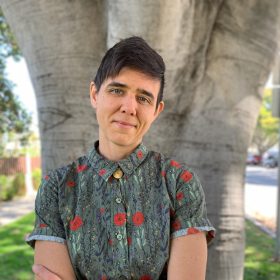
Ella Haselswerdt

Ella Haselswerdt

· Assistant Professor of ClassicsVerified

University of California, Los Angeles · Classics

Active 2018–2024

h-index2
Citations8
Papers1310 last 5y
Funding
See your match with Ella Haselswerdt — sign in to PhdFit.Sign in

About

Ella Haselswerdt joined the faculty at UCLA in 2020 after completing a postdoctoral fellowship at Cornell University, earning her Ph.D. at Princeton University, a post-baccalaureate at Columbia University, and a Bachelor of Arts in Liberal Arts from Sarah Lawrence College. Her academic interests broadly encompass ancient Greek poetics, aesthetics, and reception. Her current book project, titled Epistemologies of Suffering: Tragedy, Trauma, and the Choral Subject, explores how tragedy employs the fluidity of lyric expression and the chorus’s subjectivity to represent and derive meaning from moments of extreme violence and intimacy. She has also written on topics such as the dreamscapes of the ancient Greco-Roman body and the sublime soundscapes of Sophocles' Oedipus at Colonus. Her forthcoming work includes analyses of poetry and profit in Anne Carson’s work, the mythic landscape of Philoctetes, and Euripides' Iphigenia at Aulis as a text of queer liberation. Additionally, her research intersects classical antiquity with queer theory and queer identity, with particular focus on Sappho and contemporary art, developing projects under the rubric of “Deep Lez Philology.” She teaches courses on ancient Greek language, literature, and culture at both graduate and undergraduate levels, including courses on tragedy, sex and gender, and a large general education lecture course titled “Classics 10: Discovering the Greeks.”

Research topics

  • Computer Science
  • Art
  • History
  • Sociology
  • Philosophy
  • Classics
  • Gender studies
  • Linguistics
  • Literature
  • Art history

Selected publications

  • Reading Greek Tragedy with Judith Butler

    Bloomsbury Publishing Plc eBooks · 2024 · 13 citations

    • Literature
    • Art
    • History

    <JATS1:p>Considering Butler’s “tragic trilogy”—a set of interventions on Sophocles’ Antigone, Euripides’ Bacchae, and Aeschylus’s Eumenides—this book seeks to understand not just how Butler uses and interprets Greek tragedy, but also how tragedy shapes Butler’s thinking, even when their gaze is directed elsewhere. Through close readings of these tragedies, this book brings to light the tragic quality of Butler’s writing. It shows how Butler’s mode of reading tragedy—and, crucially, reading tragically—offers a distinctive ethico-political response to the harrowing dilemmas of our current moment.</JATS1:p> <JATS1:p>Deeply committed both to critical theory and political activism, Judith Butler is one of the most influential intellectuals today. Their ideas have touched the lives of many people, both readers and those who have never heard Butler’s name. In encompassing gender performativity and sexual difference, vulnerability and precarity, disidentification and bodily interdependency, as well as the politics of protest, Butler’s work is often predicated on a strong engagement with or proximity to Greek tragedy.</JATS1:p>

  • <i>Bacchae</i>’s Queer Hyperchorality: Becoming-Wild, Becoming-Choral

    Classical Philology · 2024-04-01 · 1 citations

    article1st authorCorresponding

    This essay reconsiders the often remarked-upon queerness of Euripides’ Bacchae through the lens of the play’s unique deployment of chorality, read with the help of Jack Halberstam’s conceptualization of wildness. I argue that the play exhibits a tragic “hyperchorality,” that is, a systematic collapse of distinctions between chorus and character, leading to the erosion of boundaries between the dramatic world and the spectators’ world, and the suffusion of the narrative with a kind of queer choral time. I trace these dynamics in the play’s destabilizing kommos between the chorus and Dionysus, in the Theban women’s queer ecofeminist scene on the mountain described in the first messenger speech, and finally in Dionysus’ unsettling prophecy to Cadmus. Finally, I argue that the Bacchae defies literary historical inscription, operating instead as, in Halberstam’s formulation, “a chaotic forcefield of un-art.”

  • Sappho's Body as Archive

    2023-12-12

    book-chapterOpen access1st authorCorresponding

    This chapter first makes the case that philological practice, far from being a neutral or objective science, is influenced by the social positioning and biases of its practitioners. It provides a partial overview of the way misogynist and lesbophobic approaches to the corpus of Sappho’s poetry have influenced interpretation. In response, the chapter offers as a provocation a speculative, situated, “deep lez” approach to philology, borrowing the phrase from the lesbian artist Allyson Mitchell. This approach is sketched via a consideration of Mitchell’s own response to the Lesbian Herstory Archives in Brooklyn. Reading Sappho and her corpus as a queer archive of sorts, the chapter provides a series of suggestions for a philological approach that resists positivistic reconstructions of antiquity while elevating the poetry’s resonant tension between presence and absence.

  • The Routledge Handbook of Classics and Queer Theory

    Routledge eBooks · 2023 · 16 citations

    1st authorCorresponding
    • Sociology
    • Sociology
    • Art

    "New directions in queer theory continue to trouble the boundaries of both queerness and the classical, leading to an explosion of new work in the vast - and increasingly uncharted - intersection between these disciplines, which this interdisciplinary volume seeks to explore. This handbook convenes an international group of experts who work on the classical world and queer theory. The discipline of Classics has been involved with, and implicated in, queer theory from the start. By placing front and center the rejection of heteronormativity, queer theory has provided Classics with a powerful tool for analyzing non-normative sexual and gender relations in the ancient West, while Classics offers queer theory ancient material (such as literature, visual arts, and social practices) that challenges a wide range of modern normative categories. The collection demonstrates the vitality of this particular moment in queer classical studies, featuring an expansive array of methodologies applied to the interdisciplinary field of Classics. Embracing the indeterminacy that lies at the core of queer studies, the essays in this volume are organized not by chronology or genre, but rather by overlapping categories under the following rubrics: queer subjectivities, queer times and places, queer kinships, queer receptions, and ancient pasts / queer futures. The Routledge Handbook of Classics and Queer Theory offers an invaluable collection for anyone working on queer theory, especially as it applies to premodern periods; it will also be of interest to scholars engaging with the history of sexuality, both in the ancient world and more broadly"--

  • General Introduction

    2023-08-31

    book-chapter1st authorCorresponding

    The discipline of Classics has been involved with, and implicated in, queer theory from the very start. That is, when queer theory came into its own, as an approach with means and aims different to those of the history of sexuality, its leading practitioners were engaged in conversation with Classicists who were working, in various ways, on sexual practice and sexual identity in the ancient world. Teresa de Lauretis first coined the term “queer theory” in 1990 in order, as she explains, to trouble the “homogenization” of “gay and lesbian studies,” as well as to find ways of thinking about the interrelation of sexuality and race; her goal was “to construct another discursive horizon, another way of thinking the sexual”. “Queer Kinships” is a category that people did not originally conceive of or designate for contributors, but it is one that clearly emerged and asserted itself as the contributions rolled in.

  • Sappho's Body, Queer Abstraction, and Lesbian Futurity

    2023-08-31 · 2 citations

    book-chapter1st authorCorresponding

    This chapter argues that the figure of Sappho and her poetry can be useful for imagining an open and inclusive future for lesbianism. Using two queer theoretical frameworks—a mode in contemporary art called queer abstraction, and the multivalent concept of queer time—the chapter analyzes four pieces of Sappho reception that might be classified as artists’ books, that is, projects that simultaneously transmit and respond to the embodied affective excesses of Sappho’s fragments: Sappho Fragments by Rose Frain; Poetry of Sappho, a collaboration between John Daley, Page duBois, Anita Cowles Reardon, and Julie Mehretu; Sapphopunk: how Sappho almost became a stone femme a fiction in honor of otherness an experiment in dignity or Sappho’s queer biography by j/j hastain; and a fifth-century Attic hydria by a painter in the Polygnotos group. The chapter then turns to read these dynamics back into Sappho’s poetry, taking as a case study the brief fragment “no honey nor bee for me” and its reception in the Hellenistic epigrammatist Nossis and the modernist poet H.D. All of these readings coalesce to find in Sappho an idea that resists figuration, essentialism, and positivism, thereby offering more expansive ways of identifying with antiquity and with lesbianism.

  • COUNTERMYTHOLOGIES: IPHIGENIA'S ANIMAL PART

    Ramus · 2023-06-01

    article1st authorCorresponding

    Early in the first act of Shorter and spalding's … (Iphigenia) the carousing band of Argive soldiers cum frat boys dumps the body of a deer stage left, close to the audience. A spotlight is trained onto the carcass, and there it remains: as the bodies of Iphigenias pile up alongside it through Act I; as the Iphigenias are revivified and we enter a new conceptual plane in Act II; as the mythic plot reconvenes in Act III; and during the curtain call, when the cast, musicians, and crew come onto the stage to take their bows. At one point, I half expected the ensemble to smile wide and extend their arms towards the rigid body of the deer, inviting audience applause for their fellow performer, still, even now, fixed motionless under a spotlight.

  • Mythic Landscapes and Ecologies of Suffering in Sophocles’ <i>Philoctetes</i>

    Classical Antiquity · 2023-04-01 · 1 citations

    article1st authorCorresponding

    On some accounts, Sophocles’ Philoctetes is most notable for what it lacks: alone among the extant Attic tragedies, there are no women in the dramatis personae; alone among the extant plays of Sophocles, no characters die; and the chorus plays a relatively diminished role, adhering most closely to Aristotle’s injunction in the Poetics that a chorus should take on the role of an actor. But when viewed through the lens of ecocritical feminism and vibrant materialism, notably the work of Donna Haraway, Mel Chen, Jane Bennett, and Anna Tsing, the play’s landscape, the island of Lemnos, comes to life; and it teems with feminine energies as well as compromised and complicated animacies, while the chorus serves as an empathic focalizer and world-builder. This paper argues that in addition to animating the island’s material ecosystem, Sophocles conjures Lemnos’ mythic ecosystem, most notably the tale of the notorious, murderous, and malodorous Lemnian Women. All of these elements cohere to characterize Philoctetes as an abject, sterile menstruator. Furthermore, the chorus’s brief, strange Hymn to Gaia encapsulates the play’s tension between a masculine, heroic, teleological narrative and the feminine, primordial, bestial world of Lemnos. These dynamics are further considered through the lens of fifth-century Athenian colonization, the story of the indigenous Lemnian Pelasgians, and a colonial reading of the Odyssey’s Cyclopeia. Finally, the paper explores the close, mutually constitutive relationship between text, landscape, and body via the popularity, in later antiquity, of pharmacological applications of Lemnian Earth, used to treat, among other ailments, snakebites and menstruation.

  • Iphigenia in Aulis—Perhaps (Not)

    Bloomsbury Academic eBooks · 2022 · 1 citations

    1st authorCorresponding
    • Computer Science
    • Computer Science
  • Poetry and Profit

    Bloomsbury Academic eBooks · 2021-11-26

    book-chapter1st authorCorresponding

Frequent coauthors

  • Kirk Ormand

    2 shared
  • Sara H. Lindheim

    2 shared
  • Prof. James Porter

    1 shared
  • Alessandro Carrera

    1 shared
  • Paul Allen Miller

    University of South Carolina

    1 shared
  • Prof. Simon Goldhill

    1 shared
  • Prof. Francisco Barrenechea

    1 shared
  • Pantelis Michelakis

    1 shared
  • Resume-aware match score
  • Save to shortlist
  • AI-drafted outreach

See your match with Ella Haselswerdt

PhdFit ranks faculty by your research interests, methods, and publications — grounded in their actual work, not templates.

  • Free to start
  • No credit card
  • 30-second signup