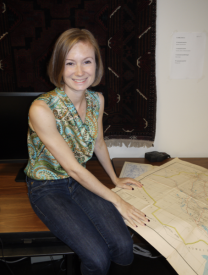
Emily Hammer
VerifiedUniversity of Pennsylvania · Near Eastern Languages and Civilizations
Active 2009–2025
About
Emily Hammer is an associate professor of Digital Humanities, Archaeology, and Anthropology of the Ancient World at the University of Pennsylvania. She is an anthropological archaeologist specializing in the Middle East and South Caucasia. Her research applies spatial analyses to material culture to investigate the territorial organization of ancient polities, the development of early cities, and long-term changes in the interactions between culture and environment. She utilizes geographic information science (GIS) methods, archaeology, and archival research to recover human experiences that have been sidelined in traditional narratives, particularly focusing on mobile pastoralists and communities living in agriculturally marginal environments such as deserts and highlands. Her field research includes work in Turkey, the United Arab Emirates, Azerbaijan, and Iraq, where she studies relationships between mobile pastoral and sedentary communities across different historical periods, including the Bronze Age, Iron Age, and medieval/Ottoman periods. Her current collaborative projects involve surveys at the Mesopotamian site of Ur in southern Iraq, fortresses and settlements in Naxçıvan, Azerbaijan, and laboratory research on mass-kill hunting traps (desert kites) in eastern Jordan and pre-Islamic fortification patterns in the Balkh oasis of northern Afghanistan. These projects incorporate rarely-used archival data sources, such as declassified military intelligence imagery from the Cold War era, which reveal archaeological features more clearly than modern satellite imagery. Additionally, Emily participates in the global collaborative project 'LandCover6K,' working with other historians and archaeologists to reconstruct land use over the last 6000 years in the Middle East and parts of Asia to enhance climate change modeling. She holds a PhD in Anthropology from Harvard University and a BA in Mathematics and Classical & Near Eastern Archaeology from Bryn Mawr College. Prior to her current position, she taught at the University of Chicago and New York University, where she directed the Center for Ancient Middle Eastern Landscapes and satellite imagery-based work on Afghanistan's cultural heritage.
Research topics
- Geography
- Ecology
- Political Science
- History
- Computer Science
- Archaeology
- Environmental science
- Economics
- Regional science
- Economy
- Cartography
- Environmental resource management
- Earth science
- Engineering
- Data science
- Remote sensing
- Astrobiology
- Economic geography
- Database
- Geology
Selected publications
PLoS ONE · 2025-02-12 · 6 citations
articleOpen accessCorrespondingWhile it is clear that current human impact on the earth system is unprecedented in scope and scale, much less is known about the long-term histories of human land use and their effects on vegetation, carbon cycling, and other factors relevant to climate change. Current debates over the possible importance of human activities since the mid second millennium CE cannot be effectively resolved without evidence-based reconstructions of past land use and its consequences. The goal of the PAGES LandCover 6K working group is to reconstruct human land use and land cover over the past 12,000 years. In this paper, we present the first large-scale synthesis of archaeological evidence for human land use in South Asia at 12 and 6kya, a critical period for the transition to agriculture, arguably one of the land use transitions most consequential in terms of human impact on the Earth system. Perhaps the most important narrative we can pick out is that while there are some shifts in land use across these time windows, hunter-gatherer-fisher-foraging remained the dominant land use, and within this there was a mosaic of strategies exploiting diverse and complex landscapes and ecologies. This is not necessarily a new conclusion-it is not new to state that South Asia is comprised of many niches, but demonstrating the deep time history of how people have adapted to these and adapted them is an important step for modelling the impacts of human populations and thinking about their footprints in a longue-durée perspective. Despite the new development of food production between the early and mid-Holocene by overall area foraging life ways continued as the dominant land use practice into the 6kya time window. The development of agriculture and food production was not unimportant-it is the beginning of a land use that eventually comes to dominate the sub-continent, but at 6kya agriculture was restricted to specific contexts. Across 12kya to 6kya and different land uses, the use of mosaic ecologies, diverse strategies and the importance of water as a resource stand out as shared themes.
The Archaeology of Pastoralism, Mobility, and Society
Cambridge University Press eBooks · 2025-09-04 · 1 citations
book1st authorCorrespondingThough mobile pastoralists were long a significant component of many societies in Eurasia and Africa, scholars have long considered them to be materially and documentarily 'invisible.' The archaeological study of pastoralism across these regions has relied on ethnographic analogies and environmentally deterministic models, often with little or no data on historically specific herding communities. This approach has yielded a static picture of pastoralism through time that has only recently been challenged. In this book, Emily Hammer articulates a new framework for investigating variability in past pastoral practices. She proposes ways to develop a more rigorous relationship with pastoralist ethnographies and illustrates new archaeological and scientific methodologies for collecting direct data on herding, mobility, and social complexity in the past. Hammer's approach to the archaeology of pastoralism promotes efforts to dismantle the legacy of evolutionary classifications of human societies, which have drawn sharp distinctions between farmers and herders, and to investigate how diverse non-agricultural and mobile groups have shaped complex society and environment.
Quaternary Science Reviews · 2024-12-18 · 2 citations
articleOpen accessLand use and land cover (LULC) changes have important biophysical and biogeochemical effects on climate via a variety of mechanisms. Several climate modelling studies have demonstrated the impact of LULC scenarios on past climate reconstructions. Testing the impact of anthropogenic land use on mid-Holocene climate thus requires reconstructions of land use that accurately reflect this time frame. To address these concerns, the PAGES LandCover6k working group aims to create data-driven gridded global reconstructions of land use and land cover to provide the climate modelling community with inputs for sensitivity testing of the impact of LULC changes on global climate. As one of the earliest global centres of domestication, agricultural production, and population nucleation, Southwest Asia represents one of the areas of the world expected to display the greatest land use impact and human-induced land cover change at 6 kya, and is therefore critical for the mid-Holocene time frame. Here, we reconstruct land use for Southwest Asia for the 6 kya time frame at a regional scale. We draw on environmental data to reconstruct the range of possible land uses within each particular environment and on archaeological and historical data to reconstruct actualized land use. We then compare this reconstruction to common global LULC models, including the most recent HYDE and KK10 iterations. The reconstruction presented here differs from these previous reconstructions in its methodological approach, spatial extent and resolution. It also differs from both models in population density distribution and land use allocation. While the output of our reconstruction is generally more similar to HYDE 3.2 than KK10, particularly in terms of reconstructed pastoral land use, we model greater agricultural land use than HYDE across the entire region, and less land use overall compared with KK10. The paper provides a method for systematically incorporating archaeological data into models of past land use and demonstrates the value of such an approach for enhancing empirical validity.
Land · 2024-07-26 · 4 citations
articleOpen accessAnthropogenic land cover change (ALCC) models, commonly used for climate modeling, tend to utilize relatively simplistic models of human interaction with the environment. They have historically relied on unsophisticated assumptions about the temporal and spatial variability of the area needed to support one person: per capita land use (PCLU). To help refine ALCC models, we used a range of data sources to build a new database that attempts to bring together PCLU data with significant time depth and a global perspective. This new database can provide new nuance for our understanding of the variability in land use among and between time periods and regions, data that will have wide applicability for continued research into past human land use and present land-use change, and can hopefully help improve existing ALCC models. An example is provided, showing the potential impact of new PCLU data on land-use mapping in the Middle East at 6000 BP.
PLoS ONE · 2024-03-07 · 1 citations
articleOpen access1st authorCorrespondingScant literature has been able to demonstrate an association between dietary habits and spice and herb consumption, especially for those who have chronic kidney disease. The objectives of this study were to 1) determine the frequency and quantity of spices and herbs consumed and 2) determine the associations between diet quality and its food components, demographics, and health conditions with spice and herb frequency and variety consumption of adults with chronic kidney disease. A cross-sectional online study was conducted with adults with various stages of chronic kidney disease (n = 71). Participants responded to an online demographic, diet and spice and herb questionnaire on RedCap. Diet quality was determined through the diet questionnaire. Descriptives, frequencies and Spearman correlations were conducted using SPSS v28 with a significance of p<0.05. Most participants were in chronic kidney disease stage 3 (42.3%) with a majority (98.6%) self-identifying as non-Hispanic white. On average, participants consumed black pepper more than once daily (47.9%) with the spice quantity at 5 g. The median diet quality score was 38.5 (range 31.5-48.5). Positive associations were identified with overall diet quality scores and certain spices such as basil (r = 0.33; p<0.01) and cinnamon (r = 0.37; p<0.002). Further associations were seen with food groups, self-identifying as white and health conditions with spice frequency and variety of spices and herbs consumed. Overall, positive associations were observed with diet quality and spice and herb intake, in which higher diet quality scores would indicate higher consumption of spices and herbs. Further research should focus on diet quality and spice and herb consumption in reducing progression of this disease.
Journal of Anthropological Archaeology · 2023-07-06 · 1 citations
article1st authorCorrespondingDense urbanism and economic multi-centrism at third-millennium BC Lagash
Antiquity · 2023 · 34 citations
- Political Science
- Geography
- Economic geography
Studies of ancient Mesopotamian cities have long focused on their institutions. Here, instead, the authors draw on recent investigations at the third-millennium BC site of Lagash (modern Tell al-Hiba, Iraq) to explore urban density, economy and sustainability at one of the largest ancient urban centres of the region. Drawing on excavation, environmental and remote-sensing data, the authors adopt a multi-scalar approach, revealing dense urban occupation, with subdivision into distinct walled quarters, as well as evidence for multiple foci of intensive industrial production and the exploitation of a rich mosaic of surrounding micro-environments. The study emphasises how a combination of new field data and alternative research directions offers novel insights into early urbanism.
The Suburbs of the Early Mesopotamian City of Ur (Tell al-Muqayyar, Iraq)
American Journal of Archaeology · 2023-09-12 · 3 citations
article1st authorCorrespondingSuburbs and other zones of urban sprawl are not recent phenomena; they are as old as cities themselves. However, archaeological investigation of them has been relatively scarce, biasing reconstructions of the scale and diversity of early urban populations, industries, and economies, as well as reconstructions of ancient cities’ size and form. Here, we use aerial and satellite imagery in combination with ground survey to identify and characterize the extramural areas of one of the world’s earliest cities, Ur (Tell al-Muqayyar), in southern Iraq. The results suggest the need for some revisions of earlier impressionistic ideas about the extent, location, and dates of Ur’s suburbs. The distributions of ceramics of periods spanning the fifth to first millennium BCE suggest that Ur may have been founded in the fifth to fourth millennium BCE as a pair of spatially separate settlements that grew at different rates, only one of which developed into the city’s highly mounded core; that more distant suburbs formed by the third millennium BCE; and that intensity of occupation of various extramural zones covering hundreds of hectares shifted throughout the third to first millennium BCE. Overall, the data challenge characterizations of Ur as more compact and spatially continuous than other early Mesopotamian cities.1
Emergence and intensification of dairying in the Caucasus and Eurasian steppes
Nature Ecology & Evolution · 2022-04-07 · 73 citations
articleOpen accessArchaeological and archaeogenetic evidence points to the Pontic-Caspian steppe zone between the Caucasus and the Black Sea as the crucible from which the earliest steppe pastoralist societies arose and spread, ultimately influencing populations from Europe to Inner Asia. However, little is known about their economic foundations and the factors that may have contributed to their extensive mobility. Here, we investigate dietary proteins within the dental calculus proteomes of 45 individuals spanning the Neolithic to Greco-Roman periods in the Pontic-Caspian Steppe and neighbouring South Caucasus, Oka-Volga-Don and East Urals regions. We find that sheep dairying accompanies the earliest forms of Eneolithic pastoralism in the North Caucasus. During the fourth millennium BC, Maykop and early Yamnaya populations also focused dairying exclusively on sheep while reserving cattle for traction and other purposes. We observe a breakdown in livestock specialization and an economic diversification of dairy herds coinciding with aridification during the subsequent late Yamnaya and North Caucasus Culture phases, followed by severe climate deterioration during the Catacomb and Lola periods. The need for additional pastures to support these herds may have driven the heightened mobility of the Middle and Late Bronze Age periods. Following a hiatus of more than 500 years, the North Caucasian steppe was repopulated by Early Iron Age societies with a broad mobile dairy economy, including a new focus on horse milking.
Land-cover and land-use change through the Holocene: Wrapping up the PAGES LandCover6k working group
Past Global Change Magazine · 2022-03-21 · 1 citations
articleOpen access
Frequent coauthors
- 18 shared
Marc Vander Linden
- 18 shared
Oliver Boles
Pompeu Fabra University
- 18 shared
J.L. Bates
Seoul National University
- 18 shared
Erle C. Ellis
University of Maryland, Baltimore County
- 18 shared
Sandy P. Harrison
University of Reading
- 17 shared
Andria Dawson
Mount Royal University
- 17 shared
Jed O. Kaplan
University of Calgary
- 17 shared
Stefania Merlo
- Resume-aware match score
- Save to shortlist
- AI-drafted outreach
See your match with Emily Hammer
PhdFit ranks faculty by your research interests, methods, and publications — grounded in their actual work, not templates.
- Free to start
- No credit card
- 30-second signup