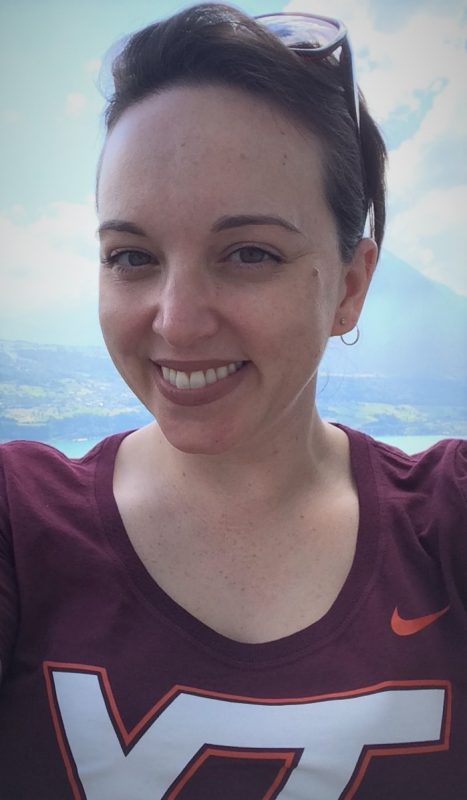
Margaret Couvillon
· Associate ProfessorVerifiedVirginia Tech · Entomology
Active 2007–2026
About
Maggie Couvillon is a faculty member at Virginia Tech's Department of Entomology, where her research focuses on pollinator biology and ecology. Her work involves studying insect-plant interactions and the broader ecological roles of pollinators. She is involved in research that aims to understand the dynamics of pollinator populations and their importance to ecosystems.
Research topics
- Ecology
- Biology
- Agronomy
- Toxicology
- Geography
Selected publications
Behavioral ecology: Tracking the flight of the foraging honey bee
Current Biology · 2026-03-01
article1st authorCorrespondingOpen MIND · 2026-03-09
datasetSenior authorHere we studied a particular kind of social network in honey bees: the recruitment of nestmates to profitable food resources via the waggle dance. We housed experimental colonies of approximately 3,000 individually-marked worker honey bees (plus the queen) in observation hives, trained bees to collect sugar solution from an artificial feeder, and then traced the spread of information about the location of the feeder as bees waggle danced to recruit one another to it. First, using these empirical data, we calculated network density for our observed recruitment networks. To do this in a biologically relevant way, we used deterministic susceptible-infected models to simulate empirical upper bounds for density values, rather than using the default reference of a complete graph. We emphasize that calculating and interpreting bread-and-butter network descriptive statistics taking the biological constraints of the system at hand into account is an important step in studying social networks in animals. Second, we calculated burstiness of waggle dance bouts in the observed networks, and found that bees danced regularly, not burstily. Finally, we investigated the role of individuality in waggle dance behavior in network structure. Each honey bee communicates the distance to a resource in a part of the waggle dance called the waggle run, whose duration is proportional to the distance she flew. However, bees differ in the proportion by which they scale the real-world distance to a waggle run duration. We found that this individuality supported network propagation when dancers had higher calibrations than their followers did. We hope that this work will be interesting across bee biology as well as bio-inspired computing. <br><br>
Virginia Tech Data Repository · 2026-03-09
datasetOpen accessSenior authorHere we studied a particular kind of social network in honey bees: the recruitment of nestmates to profitable food resources via the waggle dance. We housed experimental colonies of approximately 3,000 individually-marked worker honey bees (plus the queen) in observation hives, trained bees to collect sugar solution from an artificial feeder, and then traced the spread of information about the location of the feeder as bees waggle danced to recruit one another to it. First, using these empirical data, we calculated network density for our observed recruitment networks. To do this in a biologically relevant way, we used deterministic susceptible-infected models to simulate empirical upper bounds for density values, rather than using the default reference of a complete graph. We emphasize that calculating and interpreting bread-and-butter network descriptive statistics taking the biological constraints of the system at hand into account is an important step in studying social networks in animals. Second, we calculated burstiness of waggle dance bouts in the observed networks, and found that bees danced regularly, not burstily. Finally, we investigated the role of individuality in waggle dance behavior in network structure. Each honey bee communicates the distance to a resource in a part of the waggle dance called the waggle run, whose duration is proportional to the distance she flew. However, bees differ in the proportion by which they scale the real-world distance to a waggle run duration. We found that this individuality supported network propagation when dancers had higher calibrations than their followers did. We hope that this work will be interesting across bee biology as well as bio-inspired computing. <br><br>
Frontiers in Bee Science · 2025-09-22
articleOpen accessSenior authorSocial network analysis is increasingly and fruitfully applied to study the collective structure and function of animal societies across space and time. Honey bees ( Apis mellifera L.) are a particularly tractable model system that is rich in social relationships and dynamics. Despite the rich body of literature describing the social life of the honey bee, including the famous waggle dance by which foragers recruit nestmates to profitable resources, relatively little is known about the networks that arise from waggle dance communication. Here we conducted a field experiment with fully-marked experimental colonies (N = 2 colonies, 3,000 bees each) to characterize the honey bee waggle dance recruitment network structure and function. Particularly, we studied network density, burstiness in waggle dance bouts, and the effect of individuality in waggle dance communication behavior on network structure. We simulated a maximally-efficient honey bee recruitment network using a deterministic susceptible-infected model. Then we used this simulated network as an upper bound for network density to calculate the proportion of successful recruitment events in observed networks compared to the simulated maximal network. Next, we characterized the burstiness, or temporal distribution, of waggle dance bouts. Finally, we tested whether inter-bee differences, or individuality, in waggle dance communication affected the recruitment network structure. We found that (1) real recruitment networks are sparse, with each individual recruiting up to 3.5% as many nestmates as predicted by the simulated maximal network; (2) individual bees danced steadily, not in bursts, and (3) that individuality in waggle dance calibrations was positively associated with successful recruitment and thus the propagation of the recruitment network (p = 0.008). Our results offer the first empirical and biologically-informed descriptive statistics for honey bee waggle dance networks and may be informative in the parameterization of bio-inspired computing models.
Journal of Experimental Biology · 2025-05-01 · 4 citations
articleOpen accessSenior authorGlyphosate is a broad-spectrum herbicide that inhibits the shikimate pathway, which honey bees (Apis mellifera), a non-target beneficial pollinator, do not endogenously express. Nonetheless, sublethal glyphosate exposure in honey bees has been correlated to impairments in gustation, learning, memory and navigation. While these impacted physiologies underpin honey bee foraging and recruitment, the effects of sublethal glyphosate exposure on these important behaviors remain unclear, and any proximate mechanism of action in the honey bee is poorly understood. We trained cohorts of honey bees from the same hives to forage at one of two artificial feeders offering 1 mol l-1 sucrose solution, either unaltered (N=40) or containing glyphosate at 5 mg acid equivalent (a.e.) l-1 (N=46). We then compared key foraging behaviors and, on a smaller subset of bees, recruitment behaviors. Next, we quantified protein levels of octopamine, tyramine and dopamine, and levels of the amino acid precursor tyrosine in the brains of experimental bees collected 3 days after the exposure. We found that glyphosate treatment bees reduced their foraging by 13.4% (P=0.022), and the brain content of tyramine was modulated by a crossover interaction between glyphosate treatment and the number of feeder visits (P=0.004). Levels of octopamine were significantly correlated with its precursors tyramine (P=0.011) and tyrosine (P=0.018) in glyphosate treatment bees, but not in control bees. Our findings emphasize the critical need to investigate impacts of the world's most-applied herbicide and to elucidate its non-target mechanism of action in insects to create better-informed pollinator protection strategies.
Ecology and Evolution · 2025-05-01
articleOpen accessOptimal foraging theory (OFT) predicts that animals employ foraging strategies that maximize a particular currency, such as net energetic efficiency, to meet their nutritional demands. Two nonexclusive patterns that arise from OFT are convergence on high-quality resources and resource partitioning. Honey bees make collective decisions by integrating their individual foraging with social recruitment behaviors: returning foragers communicate the approximate vector to high-quality resources using waggle dances. Because we can eavesdrop on their communications, waggle dance decoding is a valuable tool for exploring OFT predictions as it allows us to map how honey bees use landscapes. In this study, we analyzed 8049 dances from colocalized colonies across three landscapes to investigate whether neighboring colonies forage by not partitioning patches (i.e., converging their food collection on the same patches), by partitioning at the landscape level, or by partitioning at the local level. To differentiate between these three possible scenarios, we examined three metrics: (1) interdance distances between and within colonies; (2) k-nearest neighbors; and (3) k-means clustering. We observed no difference in the distances between dances performed by bees from the same colony compared to those from different colonies. Also, we found at each of the three field sites that dances from the same colony were not more likely to appear as close neighbors to each other. Finally, k-means cluster analysis demonstrates that dance locations advertised by the same colony aggregated nonrandomly in the three sites, where dances from the same colony comprised a significant majority of dances within k-means clusters and 62% of clusters consisted entirely of dances from a single colony. Together, these results support a foraging scenario where honey bees partition their foraging, but at the local level. This strategy may help limit intercolony foraging competition.
Concrete consequences: construction on prime honey bee habitat doubles foraging distances
Biology Open · 2025-05-07 · 2 citations
articleOpen accessHuman-induced land-use change is a well-documented driver of species decline, including bees, but its true cost may be underestimated. The effects of habitat conversion on honey bee foraging metabolic costs are not well documented. Here, we quantify the impact of land use change on the foraging of freely flying honey bees (Apis mellifera) before (2018-2019, n=382) and after (2022, n=502) their historical foraging habitat is developed. We decoded and analyzed honey bee waggle dances, through which returning foragers communicate the vector of forage. We found that bees increased (from 2.4% to 8.4%) their use of undisturbed microhabitat within the development. The small-scale developments, covering just 1% of the foraging range, nearly doubled flight distance and energy expenditure. Average distance increased from 0.69 to 1.28 kilometers (from 7 to 13 Joules). Our study updates our understanding of land development costs on local bees, revealing concrete consequences to changing land upon which pollinators depend.
Individuality impacts communication success in honey bees
Current Biology · 2025-02-01 · 7 citations
articleSenior authorAirborne metofluthrin, a pyrethroid repellent, does not impact foraging honey bees
Journal of Insect Science · 2024-09-01 · 1 citations
articleOpen access1st authorCorrespondingOutdoor spatial mosquito repellents, such as mosquito coils or heating devices, release pyrethroid insecticides into the air to provide protection from mosquitoes within a defined area. This broadcast discharge of pyrethroids into the environment raises concern about the effect on non-target organisms. A previous study found that prallethrin discharged from a heating device did not affect honey bee (Apis mellifera L.) [Hymenoptera: Apidae] foraging or recruitment. In this second study, there was no significant difference in foraging frequency (our primary outcome), waggle dance propensity, or persistency in honey bees collecting sucrose solution between those exposed to metofluthrin from a different heating device and bees exposed to a non-metofluthrin control. One measure, waggle dance frequency, was higher in the metofluthrin treatment than the control but this outcome was likely a spurious result due to the small sample size. The small particle size of the emissions, averaging 4.43 µm, from the heated spatial repellent products, which remain airborne with little settling, may play an important role in the lack of effect found on honey bee foraging.
American Entomologist · 2024-01-01
article1st authorCorresponding
Frequent coauthors
- 40 shared
Roger Schürch
Virginia Tech
- 39 shared
Francis L. W. Ratnieks
University of Sussex
- 17 shared
Bradley David Ohlinger
Virginia Tech
- 12 shared
Mary R. Silliman
- 11 shared
Taylor Steele
- 10 shared
William O. H. Hughes
University of Sussex
- 9 shared
Anna Dornhaus
University of Arizona
- 8 shared
Matthias Egger
Labs
Education
- 2007
Ph.D., Animal and Plant Sciences
University of Sheffield
- 2004
M.S., Neurobiology
Duke University
- 2000
B.S.
Loyola University New Orleans
- Resume-aware match score
- Save to shortlist
- AI-drafted outreach
See your match with Margaret Couvillon
PhdFit ranks faculty by your research interests, methods, and publications — grounded in their actual work, not templates.
- Free to start
- No credit card
- 30-second signup