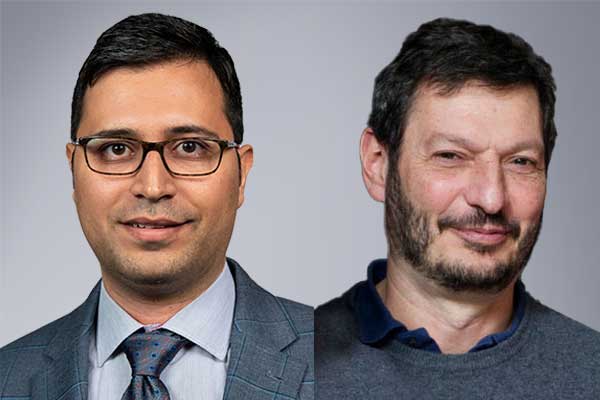
Mario Sznaier
VerifiedNortheastern University · Electrical and Energy Engineering
Active 1987–2026
About
Mario Sznaier is the Dennis Picard Trustee Professor of Electrical and Computer Engineering at Northeastern University. He received his Ingeniero Electronico and Ingeniero en Sistemas de Computacion degrees from the Universidad de la Republica in Uruguay, and his MSEE and Ph.D. degrees from the University of Washington. His academic career includes positions as an Assistant Professor at the University of Central Florida, and later at Pennsylvania State University, where he was promoted to Associate Professor and then to Professor of Electrical Engineering. In July 2006, he joined Northeastern University’s Electrical and Computer Engineering Department. His research interests encompass dynamics-enabled machine learning, robust control, control-oriented identification, semi-algebraic optimization, and dynamic computer vision. Sznaier has held visiting appointments at the California Institute of Technology and has served as an adjunct professor at Penn State. He is actively involved in the academic community as an Associate Editor for the journal Automatica, Editor in Chief for the section on AI and Machine Learning Control of Frontiers in Control Engineering, and Chair of IFAC's Technical Committee on Robust Control. Recognized as an IEEE Fellow, he has received the IEEE Control Systems Society Distinguished Member Award. His work includes leading multidisciplinary research projects funded by agencies such as the National Science Foundation, Department of Defense, and Air Force Office of Scientific Research, focusing on areas like verifiable robust AI, epidemic control, cyber-physical systems, and human behavioral modeling.
Research topics
- Artificial Intelligence
- Computer Science
- Computer vision
- Mathematics
- Algorithm
- Mathematical optimization
Selected publications
ArXiv.org · 2026-03-26
articleOpen accessThe Łojasiewicz inequality characterizes objective-value convergence along gradient flows and, in special cases, yields exponential decay of the cost. However, such results do not directly give rates of convergence in the state. In this paper, we use contraction theory to derive state-space guarantees for gradient systems satisfying generalized Łojasiewicz inequalities. We first show that, when the objective has a unique strongly convex minimizer, the generalized Łojasiewicz inequality implies semi-global exponential stability; on arbitrary compact subsets, this yields exponential stability. We then give two curvature-based sufficient conditions, together with constraints on the Łojasiewicz rate, under which the nonconvex gradient flow is globally incrementally exponentially stable.
Physics-Informed System Identification Using Randomized Atomic Features
2026-01-01
articleOpen accessarXiv (Cornell University) · 2026-03-26
preprintOpen accessThe Łojasiewicz inequality characterizes objective-value convergence along gradient flows and, in special cases, yields exponential decay of the cost. However, such results do not directly give rates of convergence in the state. In this paper, we use contraction theory to derive state-space guarantees for gradient systems satisfying generalized Łojasiewicz inequalities. We first show that, when the objective has a unique strongly convex minimizer, the generalized Łojasiewicz inequality implies semi-global exponential stability; on arbitrary compact subsets, this yields exponential stability. We then give two curvature-based sufficient conditions, together with constraints on the Łojasiewicz rate, under which the nonconvex gradient flow is globally incrementally exponentially stable.
Unsafe probabilities and risk contours for stochastic processes using convex optimization
Automatica · 2026-03-31
articleOpen accessSenior authorWhen evaluating safety specifications for trajectories of a dynamical system, it is vital to be able to bound the worst-case probability of unsafety (constraint violation) Certifications of stochastic safety and worst-case probabilities of unsafety can be expressed as infinite-dimensional linear programs (e.g. stochastic barrier functions, occupation measure problems) This paper proves that the infinite-dimensional linear programs and their finite-dimensional Moment-Sum-of-Squares truncations are nonconservative (to the true probability of unsafety) under compactness and regularity conditions in stochastic dynamics. Unsafe-probability estimates and risk contours are generated for example stochastic processes.
IEEE Robotics and Automation Letters · 2025-07-23
articleOpen accessSenior authorMotivated by the problem of pursuit-evasion, we present a motion planning framework that combines energy-based diffusion models with artificial potential fields for robust real time trajectory generation in complex environments. Our approach processes obstacle information directly from point clouds, enabling efficient planning without requiring complete geometric representations. The framework employs classifier-free guidance training and integrates local potential fields during sampling to enhance obstacle avoidance. In dynamic scenarios, the system generates initial trajectories using the diffusion model and continuously refines them through potential field-based adaptation, demonstrating effective performance in pursuit-evasion scenarios with partial pursuer observability.
Robust Data-Driven Receding Horizon Control
ArXiv.org · 2025-10-07
preprintOpen accessThis paper presents a data-driven receding horizon control framework for discrete-time linear systems that guarantees robust performance in the presence of bounded disturbances. Unlike the majority of existing data-driven predictive control methods, which rely on Willem's fundamental lemma, the proposed method enforces set-membership constraints for data-driven control and utilizes execution data to iteratively refine a set of compatible systems online. Numerical results demonstrate that the proposed receding horizon framework achieves better contractivity for the unknown system compared with regular data-driven control approaches.
Robust Data-Driven Receding-Horizon Control for LQR with Input Constraints
ArXiv.org · 2025-10-07
preprintOpen accessSenior authorThis letter presents a robust data-driven receding-horizon control framework for the discrete time linear quadratic regulator (LQR) with input constraints. Unlike existing data-driven approaches that design a controller from initial data and apply it unchanged throughout the trajectory, our method exploits all available execution data in a receding-horizon manner, thereby capturing additional information about the unknown system and enabling less conservative performance. Prior data-driven LQR and model predictive control methods largely rely on Willem's fundamental lemma, which requires noise-free data, or use regularization to address disturbances, offering only practical stability guarantees. In contrast, the proposed approach extends semidefinite program formulations for the data-driven LQR to incorporate input constraints and leverages duality to provide formal robust stability guarantees. Simulation results demonstrate the effectiveness of the method.
Safe Control for Pursuit-Evasion With Density Functions
IEEE Control Systems Letters · 2025-01-01
articleSenior authorThis letter presents a density function based safe control synthesis framework for the pursuit-evasion problem. We extend safety analysis to dynamic unsafe sets by formulating a reach-avoid type pursuit-evasion differential game as a robust safe control problem. Using density functions and semi-algebraic sets, we derive sufficient conditions for weak eventuality and evasion, reformulating the problem into a convex sum-of-squares program solvable via standard semidefinite programming solvers. This approach avoids the computational complexity of solving the Hamilton-Jacobi-Isaacs partial differential equation, offering a scalable and efficient framework. Numerical simulations demonstrate the efficacy of the proposed method.
3D-HGS: 3D Half-Gaussian Splatting<sup>*</sup>
2025-06-10 · 7 citations
articlePhoto-realistic image rendering from 3D scene reconstruction has advanced significantly with neural rendering techniques. Among these, 3D Gaussian Splatting (3D-GS) outperforms Neural Radiance Fields (NeRFs) in quality and speed but struggles with shape and color discontinuities. We propose 3D Half-Gaussian (3D-HGS) kernels as a plug-and-play solution to address these limitations. Our experiments show that 3D-HGS enhances existing 3D-GS methods, achieving state-of-the-art rendering quality without compromising speed. More demos and code are available at https://lihaolin88.github.io/CVPR-2025-3DHGS.
Challenges in Model Agnostic Controller Learning for Unstable Systems
IEEE Control Systems Letters · 2025-01-01 · 1 citations
article1st authorCorrespondingModel agnostic controller learning, for instance by direct policy optimization, has been the object of renewed attention lately, since it avoids a computationally expensive system identification step. Indeed, direct policy search has been empirically shown to lead to optimal controllers in a number of cases of practical importance. However, to date, these empirical results have not been backed up with a comprehensive theoretical analysis for general problems. In this paper we use a simple example to show that direct policy optimization is not directly generalizable to other seemingly simple problems. In such cases, direct optimization of a performance index can lead to unstable pole/zero cancellations, resulting in the loss of internal stability and unbounded outputs in response to arbitrarily small perturbations. We conclude the paper by analyzing several alternatives to avoid this phenomenon, suggesting some new directions in direct control policy optimization.
Recent grants
NSF · $415k · 2009–2014
A Systems Theoretic Approach to Robust Active Vision
NSF · $79k · 2006–2007
Risk Adjusted Robust Control Theory and Applications
NSF · $160k · 2005–2007
CPS: Frontier: Collaborative Research: Data-Driven Cyberphysical Systems
NSF · $270k · 2017–2022
Robust Identification and Model Validation for a Class of Nonlinear Dynamic Systems and Applications
NSF · $380k · 2014–2019
Frequent coauthors
- 688 shared
Robert R. Bitmead
University of California, San Diego
- 688 shared
Marco Lovera
Politecnico di Milano
- 688 shared
Warren E. Dixon
University of Florida
- 684 shared
Kirsten Morris
- 679 shared
James Farrell
University of Arizona
- 679 shared
John Lygeros
ETH Zurich
- 679 shared
Dragan Nešić
- 679 shared
P Khargonekar
Office of International Affairs
Awards & honors
- IEEE Fellow
- IEEE Control Systems Society Distinguished Member Award
- Resume-aware match score
- Save to shortlist
- AI-drafted outreach
See your match with Mario Sznaier
PhdFit ranks faculty by your research interests, methods, and publications — grounded in their actual work, not templates.
- Free to start
- No credit card
- 30-second signup