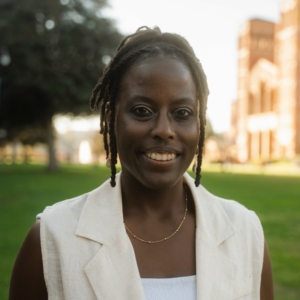
Faith M. Deckard
· Assistant ProfessorVerifiedUniversity of California, Los Angeles · Sociology
Active 2021–2025
About
Faith M. Deckard is an assistant sociology professor at the University of California - Los Angeles. Her research focuses on understanding how marginalized groups experience and respond to social control institutions, with a particular emphasis on the U.S. criminal legal system. Currently, she is engaged in a project that examines how commercial bail entangles families in a complex economic and social system of obligation, debt, and punishment. Her sociological research and teaching approach is grounded in the belief that lived experiences are essential to understanding and producing knowledge, which can ultimately inform practical applications. Whether conducting interviews, analyzing survey data, or teaching in diverse settings such as behind bars or on university campuses, she actively seeks and encourages different ways of knowing.
Research topics
- Political Science
- Sociology
- Social Science
- Psychology
- Social psychology
- Law
- Finance
- Business
- Criminology
- Psychiatry
- Clinical psychology
- Public relations
Selected publications
UNC Libraries · 2025-06-12
articleOpen access1st authorCorrespondingResearch and media discussion of police contact routinely conceptualize it as time-constrained interactions between officers and civilians. However, extant literature documents preparation for encounters and post-encounter advocacy, which each challenge restricted understandings of contact and, importantly, its relationship to mental health. We introduce “perpetual encounters” to both theoretically and empirically move closer to the temporally unbounded and enduring way that police contact is experienced in black women’s everyday lives. Utilizing a novel, nationally representative dataset on their policing experiences, we explore how mental health is independently and conjointly associated with three dimensions of police contact: preparation, police stops, and advocacy against police violence. Beyond exemplifying how pervasive the police are in the day-to-day lives of marginalized communities, extending the scope of contact recognizes preparation as a significant threat to mental health and advocacy as a health-promoting activity. This study supports moving beyond discrete notions and measurement of police contact to process-oriented understandings and relational modeling.
Theoretical Criminology · 2025-01-15 · 1 citations
articleOpen access1st authorCorrespondingCriminal legal processing is an arduous classification, supervision, and extraction cycle increasingly administered by private entities. This article spotlights processing within commercial bail and uncovers profitable subjects—people (re)identified as future assets—as a stratifying and elusive construction with implications for criminal legal experiences. Bail agents deploy marking and surveillance like other legal professionals to process people. However, a profit objective and financial risk framework give rise to distinct applications. First, a shift in marking occurs in which legal involvement operates as credit and stratifies people into “classification situations” where they unevenly, and sometimes counterintuitively, access resources. Second, marked individuals are matched to different forms of surveillance that deviate in the degree of felt hassle and punishment. Surveillance is used for people to repeatedly prove their profitability in an environment where a dominant perception is that defendants are liabilities. Consequently, few can avoid the conditions that define their varying and unequal experiences.
Social Forces · 2025-05-16 · 1 citations
articleOpen access1st authorCorrespondingResearch and media discussion of police contact routinely conceptualize it as time-constrained interactions between officers and civilians. However, extant literature documents preparation for encounters and post-encounter advocacy, which each challenge restricted understandings of contact and, importantly, its relationship to mental health. We introduce "perpetual encounters" to both theoretically and empirically move closer to the temporally unbounded and enduring way that police contact is experienced in black women's everyday lives. Utilizing a novel, nationally representative dataset on their policing experiences, we explore how mental health is independently and conjointly associated with three dimensions of police contact: preparation, police stops, and advocacy against police violence. Beyond exemplifying how pervasive the police are in the day-to-day lives of marginalized communities, extending the scope of contact recognizes preparation as a significant threat to mental health and advocacy as a health-promoting activity. This study supports moving beyond discrete notions and measurement of police contact to process-oriented understandings and relational modeling.
UNC Libraries · 2025-05-07 · 1 citations
articleOpen access1st authorCorrespondingPolice violence shapes the lives of racial and ethnic minorities, and while much has been written about strategic responses to police, missing is an examination of how black women navigate interactions with officers. Based on 32 interviews with black women, we find that they use witnessing, or the mobilization of others as observers to police encounters. Research demonstrates the rising role of videos and smartphones in documenting encounters with officers. We find that black women adapt witnessing techniques based on their surroundings, available resources, and network contacts. Three forms of witnessing are observed: physical witnessing, mobilizing others in close proximity to interactions with officers; virtual witnessing, using cellphone or social media technology to contact others or record interactions with officers; and institutional witnessing, leveraging police or other institutional contacts as interveners to interactions with officers. Black women mobilize witnessing to deescalate violence, gather evidence, and promote accountability. Attuned to both the interactional and structural dynamics of police encounters, black women conceptualize witnessing as a way to survive police encounters and navigate their legal estrangement within the carceral system. We theorize black women’s witnessing as a form of resistance as they work to reconfigure short- and long-term power relations between themselves, their communities, and police.
Surveilling Sureties: How Privately Mediated Monetary Sanctions Enroll and Responsibilize Families
Social Problems · 2024-07-14 · 8 citations
articleOpen access1st authorCorrespondingAbstract In the neoliberal age, ordinary people are increasingly responsible for taking up crime control and surveillance, what we might consider traditional state functions. This article situates commercial bail as a case of responsibilization and identifies monetary sanctions as a mechanism through which private companies offload pretrial risk management onto families. Drawing on ethnographic and interview data, I present this process via four stages. First, agents use cosigned bail bonds to selectively enroll people they perceive as suitable sureties and surveillants. Second, this monetary sanction is deployed with carceral and financial threats to encourage cosigners to embody the roles. Third, as surveillants, family members engage in invisible emotional labor to cope with or rationalize their deployment as an arm of the state. Last, through their involvement as instruments of surveillance, family members inadvertently become subjects of surveillance and carceral control. From enrollment to subjugation, this process of responsibilization is an uneven one as women, particularly women of color, are disproportionately burdened with risk management and any resulting repercussions.
Social Problems · 2022 · 13 citations
Senior authorCorresponding- Sociology
- Political Science
- Criminology
Abstract Police violence shapes the lives of racial and ethnic minorities, and while much has been written about strategic responses to police, missing is an examination of how black women navigate interactions with officers. Based on 32 interviews with black women, we find that they use witnessing, or the mobilization of others as observers to police encounters. Research demonstrates the rising role of videos and smartphones in documenting encounters with officers. We find that black women adapt witnessing techniques based on their surroundings, available resources, and network contacts. Three forms of witnessing are observed: physical witnessing, mobilizing others in close proximity to interactions with officers; virtual witnessing, using cellphone or social media technology to contact others or record interactions with officers; and institutional witnessing, leveraging police or other institutional contacts as interveners to interactions with officers. Black women mobilize witnessing to deescalate violence, gather evidence, and promote accountability. Attuned to both the interactional and structural dynamics of police encounters, black women conceptualize witnessing as a way to survive police encounters and navigate their legal estrangement within the carceral system. We theorize black women’s witnessing as a form of resistance as they work to reconfigure short- and long-term power relations between themselves, their communities, and police.
Poor People's Survival Strategies: Two Decades of Research in the Americas
Annual Review of Sociology · 2022 · 64 citations
1st authorCorresponding- Sociology
- Political Science
- Social Science
Nearly a half-century ago, two scholars north and south of the US border called attention to the role played by reciprocity networks in poor peoples’ survival strategies. This article provides a synthetic picture of the qualitative research on those strategies, focusing not only on mutual aid networks but also on clientelist politics and popular protest. These are, we argue, oftentimes complementary ways of everyday problem-solving. Furthermore, most research on survival strategies has overlooked state and street violence as literal threats to poor people's daily survival. Our review systematically describes the individual and collective strategies poor residents use to navigate daily dangers. We advocate for the incorporation of personal safety into the study of poor people's survival strategies and identify as a promising research endeavor a simultaneous attention to ways of making ends meet and coping with interpersonal and state violence.
A Network Approach to Assessing the Relationship between Discrimination and Daily Emotion Dynamics
Social Psychology Quarterly · 2022-10-15 · 11 citations
article1st authorCorrespondingDiscrimination-health research has been critiqued for neglecting the endogeneity of reports of discrimination to negative affect and the multidimensionality of mental health. To address these challenges, we model discrimination’s relationship to multiple psychological variables without directional constraints. Using time-dense data to identify associational network structures allows for joint testing of the social stress hypothesis, prominent in discrimination-health literature, and the negativity bias hypothesis, an endogeneity critique rooted in social psychology. Our results show discrimination predicts negative emotions from day-to-day but not vice versa, indicating that racial discrimination is a risk factor and not symptom of negative emotion. Furthermore, we identify sadness, guilt, hostility, and fear as a locus of interrelated emotions sensitive to racism-related stressors that emerges over time. Thus, we find support for what race scholars have argued for 120+ years in a model without a priori directional restrictions and then build on this work by empirically identifying cascading mental health consequences of discrimination.
Debt Stress, College Stress: Implications for Black and Latinx Students’ Mental Health
Race and Social Problems · 2021 · 30 citations
1st authorCorresponding- Political Science
- Psychology
- Clinical psychology
Frequent coauthors
- 2 shared
Jacob E. Cheadle
The University of Texas at Austin
- 2 shared
Bridget J. Goosby
- 1 shared
Javier Auyero
The University of Texas at Austin
- 1 shared
Andrew Messamore
University of Washington
- 1 shared
Shannon Malone Gonzalez
University of North Carolina at Chapel Hill
- Resume-aware match score
- Save to shortlist
- AI-drafted outreach
See your match with Faith M. Deckard
PhdFit ranks faculty by your research interests, methods, and publications — grounded in their actual work, not templates.
- Free to start
- No credit card
- 30-second signup