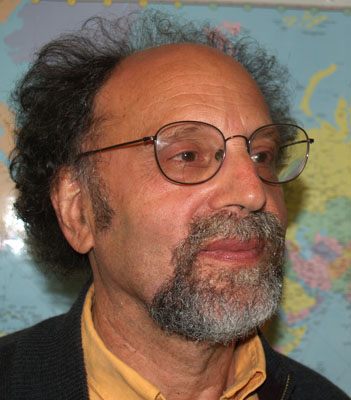
Farrell Ackerman
· Professor and Director of the Human Developmental Sciences ProgramUniversity of California, San Diego · Linguistics
Active 1950–2026
About
Farrell Ackerman is a Professor and the Director of the Human Developmental Sciences Program at UC San Diego. His role involves leading the program and contributing to the academic community within the Department of Linguistics. Further details about his research focus, background, and key contributions are not provided in the page text.
Research topics
- Computer Science
- Natural Language Processing
- Philosophy
- Linguistics
- Artificial Intelligence
- Sociology
- Biology
- Psychology
- Database
- Zoology
- Cognitive science
- Anthropology
- Epistemology
- Ecology
- Evolutionary biology
Selected publications
Introducing the DeAR principles and Paralex
Open MIND · 2026-01-01
preprintOpen accessLinguistic typology stands to gain significantly from advances in the use of extremely large datasets. However, our ability to secure these gains will depend on the availability of machine-readable data that is precise and comparable. Here we identify the challenges and opportunities ahead, relating to the quality, longevity, and (re-)usability of linguistic data in typology. Then in response, we introduce the DeAR principles (Decentralized, Automatically verified, Revisable), designed to guide and assist researchers to create diverse, high-resolution and robust datasets. We demonstrate the DeAR principles in action through the example of Paralex, a data standard (i.e., set of scientific conventions) developed collaboratively for lexicons of morphologically inflected forms. Our proposals aim to foster a more resilient and equitable infrastructure for the future of linguistic research.
Data sharing and standardization in Linguistics
White Rose Research Online (University of Leeds, The University of Sheffield, University of York) · 2026-04-28
preprintOpen accessLinguistic typology stands to gain significantly from advances in the use of extremely large datasets. However, our ability to secure these gains will depend on the availability of machine-readable data that is precise and comparable. Here we identify the challenges and opportunities ahead, relating to the quality, longevity, and (re-)usability of linguistic data in typology. Then in response, we introduce the DeAR principles (Decentralized, Automatically verified, Revisable), designed to guide and assist researchers to create diverse, high-resolution and robust datasets. We demonstrate the DeAR principles in action through the example of Paralex, a data standard (i.e., set of scientific conventions) developed collaboratively for lexicons of morphologically inflected forms. Our proposals aim to foster a more resilient and equitable infrastructure for the future of linguistic research.
Data sharing and standardization in Linguistics
Zenodo (CERN European Organization for Nuclear Research) · 2026-04-28
preprintOpen accessLinguistic typology stands to gain significantly from advances in the use of extremely large datasets. However, our ability to secure these gains will depend on the availability of machine-readable data that is precise and comparable. Here we identify the challenges and opportunities ahead, relating to the quality, longevity, and (re-)usability of linguistic data in typology. Then in response, we introduce the DeAR principles (Decentralized, Automatically verified, Revisable), designed to guide and assist researchers to create diverse, high-resolution and robust datasets. We demonstrate the DeAR principles in action through the example of Paralex, a data standard (i.e., set of scientific conventions) developed collaboratively for lexicons of morphologically inflected forms. Our proposals aim to foster a more resilient and equitable infrastructure for the future of linguistic research.
Morphological change as systemically motivated bricolage: Hungarian impulsative constructions
Morphology · 2026-01-13
articleOpen accessAbstract While many languages have voluntary desiderative constructions expressing the intention of an agent argument to engage in an activity or action, a few languages have dedicated impulsative constructions expressing an urge or feeling to engage in an activity or action. Hungarian has developed an impulsative construction by reanalyzing a series of individual verbal affixes associated with the morphosyntactic properties potential, conditional and agreement, for example sír-hat-n-ék ‘I could cry’, into a composite nominalizing affix which means ‘an urge to Verb’ as in the derived noun sír-hatnék ‘an urge to cry’. On the basis of historical corpora we argue that this construction emerges from the interaction of several large and otherwise independent systemic changes in Hungarian grammar as well as by commonly attested cross-linguistic conversational implicatures concerning modal markers.
Morphology Gets More and More Complex, Unless It Doesn’t
Cambridge University Press eBooks · 2022 · 2 citations
Senior authorCorresponding- Sociology
- Cognitive science
- Linguistics
The past few years have led to the widespread recognition that morphology is an independent domain of language functioning in dynamic interdependence with more familiar domains such as phonology and syntax. This has permitted nuanced research into the organization of morphological systems as well as the development of hypotheses concerning factors responsible for such organization. In this chapter we compare two classes of hypotheses — adaptive explanations and neutral ones — for attested differences in morphological complexity claimed to correspond with sociocultural and demographic factors. While both examine language change as a (cultural) evolutionary process, we argue that much recent work on adaptive hypotheses for morphological complexity has been uncritically adaptationist, neglecting key results and lessons from population genetics about how to study evolutionary systems. Finally, we argue that neutral explanations are presently more likely explanations for the apparent association of morphological complexity and smaller, historically more isolated populations and should a priori be preferred over adaptive explanations unless and until a high evidential burden has been met.
Handbook of pragmatics online/Handbook of pragmatics · 2022 · 2 citations
1st authorCorresponding- Computer Science
- Natural Language Processing
- Linguistics
Amsterdam studies in the theory and history of linguistic science. Series 4, Current issues in linguistic theory · 2021-03-04
book-chapter1st authorCorrespondingAbstract Aronoff (2016) argues for the value of interpreting different approaches to the analysis of morphology as reflecting the sensibilities of foxes and hedgehogs as characterized in Berlin (1997) . It is argued that Berlin also provides a way to go beyond these oppositional sensibilities and the morphological theories they develop by exploring a complex systems perspective on morphological organization of the sort adumbrated by certain late 19th century and early 20th century linguists: systems that arise from the dynamic co-activity of surprisingly many factors. The kind of view they envisioned is now quantitatively and computationally practicable and can benefit from research on complex behaviors within the developmental sciences. A view of this sort is motivated by two types of empirical evidence, one concerning implicative paradigm organization in Māori and Baale, the other concerning the dynamic relation between diachrony and synchrony as attested in Mari and Beserman Udmurt.
Lexical databases for computational analyses: A linguistic perspective
Proceedings of the Society for Computation in Linguistics · 2020 · 5 citations
- Computer Science
- Natural Language Processing
- Artificial Intelligence
Large typological databases have permitted new ways of studying cross-linguistic morphological variation. Recently, computational modelers with typological interests have begun to turn to broad multilingual text databases. In this paper, we will focus particularly on the UniMorph database, a collection of morphological paradigms, mostly gathered automatically from the crowd-sourced multi-lingual dictionary Wiktionary. It was designed to make the large quantity of data contained in Wiktionary available for NLP researchers by standardizing the data and putting it into a form that is easy to access. For typological studies, however, the requirements for a linguistically informed view of morphological variation are quite different. They involve using a morphological database as a scientific instrument to both formulate and test hypotheses about the nature and organization of language systems. The requirements are, accordingly, much higher. In this paper, we survey some of the methodological challenges and pitfalls involved in using corpora for typological research, and we end with a proposal for best practices and directions for further research.
2018-12-13 · 97 citations
reference-entryThere has been a broad resurgence in word-based approaches and the reconceptualization of classical ‘word and paradigm’ (WP) approaches as general models of morphological analysis. WP models are well adapted to the description and analysis of complex morphological patterns, most transparently clear in inflection. Modern WP models demonstrate how morphological organization is fundamentally implicational: the central role of words (and paradigms) reflects their predictive value in a morphological system. Understanding the nature of morphological organization, within and across languages, requires exploration of the fundamental elements of implicational relations. Descriptively this involves identifying the internal structure of words and the ways this structure facilitates an external organization into patterns of relatedness. Theoretically, it is necessary to identify analytic tools appropriate for specifying and quantifying word-internal and word-external organization. This type of analytic approach encourages the investigation of the types of learning theories that may play a role in determining the patterns observed to occur and thereby help to explain their learnability.
Acoustic differences in morphologically-distinct homophones
Figshare · 2017-01-01
datasetOpen accessPrevious work demonstrates that a word's status as morphologically-simple or complex may be reflected in its phonetic realisation. One possible source for these effects is phonetic paradigm uniformity, in which an intended word's phonetic realisation is influenced by its morphological relatives. For example, the realisation of the inflected word <i>frees</i> should be influenced by the phonological plan for <i>free</i>, and thus be non-homophonous with the morphologically-simple word <i>freeze</i>. We test this prediction by analysing productions of forty such inflected/simple word pairs, embedded in pseudo-conversational speech structured to avoid metalinguistic task effects, and balanced for frequency, orthography, as well as segmental and prosodic context. We find that stem and suffix durations are significantly longer by about 4–7% in fricative-final inflected words (<i>frees</i>, <i>laps</i>) compared to their simple counterparts (<i>freeze</i>, <i>lapse</i>), while we find a null effect for stop-final words. The result suggests that wordforms influence production of their relatives.
Frequent coauthors
- 34 shared
Robert Malouf
- 20 shared
James P. Blevins
George Mason University
- 5 shared
John C. Moore
University of California, San Diego
- 4 shared
Andrew Hippisley
University of Edinburgh
- 4 shared
Scott Seyfarth
University of California, San Diego
- 3 shared
Gert Webelhuth
Goethe University Frankfurt
- 2 shared
Marc Garellek
University of California, San Diego
- 2 shared
Olivier Bonami
Sorbonne Paris Cité
- Resume-aware match score
- Save to shortlist
- AI-drafted outreach
See your match with Farrell Ackerman
PhdFit ranks faculty by your research interests, methods, and publications — grounded in their actual work, not templates.
- Free to start
- No credit card
- 30-second signup