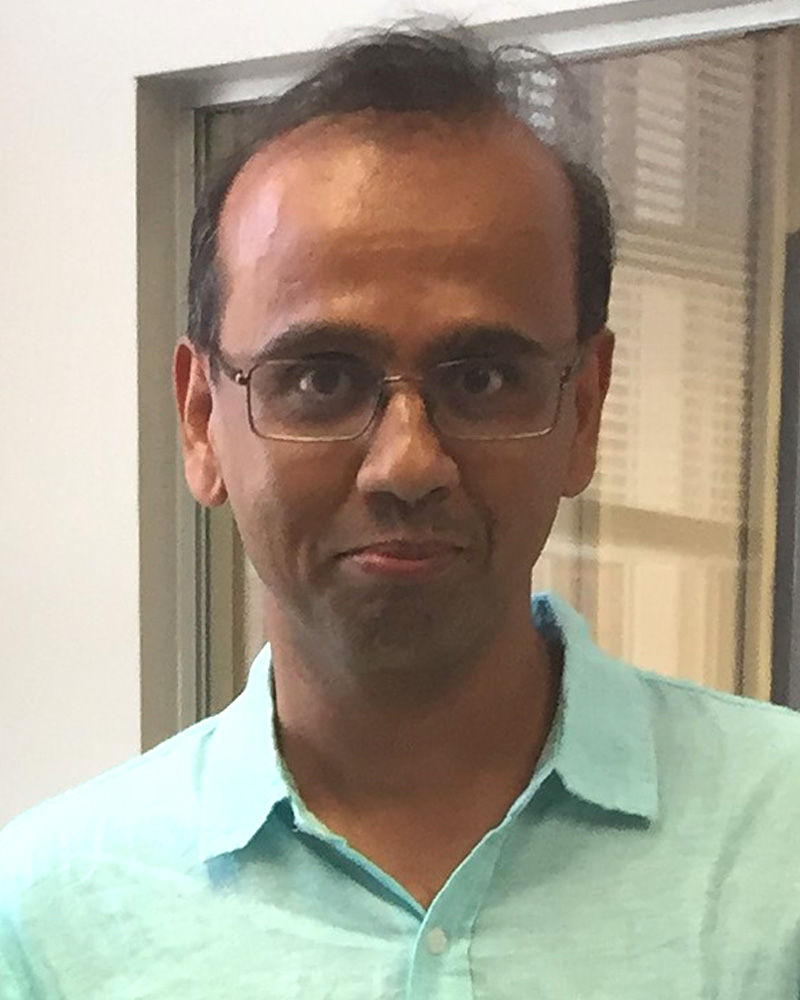
Prakash Belkale
· ProfessorVerifiedUniversity of North Carolina at Chapel Hill · Mathematics
Active 2000–2025
About
Prakash Belkale is a professor in the Department of Mathematics at the University of North Carolina at Chapel Hill. His research interests include algebraic geometry. His notable publications include work on extremal rays in the Hermitian eigenvalue problem and a quantum generalization of the Horn conjecture, indicating his focus on advanced mathematical theories and their applications within algebraic geometry.
Research topics
- Mathematics
- Pure mathematics
- Combinatorics
- Physics
- Geometry
- Quantum mechanics
- Mathematical analysis
- Particle physics
- Discrete mathematics
Selected publications
$p$-curvature operators and Satake-type phenomenon for $\frak{sl}_2$ KZ equations with $κ=\pm 2$
ArXiv.org · 2025-08-27
preprintOpen access1st authorCorrespondingThe $\frak{sl}_2$ KZ differential equations with values in the tensor power of the fundamental representation with parameter $κ=\pm 2$ are considered. A Satake-type correspondence is established over complex numbers and subsequently reduced to finite characteristic. This correspondence enables the study of the KZ equations on the lower weight subspaces of the tensor power in terms of the wedge powers of the weight subspace of the weight just below the highest weight. We apply this approach to analyze the $p$-curvature operators associated with our KZ equations, evaluate the dimension of the solution space in characteristic $p$, and determine whether all solutions are generated by the so-called $p$-hypergeometric solutions. In particular, we show that not all solutions of the KZ equations with $κ=2$ in characteristic $p$ are generated by $p$-hypergeometric solutions. Previously, no such examples were known.
Extremal Aspects of Representation Theory
Notices of the American Mathematical Society · 2025-03-13
articleOpen access1st authorCorrespondingThe Hermitian eigenvalue problem asks for the possible eigenvalues of a sum of two Hermitian matrices, given the eigenvalues of the summands.Let the summands be matrices and with eigenvaluesIn 1962, A. Horn conjectured a set of sufficient and necessary constraints for to be the spectrum of such a .These all took the form of linear inequalities in the variables , , .Some constraints are readily apparent, such asdue to the linearity of the trace, anddue to recasting the largest eigenvalue of a matrix as max{ = 1}.Other constraints are less obvious, but Horn's conjecture turned out to be true, though his list contained redundancies.Horn's inequalities all have the formwhere , , and are subsets of {1, , } of the same cardinality.If is a subset of {1, , } of cardinality , we define a partition () as follows.First enumerate the elements of in order: 1 < < .Then setConjecture 1.1.Horn conjectured that the following list of inequalities was a necessary and sufficient set of constraints for to be the spectrum of a sum = + : precisely those inequalities corresponding to , , for which (), (), and () are the eigenvalues of Hermitian matrices, the third being the sum of the first two.In other words, Horn's inequalities
Conformal Blocks in Genus Zero and the KZ Connection
Progress in mathematics · 2024-08-13
book-chapter1st authorCorrespondingConformal blocks in genus zero and the KZ connection
arXiv (Cornell University) · 2023
1st authorCorresponding- Mathematics
- Pure mathematics
- Physics
We survey some recent work on conformal blocks in genus zero, focussing on (1) Chern classes, global generation and morphisms, and (2) the Knizhnik--Zamolodchikov connection on conformal blocks (and invariants), their motivic realizations, and unitarity.
Motivic factorisation of KZ local systems and deformations of representation and fusion rings
arXiv (Cornell University) · 2023
1st authorCorresponding- Mathematics
- Pure mathematics
- Combinatorics
Let $\mathfrak{g}$ be a simple Lie algebra over $\mathbb{C}$. The KZ connection is a connection on the constant bundle associated to a set of $n$ finite dimensional irreducible representations of $\mathfrak{g}$ and a nonzero $κ\in \mathbb{C}$, over the configuration space of $n$-distinct points on the affine line. Via the work of Schechtman--Varchenko and Looijenga, when $κ$ is a rational number the associated local systems can be seen to be realisations of naturally defined motivic local systems. We prove a basic factorisation for the nearby cycles of these motivic local systems as some of the $n$ points coalesce. This leads to the construction of a family (parametrised by $κ$) of deformations over $\mathbb{Z}[t]$ of the representation ring of $\mathfrak{g}$--we call these enriched representation rings--which allows one to compute the ranks of the Hodge filtration of the associated variations of mixed Hodge structure; in turn, this has applications to both the local and global monodromy of the KZ connection. In the case of $\mathfrak{sl}_n$ we give an explicit algorithm for computing all products in the enriched representation rings, which we use to prove that if $1/κ$ is an integer then the global monodromy is finite and scalar. We also prove a similar factorisation result for motivic local systems associated to conformal blocks in genus $0$; this leads to the construction of a family of deformations of the fusion rings. Computations in these rings have potential applications to finiteness of global monodromy. Several open problems and conjectures are formulated. These include questions about motivic BGG-type resolutions and the relationship between the Hodge filtration and the filtration by conformal blocks at varying levels.
Vertices in multiplicative eigenvalue problem for arbitrary groups
arXiv (Cornell University) · 2023-06-29
preprintOpen access1st authorCorrespondingWe determine, in an inductive framework, the vertices of the polytope $P(s,K)$ controlling the conjugacy classes of elements which product to one in the maximal compact subgroup $K$ of a simple complex algebraic group $G$. This extends earlier work of the authors in related contexts. One feature of this work is the use of Kontsevich compactifications of the moduli of $P$-bundles (replacing the use of quot schemes in type A) which are related to semi-infinite geometry. We also obtain a quantum generalization of Fulton's conjecture valid for all $G$.
Rigid local systems and the multiplicative eigenvalue problem
Annals of Mathematics · 2022-04-30 · 1 citations
article1st authorCorrespondingWe give a construction that produces irreducible complex rigid local systems on $\mathbb{P}_C^1-\{p_1,\ldots ,p_s\}$ via quantum Schubert calculus and strange duality. These local systems are unitary and arise from a study of vertices in the polytopes controlling the multiplicative eigenvalue problem for the special unitary groups $\mathrm{SU}(n)$ (i.e., determination of the possible eigenvalues of a product of unitary matrices given the eigenvalues of the matrices). Roughly speaking, we show that the strange duals of the simplest vertices of these polytopes give all possible unitary irreducible rigid local systems. As a consequence we obtain that the ranks of unitary irreducible rigid local systems, including those with finite global monodromy, on $\mathbb{P}^1-S$ are bounded above if we fix the cardinality of the set $S=\{p_1,\ldots ,p_s\}$ and require that the local monodromies have orders that divide $n$ for a fixed $n$. Answering a question of N.~Katz, we show that there are no irreducible rigid local systems of rank greater than one, with finite global monodromy, all of whose local monodromies have orders dividing $n$, when $n$ is a prime number. We also show that all unitary irreducible rigid local systems on $\mathbb{P}_C^1-S$ with finite local monodromies arise as solutions to the Knizhnik-Zamalodchikov equations on conformal blocks for the special linear group. Along the way, generalizing previous works of the author and J.~Kiers, we give an inductive mechanism for determining all vertices in the multiplicative eigenvalue problem for $\mathrm{SU}(n)$.
Geometric proof of a conjecture of Fulton
UNC Libraries · 2021-06-24
articleOpen access1st authorCorrespondingWe give a geometric proof of a conjecture of Fulton on the multiplicities of irreducible representations in a tensor product of irreducible representations for .
A generalization of Fulton’s conjecture for arbitrary groups
UNC Libraries · 2021-08-28
articleOpen accessWe prove a generalization of Fulton’s conjecture which relates intersection theory on an arbitrary flag variety to invariant theory.
Conformal blocks and cohomology in genus 0
UNC Libraries · 2021-10-29
articleOpen accessSenior authorWe give a characterization of conformal blocks in terms of the singular cohomology of suitable smooth projective varieties, in genus $0$ for classical Lie algebras and $G_2$.
Recent grants
Theta Functions, Intersection Theory and Representation Theory
NSF · $239k · 2009–2013
Quantum Cohomology, Representation Theory, and Feynman Amplitudes
NSF · $100k · 2003–2007
Frequent coauthors
- 18 shared
Swarnava Mukhopadhyay
Tata Institute of Fundamental Research
- 14 shared
Angela Gibney
- 9 shared
Patrick Brosnan
- 8 shared
Shrawan Kumar
- 6 shared
Shrawan Kumar
- 6 shared
Najmuddin Fakhruddin
Tata Institute of Fundamental Research
- 4 shared
Nicolas Ressayre
Université Claude Bernard Lyon 1
- 4 shared
Joshua Kiers
- Resume-aware match score
- Save to shortlist
- AI-drafted outreach
See your match with Prakash Belkale
PhdFit ranks faculty by your research interests, methods, and publications — grounded in their actual work, not templates.
- Free to start
- No credit card
- 30-second signup