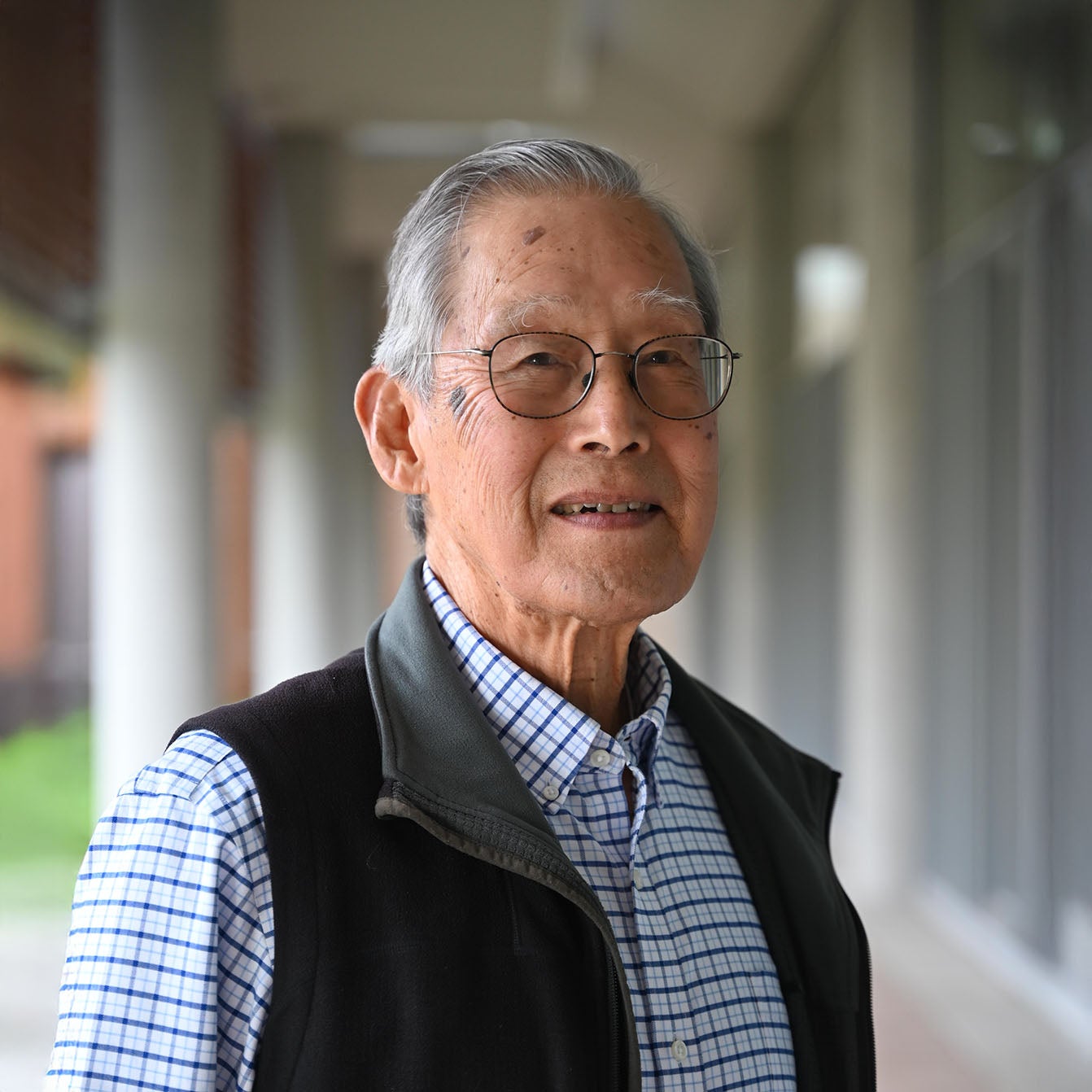
George Hirasaki
· A.J. Hartsook Professor Emeritus, Chemical and Biomolecular Engineering (NAE) Research ProfessorVerifiedRice University · Chemical and Biomolecular Engineering
Active 1968–2024
Research topics
- Organic chemistry
- Chemistry
- Chemical physics
- Materials science
- Physics
- Thermodynamics
- Chemical engineering
- Nuclear magnetic resonance
- Inorganic chemistry
- Chromatography
- Computational chemistry
Selected publications
The Journal of Physical Chemistry B · 2020 · 34 citations
- Materials science
- Nuclear magnetic resonance
- Thermodynamics
dispersion at high viscosities agrees with previously reported MD simulations of heptane confined in a polymer matrix, which suggests a common NMR relaxation mechanism between viscous polydisperse fluids and fluids under nanoconfinement, without the need to invoke paramagnetism.
The Journal of Physical Chemistry B · 2020 · 31 citations
- Chemistry
- Chemical physics
- Materials science
H dipole-dipole interactions enhanced by organic nanopore confinement dominate the NMR response in saturated organic-rich shales.
Role of Wettability on the Adsorption of an Anionic Surfactant on Sandstone Cores
Langmuir · 2020 · 55 citations
- Chemistry
- Chemical engineering
- Inorganic chemistry
alpha olefin sulfonate on Berea sandstone cores with different surface wettability and redox states under high temperature that represents reservoir conditions. Surfactant adsorption levels are determined by analyzing the effluent history data with a dynamic adsorption model assuming Langmuir isotherm. A variety of analyses, including surface chemistry, ionic composition, and chromatography, is performed. It is found that the surfactant breakthrough in the neutral-wet core is delayed more compared to that in the water-wet core because the deposited crude oil components on the rock surface increase the surfactant adsorption via hydrophobic interactions. As the surfactant adsorption is satisfied, the crude oil components are solubilized by surfactant micelles and some of the adsorbed surfactants are released from the rock surface. The released surfactant dissolves in the flowing surfactant solution, thereby resulting in an overshoot of the produced surfactant concentration with respect to the injection value. Furthermore, under water-wet conditions, changing the surface redox potential from an oxidized to a reduced state decreases the surfactant adsorption level by 40%. We find that the decrease in surfactant adsorption is caused not only by removing the iron oxide but also by changing the calcium concentration after the core restoration process (calcite dissolution and ion exchange as a result of using EDTA). Findings from this study suggest that laboratory surfactant adsorption tests need to be conducted by considering the wettability and redox state of the rock surface while recognizing how core restoration methods could significantly alter the ionic composition during surfactant flooding.
Frequent coauthors
- 71 shared
Walter G. Chapman
- 60 shared
Clarence A. Miller
- 57 shared
Sibani Lisa Biswal
Rice University
- 53 shared
Maura Puerto
Rice University
- 38 shared
Philip M. Singer
Rice University
- 32 shared
Doris L. González
- 28 shared
Kun Ma
- 27 shared
Francisco M. Vargas
Rice University
Education
- 1967
PhD, Chemical & Biomolecular Engineering
Rice University
- 1963
B.S., Chemical Engineering
Lamar University
Similar researchers at Rice University
- Resume-aware match score
- Save to shortlist
- AI-drafted outreach
See your match with George Hirasaki
PhdFit ranks faculty by your research interests, methods, and publications — grounded in their actual work, not templates.
- Free to start
- No credit card
- 30-second signup