Resume-aware faculty matching

Find professors who actually fit you

Upload your resume. Four AI agents analyze your background, rank the faculty who fit, inspect their recent research, and help you draft outreach — grounded in their actual work, not templates.

Free to startNo credit cardCancel anytime
Top matches Balanced preset
Dr. Sarah Chen
Stanford · Interpretability · NLP
91
Dr. Marcus Holloway
MIT · Robotics · RL
84
Dr. Aisha Okonkwo
CMU · Fairness · HCI
82
Nova · Professor Researcher · re-ranking top 20…
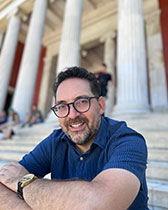
Geraldo L. Cadava

Geraldo L. Cadava

· Professor of History, Wender-Lewis Teaching and Research Professor

Northwestern University · History

Active 2005–2023

h-index3
Citations38
Papers6410 last 5y
Funding
See your match with Geraldo L. Cadava — sign in to PhdFit.Sign in

About

Geraldo Cadava is a historian of the United States with a focus on Latinos in the United States, the U.S.-Mexico borderlands, and Latin American immigration. Originally from Tucson, Arizona, he earned his Ph.D. from Yale University in 2008 and his B.A. from Dartmouth College in 2000. Cadava is the author of two books: 'The Hispanic Republican: The Shaping of An American Political Identity, from Nixon to Trump,' published in 2020, and 'Standing on Common Ground: The Making of a Sunbelt Borderland,' published in 2013. He is working on a third book titled 'A Thousand Bridges,' which offers an overview of Latino history since the Spanish conquest. In addition to his writing, Cadava contributes to The New Yorker, co-edits Public Books, and writes a Substack newsletter called Latinos in Depth. His other writings have appeared in prominent outlets such as The Journal of American History, The New York Times, The Atlantic, The Los Angeles Times, The Washington Post, and The Boston Globe. Cadava teaches courses on Latino history, the American West, the U.S.-Mexico borderlands, migration, and various topics in U.S. history, including Watergate, the musical Hamilton, recent elections, and the history of college sports. He also serves as the Director of the American Studies Program at Northwestern University.

Research topics

  • Sociology
  • Political Science
  • Humanities
  • Art
  • Media studies
  • Demography
  • Epistemology
  • Geography
  • Psychology
  • Aesthetics
  • Visual arts
  • History

Selected publications

  • Lyndon Johnson, Mexican Americans,and the Border

    Cambridge University Press eBooks · 2023-09-30

    book-chapter1st authorCorresponding

    This chapter is about Lyndon Johnson’s relationship with Mexican Americans and his work in the arena of US–Latin American relations. Johnson always credited his teaching experience at the “Mexican school” in Cotulla, Texas with his lifelong sympathy toward Mexican Americans, and as the influence that made him want to help them when he was president. But Johnson’s presidency also coincided with a period of great flux for Latinos in the United States and US–Latin American relations more broadly. The number of Latinos in the United States was growing, in part because of the Immigration and Nationality Act that Johnson signed into law in 1965, and in part because the United States needed Cold War allies, so Johnson maintained the “Good Neighbor” policies of his predecessors in order to secure support from Mexico and other Latin American nations. Throughout the civil rights era and the middle period of the Cold War, when Johnson was in office, Latinos were key deciders of their own fate, waging campaigns for greater rights and inclusion in the social, political, and economic life of the United States.

  • Afterword

    New York University Press eBooks · 2022-02-22

    book-chapter1st authorCorresponding
  • 6 Latinos for Trump

    Princeton University Press eBooks · 2022-03-30

    book-chapter1st authorCorresponding
  • Afterword

    New York University Press eBooks · 2022-12-31

    book-chapter1st authorCorresponding
  • Latinos for Trump

    Princeton University Press eBooks · 2022-04-12

    book-chapter1st authorCorresponding
  • Is the Chicago Latino Film Festival a Latinx Place?

    University of Illinois Press eBooks · 2022

    1st authorCorresponding
    • Sociology
    • Political Science
    • Humanities

    The Chicago Latino Film Festival is one of the oldest and biggest Latinx film festivals in the United States. Founded in 1985, it is now an important institution and has grown alongside Chicago’s Latinx community. This chapter examines the ways in which the Chicago Latino Film Festival has and has not been a Latinx place. The film festival certainly represents a vision of Latinx Chicago and the Latinx population in the United States in general as cosmopolitan and diverse, but it is more invested in projecting an expansive understanding of latinidad than in benefitting, and being a space for, Chicago’s Latinx community.

  • Introduction

    University of Illinois Press eBooks · 2022

    • Sociology
    • Political Science
    • Aesthetics

    This opening essay asserts that we create place through performative, activist, and aesthetic imaginaries as well as representational practices that render a diversity of Latinx Midwests through the formal creative practices of writing, photography, film, theatre, performance, and dance, as well as the informal creative practices of craft and community-making in social gathering. Drawing on the work of Priscilla Solis Ybarra, Julie Sze, and Elizabeth Povinelli, among other scholars, this chapter outlines the power of cultural expression as endurance in placemaking, illustrating the interconnection among sustenance, sustainability, temporality, and scale in Latinx cultural expressions by considering the volume’s research against the backdrop of recent public discourse about Latinxs in the U.S. In considering both social and environmental climate, the co-editors suggest, this volume prompts us to consider for whom are we imagining healthier worlds.

  • Afterword

    NYU Press eBooks · 2022-02-22

    book-chapter1st authorCorresponding
  • Entrepreneurs from the Beginning:

    Purdue University Press eBooks · 2020 · 2 citations

    1st authorCorresponding
    • Psychology
    • History
  • The King of Adobe: Reies López Tijerina Lost Prophet of the Chicano Movement. By Lorena Oropeza

    Western Historical Quarterly · 2020-01-01

    article1st authorCorresponding

    Lorena Oropeza’s The King of Adobe: Reies López Tijerina, Lost Prophet of the Chicano Movement offers a stunning portrayal of one of the most enigmatic figures in Mexican American and Chicano history. Covering the New Mexican land grant activist’s personal and public life from his birth in 1926 until the end of his life in the twenty-first century, The King of Adobe is beautifully written and creatively structured. It is based on archival materials, newspapers, and interviews with Tijerina himself, his family members, and other land grant activists and is situated nicely within broader national and international contexts such as the Great Depression, World War II, the Cold War, and Chicano, African American, and Native American struggles for civil rights. Oropeza’s magnificent book should be read widely by historians of the American West, Mexican Americans, and the United States broadly. Tijerina’s research in Mexico on Spanish land grants is the...

Frequent coauthors

  • Grosklaus Diane

    Haverford College

    16 shared
  • Kate Bonansinga

    16 shared
  • Jorge Duany

    16 shared
  • Andrae Marak

    Academy of American Franciscan History

    16 shared
  • Patience A. Schell

    16 shared
  • Bryan McCann

    16 shared
  • Donald R. Stevens

    Haverford College

    16 shared
  • H.S. Regina

    Academy of American Franciscan History

    16 shared

Labs

Awards & honors

  • Northwestern University, Associated Student Government, Facu…
  • Stanford Humanities Center, External Faculty Fellowship (201…
  • Center for Advanced Studies in the Behavioral Sciences at St…
  • Radcliffe Institute for Advanced Study at Harvard University…
  • The Alumnae of Northwestern University Research Grant (2019)
  • Resume-aware match score
  • Save to shortlist
  • AI-drafted outreach

See your match with Geraldo L. Cadava

PhdFit ranks faculty by your research interests, methods, and publications — grounded in their actual work, not templates.

  • Free to start
  • No credit card
  • 30-second signup