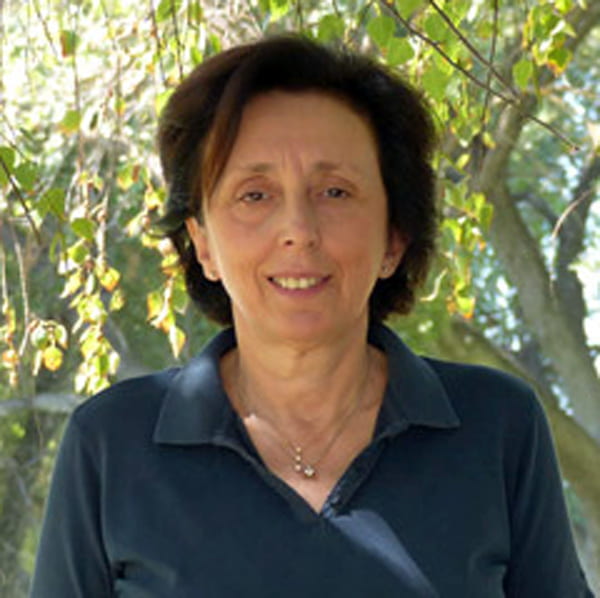
Giulia Galli
· Liew Family Professor of Molecular Engineering in the UChicago Pritzker School of Molecular EngineeringVerifiedUniversity of Chicago · Departments of Physics and Molecular Genetics and Cell Biology
Active 1968–2026
About
Giulia Galli is the Liew Family Professor of Electronic Structure and Simulations in the Pritzker School of Molecular Engineering and the Department of Chemistry at the University of Chicago. She also holds a senior scientist position at Argonne National Laboratory, where she is a group leader and the director of the Midwest Integrated Center for Computational Materials. Her expertise lies in the development of theoretical and computational methods to predict and engineer material and molecular properties from first principles. Her research focuses on problems relevant to the development of sustainable energy sources and quantum technologies. Prior to her current roles, she was a professor of chemistry and physics at the University of California, Davis, and the head of the Quantum Simulations group at Lawrence Livermore National Laboratory. She holds a PhD in Physics from the International School of Advanced Studies in Trieste, Italy. She is a member of the National Academy of Sciences, the American Academy of Arts and Science, and the International Academy of Quantum Molecular Science, and is a fellow of the American Physical Society and the American Association for the Advancement of Science. She has received numerous awards, including the Materials Research Society Theory Award, the American Physical Society David Adler Award in Materials Physics, the Feynman Nanotechnology Prize in Theory, among others.
Research topics
- Computer Science
- Materials science
- Nanotechnology
- Physics
- Engineering physics
- Condensed matter physics
- Chemistry
- Computational chemistry
- Quantum mechanics
- Engineering
- Artificial Intelligence
- Mathematics
- Thermodynamics
- Electrical engineering
- Parallel computing
- Database
- Chemical physics
- Optics
- Pure mathematics
- Optoelectronics
Selected publications
Trans-dimensional Hamiltonian model selection and parameter estimation from sparse, noisy data
Quantum · 2026-04-08
articleOpen accessSenior authorHigh-throughput characterization often requires estimating parameters and model dimension from experimental data of limited quantity and quality. Such data may result in an ill-posed inverse problem, where multiple sets of parameters and model dimensions are consistent with available data. This ill-posed regime may render traditional machine learning and deterministic methods unreliable or intractable, particularly in high-dimensional, nonlinear, and mixed continuous and discrete parameter spaces. To address these challenges, we present a Bayesian framework that hybridizes several Markov chain Monte Carlo (MCMC) sampling techniques to estimate both parameters and model dimension from sparse, noisy data. By integrating sampling for mixed continuous and discrete parameter spaces, reversible-jump MCMC to estimate model dimension, and parallel tempering to accelerate exploration of complex posteriors, our approach enables principled parameter estimation and model selection in data-limited regimes. We apply our framework to a specific ill-posed problem in quantum information science: recovering the locations and hyperfine couplings of nuclear spins surrounding a spin-defect in a semiconductor from sparse, noisy coherence data. We show that a hybridized MCMC method can recover meaningful posterior distributions over physical parameters using an order of magnitude less data than existing approaches, and we validate our results on experimental measurements. More generally, our work provides a flexible, extensible strategy for solving a broad class of ill-posed inverse problems under realistic experimental constraints.
Towards dislocation-driven quantum interconnects
npj Computational Materials · 2026-01-09 · 5 citations
articleOpen accessSenior authorCorrespondingA central problem in the deployment of quantum technologies is the realization of robust architectures for quantum interconnects. We propose to engineer interconnects in semiconductors and insulators by patterning spin qubits at dislocations, thus forming quasi one-dimensional lines of entangled point defects. To gain insight into the feasibility and control of dislocation-driven interconnects, we investigate the optical cycle and coherence properties of nitrogen-vacancy (NV) centers in diamond, in proximity of dislocations, using a combination of advanced first-principles calculations. We show that one can engineer spin defects with properties similar to those of their bulk counterparts, including charge stability and a favorable optical cycle, and that NV centers close to dislocations have much improved coherence properties. Finally, we predict optically detected magnetic resonance spectra that may facilitate the experimental identification of specific defect configurations. Our results provide a theoretical foundation for the engineering of one-dimensional arrays of spin defects in the solid state.
Journal of Chemical Theory and Computation · 2026-04-23
preprintOpen accessSilicon carbide (SiC) divacancies are attractive candidates for spin-defect qubits possessing long coherence times and optical addressability. The high activation barriers associated with SiC defect formation and motion pose challenges for their study by first-principles molecular dynamics. In this work, we develop and deploy machine learning interatomic potentials (MLIPs) to accelerate defect dynamics simulations while retaining ab initio accuracy. We employ an active learning strategy comprising symmetry-adapted collective variable discovery and enhanced sampling to compile configurationally diverse training data, calculation of energies and forces using density functional theory (DFT), and training of an E(3)-equivariant MLIP based on the Allegro model. The trained MLIP reproduces DFT-level accuracy in defect transition activation free energy barriers, enables the efficient and stable simulation of multidefect 216-atom supercells, and permits an analysis of the temperature dependence of defect thermodynamic stability and formation/annihilation kinetics to propose an optimal annealing temperature to maximally stabilize VV divacancies.
Design Rules to Engineer the Spin Structure of Cr4+ Molecular Qubits via Matrix Modularity
ChemRxiv · 2025-05-12 · 1 citations
articleSenior authorUsing a multi-level computational approach, we predict the zero-field splitting (ZFS) parameters of Cr(IV) molecular qubits with unprecedented accuracy, obtaining results in excellent agreement with experiments. We then apply the protocol to Cr(IV) molecular color centers embedded in non-isostructural tin host matrices. We show that by simply altering the matrix composition, one can effectively modify the relative energies of the spin sub-levels, thus enabling a fine-tuning of the qubit’s magnetic anisotropy for optimal performance in quantum technologies. We identify two effects influencing matrix design: the molecular symmetry of the qubit and the presence of inhomogeneous electrostatic fields arising from the chemical composition of the matrix. Finally, we compute spin-coherence times and discuss their sensitivity to the matrix environment through the ZFS parameters. Our work provides predictive strategies for tailoring the spin structure and coherence properties of molecular color centers through a rational control of their matrix environment.
Donor–Acceptor Pairs Near Silicon Carbide Surfaces
The Journal of Physical Chemistry Letters · 2025-09-30 · 2 citations
articleSenior authorCorrespondingDonor–acceptor pairs (DAPs) in wide-bandgap semiconductors are promising platforms for the realization of quantum technologies, due to their optically controllable, long-range dipolar interactions. Specifically, Al–N DAPs in bulk silicon carbide (SiC) have been predicted to enable coherent coupling over distances exceeding 10 nm. However, their practical implementations require an understanding of the properties of these pairs near surfaces and interfaces. Here, using first-principles calculations, we investigate how the presence of surfaces influence the stability and optical properties of Al–N DAPs in SiC, and we show that they retain favorable optical properties comparable to their bulk counterparts, despite a slight increase in electron–phonon coupling. Furthermore, we introduce the concept of surface-defect pairs (SDPs), where an electron–hole pair is generated between a near-surface defect and an occupied surface state located in the bandgap of the material. We show that vanadium-based SDPs near OH-terminated 4H-SiC surfaces exhibit dipoles naturally aligned perpendicular to the surface, greatly enhancing dipole–dipole coupling between SDPs. Our results also reveal significant polarization-dependent modulation in the stimulated emission and photoionization cross sections of V-based SDPs, which are tunable by 2 orders of magnitude via the incident laser’s polarization angle. The near-surface defects investigated here provide novel possibilities for the development of hybrid quantum-classical interfaces, as they can be used to mediate information transfer between quantum nodes and integrated photonic circuits.
Journal of the American Chemical Society · 2025-08-14 · 5 citations
articleOpen accessCorrespondingIn photoelectrochemical cells, semiconductor electrodes are usually interfaced with protection layers to extend their stability. Ideally, the protection layer should not decrease photocurrent generation. Hence, the conduction band minimum (CBM) and valence band maximum (VBM) of the protection layer should appropriately align with those of the underlying semiconductor electrode to facilitate the desired interfacial charge transfer with minimal interfacial recombination. However, predicting interfacial band alignment can be challenging, as it may vary depending on the detailed interfacial atomic structure. Investigating the effect of the atomic structure at the semiconductor/protection layer junction on the band alignment is also challenging as it requires samples with varied interfaces without altering the semiconductor and protection layers. Here, we considered TiO2, the most widely used material as a protection layer, interfaced with a BiVO4 photoanode, and we fabricated two n-type BiVO4(010)/TiO2 photoanodes where a thin (∼4 nm) amorphous TiO2 layer was deposited by atomic layer deposition (ALD). While the individual BiVO4(010) and TiO2 layers were identical in these two samples, we modified the interfacial atomic structure at the BiVO4/TiO2 junction by changing which precursor, Ti or O, was introduced first upon deposition of TiO2. By experimentally and computationally investigating the differences in these two samples, we show that the band alignments between BiVO4 and TiO2 at the interface may not be straightforwardly predicted by the CBM and VBM of bulk BiVO4 and TiO2 and that interfacial atomic arrangements can have a marked impact on the electronic properties and photoelectrochemical performance of the BiVO4(010)/TiO2 photoanode.
Engineering diamond interfaces free of dark spins
ArXiv.org · 2025-04-11
preprintOpen accessNitrogen-vacancy (NV) centers in diamond are extensively utilized as quantum sensors for imaging fields at the nanoscale. The ultra-high sensitivity of NV magnetometers has enabled the detection and spectroscopy of individual electron spins, with potentially far-reaching applications in condensed matter physics, spintronics, and molecular biology. However, the surfaces of these diamond sensors naturally contain electron spins, which create a background signal that can be hard to differentiate from the signal of the target spins. In this study, we develop a surface modification approach that eliminates the unwanted signal of these so-called dark electron spins. Our surface passivation technique, based on coating diamond surfaces with a thin titanium oxide (TiO$_2$) layer, reduces the dark spin density. The observed reduction in dark spin density aligns with our findings on the electronic structure of the diamond-TiO$_2$ interface. The reduction, from a typical value of $2,000$~$μ$m$^{-2}$ to a value below that set by the detection limit of our NV sensors ($200$~$μ$m$^{-2}$), results in a two-fold increase in Hahn-echo coherence time of near surface NV centers. Furthermore, we derive a comprehensive spin model that connects dark spin relaxation with NV coherence, providing additional insights into the mechanisms behind the observed spin dynamics. Our findings are directly transferable to other quantum platforms, including nanoscale solid state qubits and superconducting qubits.
Probing aqueous interfaces with spin defects
The Journal of Chemical Physics · 2025-11-04
articleOpen accessSenior authorUnderstanding the physical and chemical properties of aqueous interfaces is important in diverse fields of science, ranging from biology and chemistry to materials science. In spite of crucial progress in surface sensitive spectroscopic techniques over the past decades, the microscopic properties of aqueous interfaces remain difficult to measure. Here, we explore the use of noise spectroscopy to characterize interfacial properties, specifically of quantum sensors hosted in two-dimensional materials in contact with water. We combine molecular dynamics simulations of water interfaced with a model two-dimensional substrate and the calculation of the dynamical properties of a spin defect, representing a quantum sensor, and we investigate the impact of interfacial water and simple ions on the decoherence time of the defect. We show that the Hahn echo coherence time of the quantum sensor is sensitive to motional narrowing and to the hydrogen bonding arrangement and the dynamical properties of water and ions at the interface. We present results as a function of the liquid temperature, strength of the water-surface interaction, and varied monovalent and divalent ions, highlighting the broad applicability of near-surface quantum sensors to gain insight into the properties of aqueous interfaces.
Strategies to search for two-dimensional materials with long spin qubit coherence time
arXiv (Cornell University) · 2025-08-29 · 1 citations
preprintOpen accessSenior authorTwo-dimensional (2D) materials that can host qubits with long spin coherence time (T2) have the distinct advantage of integrating easily with existing microelectronic and photonic platforms, making them attractive for designing novel quantum devices with enhanced performance. However, the relative lack of 2D materials as spin qubit hosts, as well as appropriate substrates that can help maintain long T2, necessitates a strategy to search for candidates with robust spin coherence. Here, we develop a high-throughput computational workflow to predict the nuclear spin bath-driven qubit decoherence and T2 in 2D materials and heterostructures. We initially screen 1173 2D materials and find 190 monolayers with T2 > 1 ms, higher than that of naturally-abundant diamond. We then construct 1554 lattice-commensurate heterostructures between high-T2 2D materials and select 3D substrates, and we find that T2 is generally lower in a heterostructure than in the bare 2D host material; however, low-noise substrates (such as CeO2 and CaO) can help maintain high T2. To further accelerate the material screening effort, we derive analytical models that enable rapid predictions of T2 for 2D materials and heterotructures. The models offer a simple, yet quantitative, way to determine the relative contributions to decoherence from the nuclear spin baths of the 2D host and substrate in a heterostructural system. By developing a high-throughput workflow and analytical models, we expand the genome of 2D materials and their spin coherence times for the development of spin qubit platforms.
Donor-Acceptor Pairs near Silicon Carbide surfaces
ArXiv.org · 2025-04-14
preprintOpen accessSenior authorDonor-acceptor pairs (DAPs) in wide-bandgap semiconductors are promising platforms for the realization of quantum technologies, due to their optically controllable, long-range dipolar interactions. Specifically, Al-N DAPs in bulk silicon carbide (SiC) have been predicted to enable coherent coupling over distances exceeding 10 nm. However, their practical implementations require an understanding of the properties of these pairs near surfaces and interfaces. Here, using first principles calculations we investigate how the presence of surfaces influence the stability and optical properties of Al-N DAPs in SiC, and we show that they retain favorable optical properties comparable to their bulk counterparts, despite a slight increase in electron-phonon coupling. Furthermore, we introduce the concept of surface-defect pairs (SDPs), where an electron-hole pair is generated between a near-surface defect and an occupied surface state located in the bandgap of the material. We show that vanadium-based SDPs near OH-terminated 4H-SiC surfaces exhibit dipoles naturally aligned perpendicular to the surface, greatly enhancing dipole-dipole coupling between SDPs. Our results also reveal significant polarization-dependent modulation in the stimulated emission and photoionization cross sections of V-based SDPs, which are tunable by two orders of magnitude via the polarization angle of the incident laser light. The near-surface defects investigated here provide novel possibilities for the development of hybrid quantum-classical interfaces, as they can be used to mediate information transfer between quantum nodes and integrated photonic circuits.
Frequent coauthors
- 220 shared
Marco Govoni
Argonne National Laboratory
- 176 shared
François Gygi
University of California, Davis
- 99 shared
Eric Schwegler
Lawrence Livermore National Laboratory
- 84 shared
D. D. Awschalom
- 71 shared
Márton Vörös
Samsung (United States)
- 55 shared
Mykyta Onizhuk
University of Chicago
- 52 shared
Tuan Anh Pham
Lawrence Livermore National Laboratory
- 49 shared
Davide Donadio
Labs
Awards & honors
- Materials Research Society Theory Award
- American Physical Society David Adler Award in Materials Phy…
- Feynman Nanotechnology Prize in Theory
- medal of the Schola Physica Romana
- Tomassoni-Chisesi award by La Sapienza University in Rome
- Resume-aware match score
- Save to shortlist
- AI-drafted outreach
See your match with Giulia Galli
PhdFit ranks faculty by your research interests, methods, and publications — grounded in their actual work, not templates.
- Free to start
- No credit card
- 30-second signup