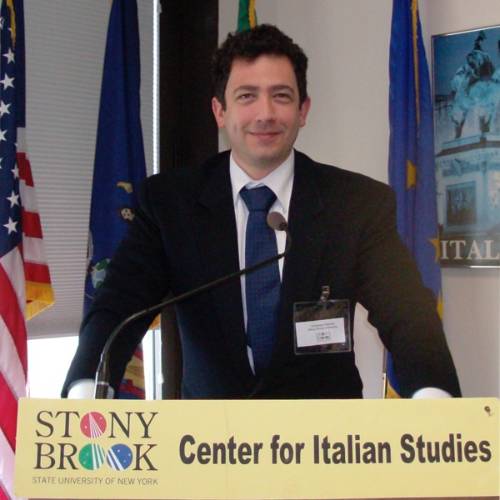
Giuseppe Gazzola
· Associate ProfessorStony Brook University · Modern Languages and Literature
Active 2005–2020
Research topics
- Sociology
- Art
- Art history
- Aesthetics
- Genealogy
- Ancient history
- Literature
- History
- Anthropology
Selected publications
The Montale Siblings and the Great War
Italian and Italian American studies · 2020
1st authorCorresponding- Sociology
- History
- Art
The Making and Unmaking of Mediterranean Landscape in Italian Literature: The Case of Liguria
Italica · 2019-03-01
article1st authorCorrespondingMallarmé : versi e prose : seconda stesura inedita
2018-01-01
article1st authorCorrespondingForum Italicum A Journal of Italian Studies · 2016-08-19
article1st authorCorrespondingThe article considers primarily Montale’s fourth book, Satura (1971), and interrogates the connections between the new direction of Montale’s poetry and the scientific and philosophical trends of the 1950s and 1960s. To describe Montale’s late work as postmodernist is to measure the self-conscious distancing of his poetics from the writing of the first three volumes: the poetic voice of Satura explores the dialectic relationship between modern and postmodern. The common postmodernist annulments – the end of ideology, the end of history, the end of authorial presence, the distinction between high and low culture – all play a role in Satura’s composition. The article includes a discussion of Cesare Vasoli’s Tra cultura e ideologia as an important source to explain Montale’s suspension of poetic output as a symptom of the political and philosophical disillusionment he experienced during the years of the reconstruction and the economic boom. Using the latter text as a guide, the article analyzes one of the most hermeneutically complex poems of Satura, ‘Dialogo’.
Oxford University Press eBooks · 2016-05-02
book1st authorCorrespondingAccording to the famous definition by Benedetto Croce, ‘Ugo Foscolo was a European man and writer; even if . . . the European literary world ignored him in the complexity of his personality and his major works.’ Almost a century later, Croce’s assertion is still useful: Foscolo was an intellectual of European significance, and locating him in a transnational context offers an enriched perspective on his life and works. His particular biographical and poetic trajectories made it easy for him to be overlooked in non-Italian literary contexts. Foscolo was European because he knew, as a writer and as a scholar, by nature and culture, how to escape the provincialism that permeated the academies of the Italian cities; far ahead of his time, he combined a classical education with encyclopedic culture and a critical sensibility in a way previously unknown in Italian letters.
Casa Editrice Leo S. Olschki s.r.l. eBooks · 2016-12-15 · 1 citations
book1st authorCorrespondingForum Italicum. Journal of Italian Studies. Special Issue: Italy from Without
Quaderni d italianistica · 2015-07-22
articleOpen access1st authorCorrespondingQuaderni d italianistica · 2015-07-22
articleOpen accessSenior authorRecensioni / Book Reviews / Revues des Livres -290 -latino o francese), ma nella maggior parte dei casi sono state lasciate nella lingua originale e subito dopo tradotte in inglese (tra parentesi quadre).
MLN · 2015-01-01 · 2 citations
article1st authorCorrespondingBetting Against Themselves:Conflicting Conceptions of Love in Così fan tutte, o: la scola degli amanti Giuseppe Gazzola As early as a year after the début of Così fan tutte in Vienna (January 26th, 1790), the actor, playwright for the Imperial Court Theatre, and Freemason Friedrich Ludwig Schröder recorded in his diary that the opera was “a miserable thing, which lowers all women, cannot possibly please female spectators, and will therefore not make its fortune.”1 Since then, it has become a critical commonplace to bemoan the libretto’s attitude towards its female characters: the opera has been considered an expression of a classical antifeminist mode in comedy. In order to salvage the score without subjecting the audience to what was considered an unsuccessful plot, many impresarios of the nineteenth and twentieth century decided to stage it either by altering the written text, or substituting it altogether, reportedly with mixed results.2 [End Page 105] Today, even if Così fan tutte is one of the most performed, acclaimed, and discussed operas, a sense of its antifeminism still lingers: the bill for this year’s staging at the Metropolitan Opera in New York, for example, calls it “a beautiful score depicting questionable behavior.”3 Such an impression is due, no doubt, to the titular emphasis on Don Alfonso’s infamous opinion on female behavior, and by the fact that Fiordiligi and Dorabella are indeed tricked by their reciprocal fiancés under his guidance with the complicity of their maid Despina.4 As Peter Cochran observes: “Così was rarely performed before the mid-twentieth century anyway, because of its satirical portrayal of women, which, even more brutally than Don Juan, went against the cant of the age; even now, it is often excused by feminists on the sole ground that Mozart’s music makes it irresistible—Da Ponte’s contribution is dismissed as unfortunate” (136). Readers and spectators continue to feel discomfort when faced with the seemingly blatant sexual double standard that appears to drive the plot, despite its historic context, which makes it a participant in the Enlightenment’s querelle des dames. But this attention to gender politics, I would argue, reflects an incomplete, if not mistaken, focus. For Da Ponte is not so much engaged in a battle between the sexes as in a complex dramatization of the nature of love that involves social, moral, and philosophical issues. In the cosmopolite and multilingual capital of the Austrian empire, at the verge of the epochal changes brought forth by the French Revolution, Così fan tutte speaks to the intuition that an old order—of gender, class, and sexual mores—was on the brink of transformation. In contrast to conventional accounts, this article suggests an alternate reading of the libretto, one that rebalances the actions of all six characters and considers the opposite ideas of love at work in the plot: the medieval (and surpassed) idea of chivalric love maintained [End Page 106] by the two pairs of lovers, and the libertine idea of love extolled by Don Alfonso and Despina. I argue that Da Ponte’s libretto, rather than dramatizing gender stereotypes and gender conflicts with a misogynistic attitude, marks an important intervention in a larger cultural transition involving theories of love and erotic engagement. Understanding the libretto in these terms allows us to see how in fact all the lovers, men and women, are subjected to ruthless testing, albeit through different mechanisms of the plot. This fact is underscored by the subtitle of the work, which is often ignored, but is the title by which Da Ponte refers to the text in his Memorie.5 La scola degli amanti grammatically could indicate either a plural masculine (thus referring exclusively to the officers), or a collective gender neutral plural (thus referring to all four lovers), or both. Following this lead, I suggest that the libretto challenges all lovers, with a particular emphasis on the young men, by testing their antiquated conceptions of gender dynamics and offering them a chance to learn an enlightened, safer way to manage their erotic relationships. The originality of Così fan tutte’s plot is best appreciated when considered against Da Ponte’s other...
Return to Tiraboschi: On Italian Literary Canon Formation and National Identity
Modern Language Quarterly · 2015-08-18
article1st authorCorrespondingAbstract This essay traces the interrelationship between Italian literary canon formation and constructions of national identity in the literary histories of Girolamo Tiraboschi and Francesco De Sanctis. It examines both the ruptures and the continuities between eighteenth- and nineteenth-century literary historiography, analyzing the political, teleological agenda of De Sanctis’s Storia della letteratura italiana (1870–71) while revealing the equally powerful theoretical underpinnings of Tiraboschi’s vision of the Italian canon. Tiraboschi’s own Storia della letteratura italiana (1772–82; rev. and exp. 1789–94), because of its precise geographic grounding of literary phenomena, its conceptual proximity to what is now considered cultural studies, and its attention to minority writers, represents a more compelling model for contemporary Italian literary historiography than De Sanctis’s, which was developed for and in a different nationalist context.
Frequent coauthors
- 9 shared
Bennett Carpenter
- 9 shared
Stefano Ercolino
- 9 shared
Francesco Frisari
University of North Carolina at Chapel Hill
- 9 shared
Danila Cannamela
- 9 shared
Guido Mattia Gallerani
- 9 shared
Can Evren
University of St Andrews
- 9 shared
Alberto Comparini
University of Trento
- 9 shared
Achille Castaldo
- Resume-aware match score
- Save to shortlist
- AI-drafted outreach
See your match with Giuseppe Gazzola
PhdFit ranks faculty by your research interests, methods, and publications — grounded in their actual work, not templates.
- Free to start
- No credit card
- 30-second signup