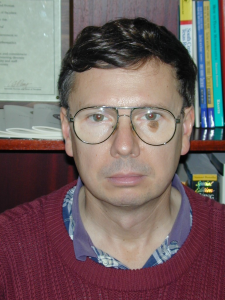
Guy Battle
· ProfessorVerifiedTexas A&M University · Mathematics
Active 1937–2024
About
Guy Battle is a professor at Texas A&M University College of Arts and Sciences, specializing in Mathematical Physics. He holds a Ph.D. from Duke University obtained in 1977, along with a Master of Science from Murray State University in 1973 and a Master of Arts from Indiana University in 1970. His academic and research activities are centered around mathematical physics, contributing to the understanding of complex mathematical structures within physical theories. He is based in the Department of Mathematics at Texas A&M University, located in the Blocker Building, and can be contacted via email at g-battle@tamu.edu or by phone at 979-845-7554.
Research topics
- Physics
- Mathematical physics
- Mathematics
- Geometry
- Theoretical physics
- Mathematical analysis
- Quantum mechanics
- Pure mathematics
Selected publications
2024-09-25
book-chapter1st authorCorrespondingA wavelet-based set of constructive masses for the Minkowskian Feynman propagator
Journal of Mathematical Physics · 2022
1st authorCorresponding- Mathematics
- Mathematical physics
- Physics
We continue our pursuit of Minkowskian quantum field theory—specifically, a nonperturbative analysis of the characteristic functional generating the time-ordered Wightman distributions for the quartic scalar field interaction. As in a previous paper, our starting point is the Minkowskian Feynman propagator for the free scalar field theory analyzed by a system of expansion functions in space-time. Here, we choose a significantly different system of expansion functions. We start with an L2-orthonormal wavelet basis {Ψw:w∈W}, where each Ψw has the properties of a Daubechies wavelet in the temporal coordinate and the properties of a Meyer wavelet in the spatial coordinates. We consider the matrix elements Gww′(m) of the mass-m Feynman propagator based on the expansion functions vw=Lw−1Ψw, where Lw denotes the length scale of w∈W. For every finite Λ⊂W, we let GΛ(m) denote the Λ × Λ matrix of such elements. We define a constructive mass to be any value of m such that GΛ(m) is nonsingular for each finite Λ⊂W. We prove that the set of such masses is at least co-countable (although we expect every mass value to be constructive). For an arbitrary constructive mass m and an arbitrary finite Λ⊂W, we rigorously construct the interacting characteristic functional as an integral in amplitudes, where the Λ-cutoff on the quartic interaction is supplemented by a cutoff on the free-field action defined by GΛ(m)−1.
Journal of Mathematical Physics · 2020 · 1 citations
1st authorCorresponding- Mathematics
- Physics
- Quantum mechanics
This paper is another step in our pursuit of nonperturbative Minkowskian quantum field theory. Instead of studying the Schwinger functions arising from the Euclidean approach, we study the Wightman distributions directly. We use the non-rigorous Feynman integral for a given quantum field theory as a guide for the rigorous definition of the characteristic functional corresponding to the Lagrangian, but this approach limits us to time-ordered Wightman distributions. We use the idea that if a classical action is perturbed by an interaction involving only N excitations, then one should be able to express the resulting characteristic functional rigorously in terms of the previous characteristic functional. Implementation requires the modification of the classical action with imaginary terms involving the excitation amplitudes. If the previous characteristic functional has a measure-theoretic representation of some kind, then one can subsequently remove these auxiliary terms with a limiting argument. We continue to consider the scalar Minkowskian quantum field theory with the free, massive case as our starting point. The characteristic functional can be defined in terms of the Minkowskian Feynman propagator, and previously, we constructed a probabilistic representation of the functional. In the appendix of that previous paper, we introduced the scalar quartic field interaction with only N space–time excitations. Under the condition that their Fourier transforms be all supported on one side of the mass hyperboloid, we constructed the resulting characteristic functional. In this paper, we construct the characteristic functional in the case where both regions of energy–momentum space contribute to the finite collection of excitations.
Gradient-Orthonormal Bases of Momentum-Entire Wavelets in Odd Dimension
British Journal of Mathematics & Computer Science · 2014-01-10
article1st authorCorrespondingInternational audience
Momentum-Entire Wavelets with Discrete Rotational Symmetries in 2D
British Journal of Mathematics & Computer Science · 2013-01-10 · 1 citations
articleOpen access1st authorCorrespondingInternational audience
A gradient-projective basis of compactly supported wavelets in dimension n > 1
Open Mathematics · 2013-04-26 · 1 citations
articleOpen access1st authorCorrespondingAbstract A given set W = {W X } of n-variable class C 1 functions is a gradient-projective basis if for every tempered distribution f whose gradient is square-integrable, the sum $\sum\limits_\chi {(\int_{\mathbb{R}^n } {\nabla f \cdot } \nabla W_\chi ^* )} W_\chi $ converges to f with respect to the norm \(\left\| {\nabla ( \cdot )} \right\|_{L^2 (\mathbb{R}^n )} \) . The set is not necessarily an orthonormal set; the orthonormal expansion formula is just an element of the convex set of valid expansions of the given function f over W. We construct a gradient-projective basis W = {W x } of compactly supported class C 2−ɛ functions on ℝn such that where X has the structure \(\chi = (\tilde \chi ,\nu )\) , ν ∈ ℤ. W is a wavelet set in the sense that the functions indexed by \(\tilde \chi \) are generated by an averaging of lattice translations with wave propagations, and there are two additional discrete parameters associated with the latter. These functions indexed by \(\tilde \chi \) are the unit-scale wavelets. The support volumes of our unit-scale wavelets are not uniformly bounded, however. While the practical value of this construction is doubtful, our motivation is theoretical. The point is that a gradient-orthonormal basis of compactly supported wavelets has never been constructed in dimension n > 1. (In one dimension the construction of such a basis is easy — just anti-differentiate the Haar functions.)
A block spin construction of Ondelettes. Part i: Lemarié Functions
Princeton University Press eBooks · 2009-12-31 · 5 citations
book-chapter1st authorCorrespondingOsiris wavelets and Set wavelets
Journal of Applied Mathematics · 2004-01-01
articleOpen access1st authorCorrespondingAn alternative to Osiris wavelet systems is introduced in two dimensions. The basic building blocks are continuous piecewise linear functions supported on equilateral triangles instead of on squares. We refer to wavelets generated in this way as Set wavelets. We introduce a Set wavelet system whose homogeneous mode density is 2/5. The system is not orthonormal, but we derive a positive lower bound on the overlap matrix.
Osiris Wavelets and Isis Variables
Birkhäuser Boston eBooks · 2003-01-01 · 1 citations
book-chapter1st authorCorrespondingIn the familiar formulations of the renormalization group in equilibrium statistical mechanics, the variables associated with different length scales are independent random variables with respect to the massless Gaussian continuum measures (or its equivalent for the given model). We have recently introduced a new type of modeling based on Osiris wavelets. While such models represent a new hierarchical approximation that is expected to have important advantages over the familiar hierarchical approximations, the focus of this paper is on the kinematic coupling of the wavelet amplitudes that arises for these models. The variables associated with different length scales are no longer independent with respect to the massless Gaussian. This creates undefined Gaussian states that are fixed with respect to the renormalization group iteration—in addition to the usual Gaussian fixed point, which is a well-defined state. We show that these spurious Gaussian fixed points influence the flow of the iteration. We also derive the recursion formula—and its linearization—for dipole perturbations of the Gaussian fixed point. Such a formula is best described by Isis variables. This paper deals with two dimensions only.
Osiris Wavelets and the Dipole Gas
Birkhäuser Boston eBooks · 2001-01-01 · 2 citations
book-chapter1st authorCorrespondingWe introduce a new hierarchical modeling of scalar field theories that is based on a set of continuous, piecewise-linear wavelets with Sobolev-orthogonality properties. The set is not a basis, but the difference between the hierarchical models and the realistic models arises entirely from this lack of completeness. Not only is this in elegant contrast to the more familiar hierarchical approximations, but it also raises the possibility of calculating the critical exponent ŋ (which is automatically zero for the familiar hierarchical models). We call these expansion functions Osiris wavelets and in this chapter we introduce them in two dimensions. Sobolev orthogonality breaks down only between adjacent length scales for these wavelets, and we derive a positive lower bound on the overlap matrix. In the case of the dipole gas we also derive the hierarchical reduction of the renormalization group transformation for this wavelet modeling.
Recent grants
Osiris Wavelets and Quantum Entanglement
NSF · $50k · 2002–2006
Frequent coauthors
- 13 shared
Paul Federbush
- 10 shared
S Lukes
Centre on Dynamics of Ethnicity
- 10 shared
Illinois Devry
Laboratoire de Chimie
- 10 shared
W Hyndman
Laboratoire de Chimie
- 9 shared
Peter Richardson
Michael E. DeBakey VA Medical Center
- 9 shared
F Hotchkiss
Florida Museum of Natural History
- 9 shared
F Miller
- 9 shared
G. E. Mitchell
- Resume-aware match score
- Save to shortlist
- AI-drafted outreach
See your match with Guy Battle
PhdFit ranks faculty by your research interests, methods, and publications — grounded in their actual work, not templates.
- Free to start
- No credit card
- 30-second signup